Question
A simple pendulum is constructed by hanging a heavy ball by a 5.0m long string. It undergoes small oscillations.
  1. How many oscillations does it make per second?
  2. What will be the frequency if the system is taken on the moon where acceleration due to gravitation of the moon is 1.67m/s2.
Answer

$\text{L}=5\text{m}$

  1. $\text{T}=2\pi\sqrt{\frac{\ell}{\text{g}}}=2\pi\sqrt{0.5}=2\pi(0.7)$

$\therefore$ in $2\pi(0.7)\sec$ the body completes 1 oscillation,

In 1 second, the body will complete $\frac{1}{2\pi(0.7)}$ oscillation

$\therefore\text{f}=\frac{1}{2\pi(0.7)}=\frac{10}{14\pi}=\frac{0.70}{\pi}$ Times

  1. When it is taken to the moon

$\text{T}=2\pi\sqrt{\frac{\ell}{\text{g'}}}$ where g' → Acceleration in the moon.

$=2\pi\sqrt{\frac{5}{1.67}}$

$\therefore\text{f}=\frac{1}{\text{T}}=\frac{1}{2\pi}\sqrt{\frac{1.67}{5}}=\frac{1}{2\pi}(0.577)=\frac{1}{2\pi\sqrt{3}}$ times.

Need a full question paper?

Generate a complete, print-ready paper with questions like this in minutes — across 16+ boards, with answer keys.

Start Generating Free

Similar questions

A ballon has 5.0g mole of helium at 7°C. Calculate.
  1. The number of atoms of helium in the balloon,
  2. The total internal energy of the system.
If a liquid is flowing through a horizontal tube, write down the formula for the volume of the liquid flowing per second through it. Water is flowing through a horizontal tube of radius 2r and length 1m at a rate of 60L/s, when connected to a pressure difference of h cm of water. Another tube of same length but radius is connected in series with this tube and the combination is connected to the same pressure head. Find out the pressure difference across each tube and the rate of flow of water through the combination.
A gas in equilibrium has uniform density and pressure throughout its volume. This is strictly true only if there are no external influences. A gas column under gravity, for example, does not have uniform density (and pressure). As you might expect, its density decreases with height. The precise dependence is given by the so-called law of atmospheres:
$\text{n}_2=\text{n}_1\text{exp}\Big[\frac{-\text{mg}}{\text{k}_\text{B}\text{T}}(\text{h}_2-\text{h}_1)\Big]$
where n2, n1 refer to number density at heights h2 and h1 respectively. Use this relation to derive the equation for sedimentation equilibrium of a suspension in a liquid column:
$\text{n}_2=\text{n}_1\text{exp}\Big[\frac{-\text{mgN}_\text{A}(\rho-\rho')(\text{h}_2-\text{h}_1)}{(\rho\text{RT})}\Big]$
where $\rho$ is the density of the suspended particle, and $\rho'$ that of surrounding medium. [NA is Avogadro’s number, and R the universal gas constant]
[Hint: Use Archimedes principle to find the apparent weight of the suspended particle]
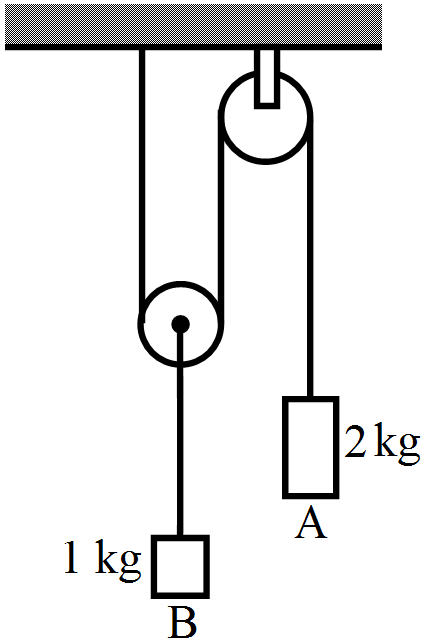
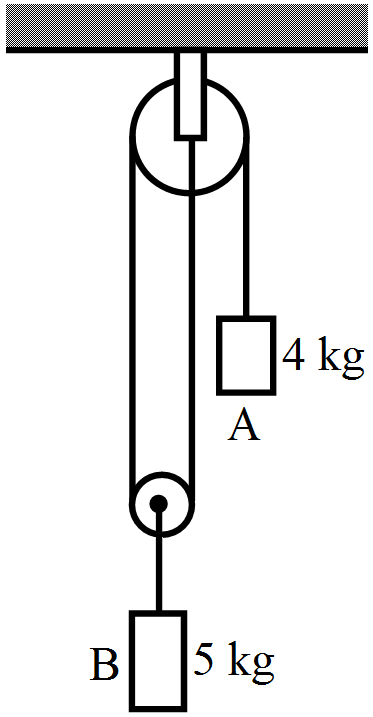
Find the acceleration of the blocks A and B in the three situations shown in figure.


In a Young's double slit experiment using monochromatic light, the fringe pattern shifts by a certain distance on the screen when a mica sheet of refractive index 1.6 and thickness 1.964 micron (1 micron = 10-6m) is introduced in the path of one of the interfering waves. The mica sheet is then removed and the distance between the screen and the slits is doubled. It is found that the distance between the successive maxima now is the same as the observed fringe-shift upon the introduction of the mica sheet. Calculate the wavelength of the monochromatic light used in the experiment.
A car is speeding up on a horizontal road with an acceleration a. Consider the following situations in the car.
  1. A ball is suspended from the ceiling through a string and is maintaining a constant angle with the vertical. Find this angle.
  2. A block is kept on a smooth incline and does not slip on the incline. Find the angle of the incline with the horizontal.
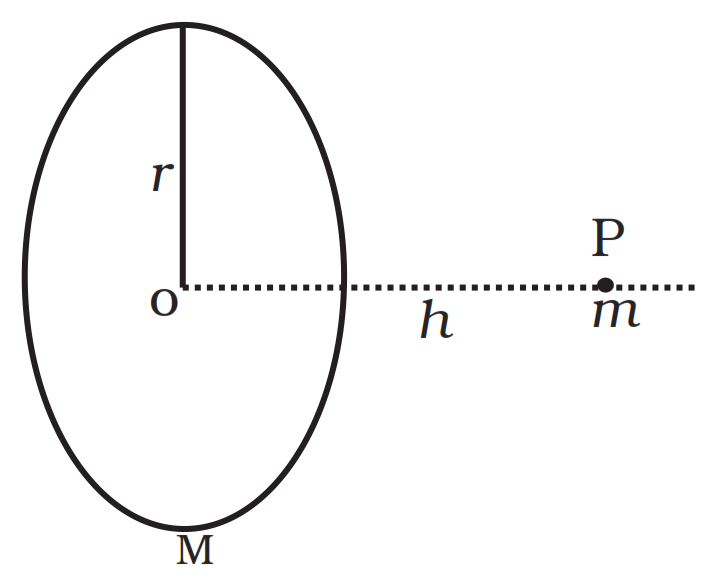
A mass m is placed at P a distance h along the normal through the centre O of a thin circular ring of mass M and radius r

If the mass is removed further away such that OP becomes 2h, by what factor the force of gravitation will decrease, if h = r?
Suppose there existed a planet that went around the sun twice as fast as the earth. What would be its orbital size as compared to that of the earth?
Calculate the Q-values of the following fusion reactions:

  1. $\text{ }^2_1\text{H}+\text{ }^2_1\text{H}\rightarrow\text{ }^3_1\text{H}+\text{ }^1_1\text{H}$

  2. $\text{ }^2_1\text{H}+\text{ }^2_1\text{H}\rightarrow\text{ }^3_2\text{H}+\text{n}$

  3. $\text{ }^2_1\text{H}+\text{ }^3_1\text{H}\rightarrow\text{ }^4_1\text{H}+\text{n}$

Atomic masses are

$\text{m}\big(\text{ }^2_1\text{H}\big)=2.014102\text{u}$

$\text{m}\big(\text{ }^3_1\text{H}\big)=3·016049\text{u}$

$\text{m}\big(\text{ }^3_2\text{H}\big)=3.016029\text{u}$

$\text{m}\big(\text{ }^4_2\text{He}\big)=4·002603\text{u}$

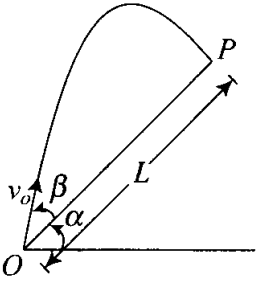
A particle is projected in air at an angle $\beta$ to a surface which itself is inclined at an angle $\alpha$ to the horizontal (Fig.).

  1. β at which range will be maximum.
(Hint: This problem can be solved in two different ways:

  1. Point P at which particle hits the plane can be seen as intersection of its trajectory (parobola) and straight line. Remember particle is projected at an angle $(\alpha+\beta)$ w.r.t. horizontal.
  2. We can take x-direction along the plane and y-direction perpendicular to the plane. In that case resolve g (acceleration due to gravity) in two differrent components, gx along the plane and gy perpendicular to the plane. Now the problem can be solved as two independent motions in x and y directions respectively with time as a common parameter.)