Question
Suppose the loop in Exercise $6.4$ is stationary but the current feeding the electromagnet that produces the magnetic field is gradually reduced so that the field decreases from its initial value of $0.3T$ at the rate of $0.02T s^{–1}$. If the cut is joined and the loop has a resistance of $1.6\Omega ,$ how much power is dissipated by the loop as heat? What is the source of this power?
Answer

Sides of the rectangular loop are $8\ cm$ and $2\ cm.$
Hence, area of the rectangular wire loop,
$A =$ length $ \times$ width
$= 8 \times 2 = 16\ cm^2$
$= 16 \times 10^{-4}m^2$
Initial value of the magnetic field $, B^r = 0.3T$
Rate of decrease of the magnetic field, $\frac{\text{dB}}{\text{dt}}=0.02\text{T/s}$
$\text{Emf}$ developed in the loop is given as:
$\text{e}=\frac{\text{d}\phi}{\text{dt}}$
$\text{d}\phi=$ Change in flux through the loop area
$= AB$
$\therefore\ \text{e}=\frac{\text{d(AB)}}{\text{dt}}=\frac{\text{AdB}}{\text{dt}}$
=$ 16 \times 10^{-4} \times 0.02 = 0.32$
$\therefore 10^{-4}V$
Resistance of the loop, $\text{R}=1.6\Omega$
The current induced in the loop is given as:
$\text{i}=\frac{\text{r}}{\text{R}}$
$=\frac{0.32\times10^{-4}}{1.6}=2\times10^{-5}\text{A}$
Power dissipated in the loop in the form of heat is given as:
$P = i^2R$
$= (2 \times 10^{-5})^2 \times 1.6$
$= 6.4 \times 10^{-10} W$
The source of this heat loss is an external agent, which is responsible for changing the magnetic field with time.

Need a full question paper?

Generate a complete, print-ready paper with questions like this in minutes — across 16+ boards, with answer keys.

Start Generating Free

Similar questions

The switch S shown in figure. is kept closed for a long time and is then opened at t = 0. Find the current in the middle $1.0\Omega$ resistor at t = 1ms.
Two large conducting plates are placed parallel to each other and they carry equal and opposite charges with surface density $\sigma$ as shown in figure. Find the electric field:
  1. At the left of the plates.
  2. In between the plates.
  3. At the right of the plates.
$A 12.5 eV$ electron beam is used to bombard gaseous hydrogen at room temperature. What series of wavelengths will be emitted?
The magnetic field in a region is given by $\vec{\text{B}}=\vec{\text{k}}\frac{\text{B}_0}{\text{L}}\text{y}$ where L is a fixed length. A conductihg rod of of length lies along the Y-axis between the origin and the point (0, L, 0). If the rod moves with a velocity $\text{v}=\text{v}_0\vec{\text{i}},$ find the emf induced between the ends of the rod.

Find the currents through the resistances in the circuits shown in figure.
Briefly explain the principle of a capacitor. Derive an expression for the capacitance of a parallel plate capacitor, whose plates are separated by a dielectric medium.
Consider a wire of length $4m$ and cross$-$sectional area $1\ mm^2$ carrying a current of $2A.$ If each cubic metre of the material contains $10^{29}$ free electrons, find the average time taken by an electron to cross the length of the wire.
  1. Using Biot-Savart’s law, derive an expression for the magnetic field at the centre of a circular coil of radius R, number of turns N, carrying current i.
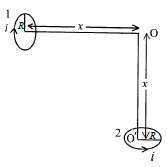
  2. Two small identical circular coils marked 1, 2 carry equal currents and are placed with their geometric axes perpendicular to each other as shown in the figure. Derive an expression for the resultant magnetic field at O.
 
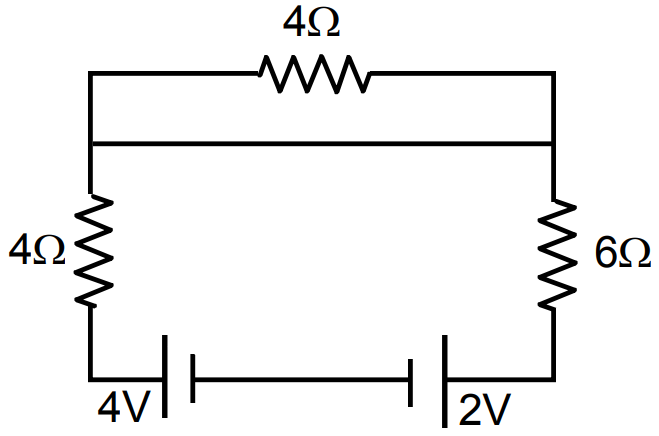
Find the currents through the three reaiators shown in figure.
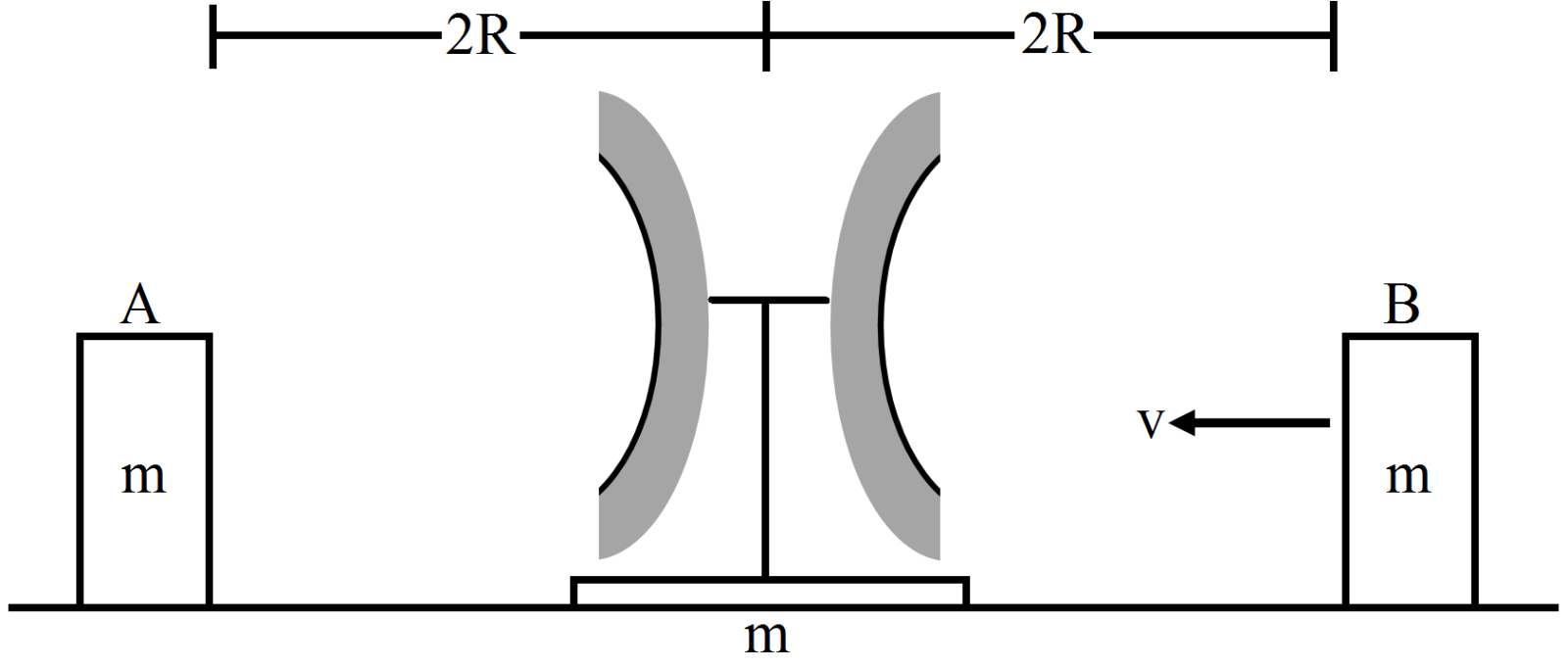
Two concave mirrors of equal radii of curvature R are fixed on a stand facing opposite directions. The whole system has a mass m and is kept on a frictionless horizontal table. Two blocks A and B, each of mass m, are placed on the two sides of the stand. At t = 0, the separation between A and the mirrors is 2 R and also the separation between B and the mirrors is 2 R. The block B moves towards the mirror at a speed v. All collisions which take place are elastic. Taking the original position of the mirrors-stand system to be x = 0 and X-axis along AB, find the position of the images of A and B at t =
  1. $\frac{\text{R}}{\text{v}}$
  2. $\frac{3\text{R}}{\text{v}}$
  3. $\frac{5\text{R}}{\text{v}}$