Question
Suppose the loop in Exercise 6.4 is stationary but the current feeding the electromagnet that produces the magnetic field is gradually reduced so that the field decreases from its initial value of 0.3T at the rate of $0.02T s^{–1}.$ If the cut is joined and the loop has a resistance of 1.6Ω, how much power is dissipated by the loop as heat? What is the source of this power?
Answer

Sides of the rectangular loop are 8cm and 2cm.
Hence, area of the rectangular wire loop,
A = length × width
$= 8 \times 2 = 16cm^2$
$= 16 \times 10^{-4}m^2$
Initial value of the magnetic field, $B^r = 0.3T$
Rate of decrease of the magnetic field, $\frac{\text{dB}}{\text{dt}}=0.02\text{T/s}$
Emf developed in the loop is given as:
$\text{e}=\frac{\text{d}\phi}{\text{dt}}$
$\text{d}\phi=$ Change in flux through the loop area
= AB
$\therefore\ \text{e}=\frac{\text{d(AB)}}{\text{dt}}=\frac{\text{AdB}}{\text{dt}}$
$= 16 \times 10^{-4} \times 0.02 = 0.32 $
$\therefore 10^{-4}V$
Resistance of the loop, $\text{R}=1.6\Omega$
The current induced in the loop is given as:
$\text{i}=\frac{\text{r}}{\text{R}}$
$=\frac{0.32\times10^{-4}}{1.6}=2\times10^{-5}\text{A}$
Power dissipated in the loop in the form of heat is given as:
$P = i^2R$
$= (2 \times 10^{-5})^2 \times 1.6$
$= 6.4 \times 10^{-10} W$
The source of this heat loss is an external agent, which is responsible for changing the magnetic field with time.

Need a full question paper?

Generate a complete, print-ready paper with questions like this in minutes — across 16+ boards, with answer keys.

Start Generating Free

Similar questions

A coil of resistance $40\Omega$ is connected across a 4.0V battery 0.10s after the battery is connected, the current in the coil is 63mA. Find the inductance of the coil.
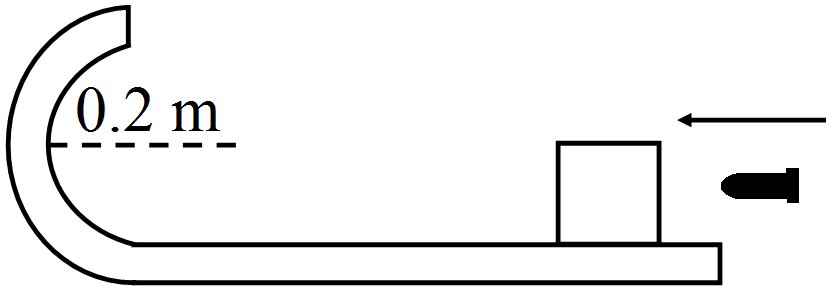
A bullet of mass 10g moving horizontally at a speed of 5017m/s strikes a block of mass 490g kept on a frictionless track as shown in figure. The bullet remains inside the block and the system proceeds towards the semicircular track of radius 0.2m. Where will the block strike the horizontal part after leaving the semicircular track ?
The amount of charge that passes in time t through a cross-section of a wire is,
$Q(t) = At^2 + Bt + C.$​​​​​​​
  1. Write the dimensional formulae for A, B and C.
  2. If the numerical values of A, B and C are 5, 3 and 1, respectively, in S.I units, find the value of the current at t = 5s.
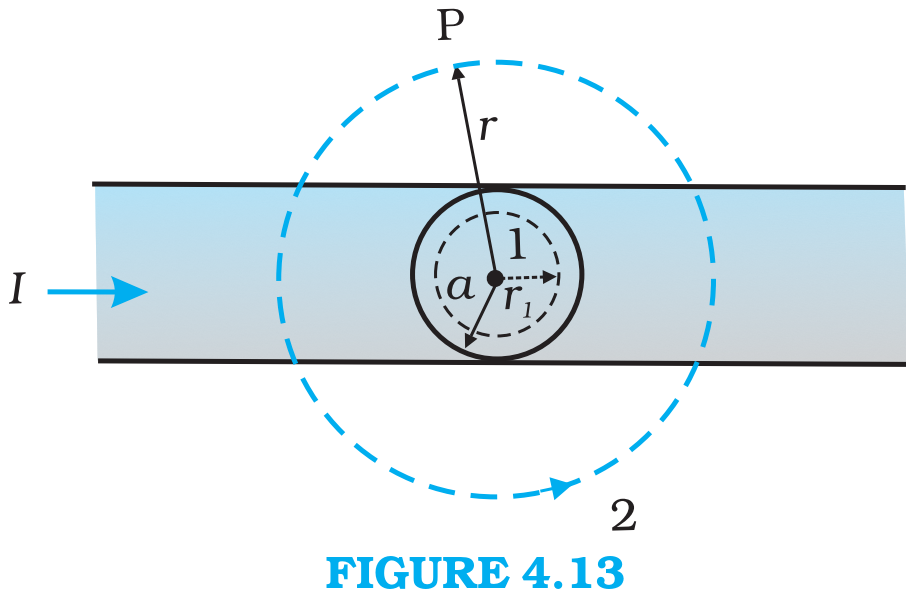
Figure $4.13$ shows a long straight wire of a circular cross $-$ section $($radius $a)$ carrying steady current $I$. The current $I$ is uniformly distributed across this cross $-$ section. Calculate the magnetic field in the region $ra$.
Image
In fig., the circuit symbol of a logic gate and two input waveforms A and B are shown:
  1. Name the logic gate.
  2. Write its truth table.
  3. Give the output waveform.
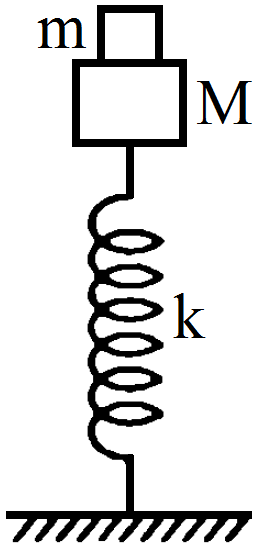
A small block of mass m is kept on a bigger block of mass M which is attached to a vertical spring of spring constant k as shown in the figure. The system oscillates vertically.
  1. Find the resultant force on the smaller block when it is displaced through a distance x above its equilibrium position.
  2. Find the normal force on the smaller block at this position. When is this force smallest in magnitude?
  3. What can be the maximum amplitude with which the two blocks may oscillate together?
A glass surface is coated by an oil film of uniform thickness $1.00 \times 10^{-4}cm$. The index of refraction of the oil is 1.25 and that of the glass is 1.50. Find the wavelengths of light in the visible region (400nm - 750nm) which are completely transmitted by the oil film under normal incidence.
The flux of magnetic field through a closed conducting loop changes with time according to the equation, $\phi=\text{at}^2+\text{bt}+\text{c}.$
  1. Write the SI units of a, band c.
  2. If the magnitudes of a, b and c are 0.20, 0.40 and 0.60 respectively, find the induced emf at t = 2s.
When a light ray passes from the atmosphere (a) through the combination of two mediums water (b) and glass (c), then find the relationship between the refractive indices of the three mediums.
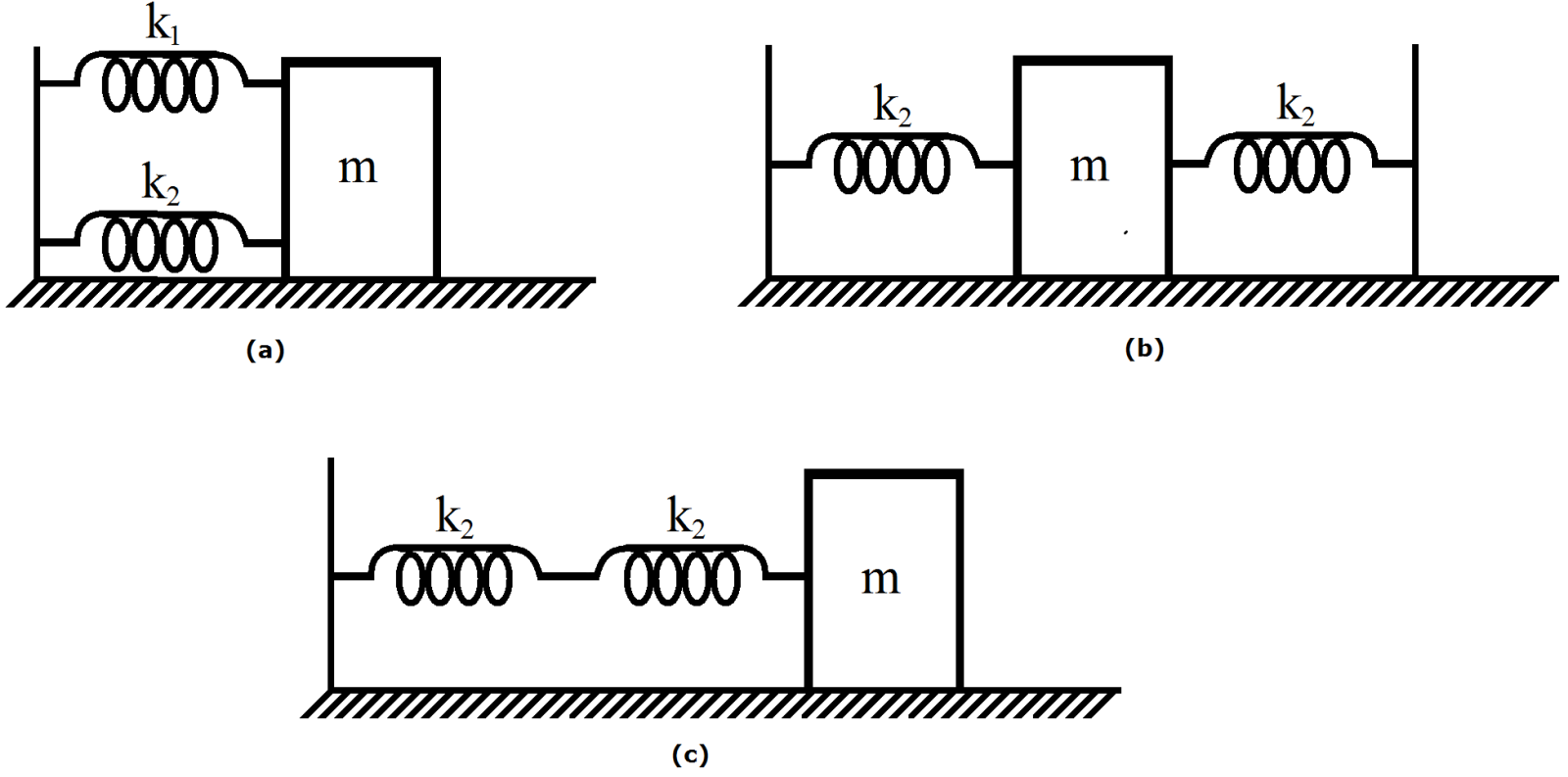
Find the time period of the oscillation of mass m in figure What is the equivalent spring constant of the pair of springs in each case?