Question
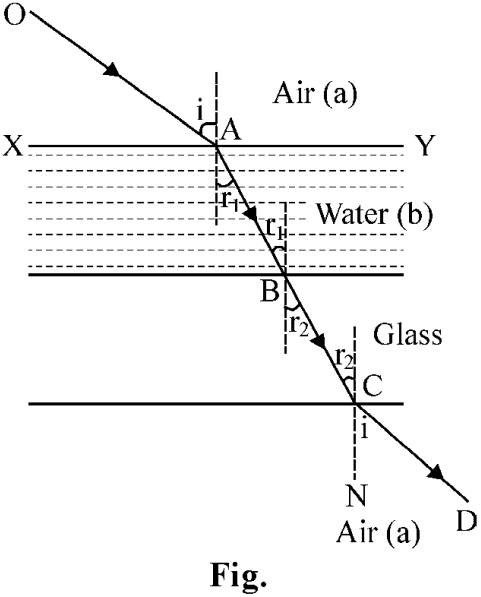
When a light ray passes from the atmosphere (a) through the combination of two mediums water (b) and glass (c), then find the relationship between the refractive indices of the three mediums.

Need a full question paper?

Generate a complete, print-ready paper with questions like this in minutes — across 16+ boards, with answer keys.
Start Generating Free

Similar questions

(a) Obtain an expression for current flowing through an ideal inductor joined with an ac source of voltage $v=v_0 \sin \omega t$ by using phasor diagram. Draw a graph between (i) voltage applied and (ii) current as a function of (wt.).
(b) Obtain an expression for average power dissipation in any series LCR circuit.
Define the capacitance of a capacitor. Obtain an expression for the capacitance of a parallel plate capacitor. And explain on what factors the does capacitance depend?
$a$. Derive the expression for the current flowing in an ideal capacitor and its reactance when connected to an ac source of voltage $V = V _{ o } \sin \omega t$.
$b$. Draw its phasor diagram.
$c$. If resistance is added in series to capacitor what changes will occur in the current flowing in the circuit and phase angle between voltage and current.
A long straight cable of length l is placed symmetrically along z-axis and has radius a(< < l). The cable consists of a thin wire and a co-axial conducting tube. An alternating current $\text{I}(\text{t})=\text{I}_0\sin(2\pi\text{vt})$ flows down the central thin wire and returns along the co-axial conducting tube. The induced electric field at a distance s from the wire inside the cable is $\text{E}(\text{s},\text{t})=\mu_0\text{I}_0\text{v}\cos(2\pi\text{vt})\text{In}\Big(\frac{\text{s}}{\text{a}}\Big)\hat{\text{k}}$.
  1. Calculate the displacement current density inside the cable.
  2. Integrate the displacement current density across the crosssection of the cable to find the total displacement current $I^d.$
  3. Compare the conduction current $I_0$​​​​​​​ with the dispalcement current $\text{I}_0^\text{d}$.
Consider a neutron and an electron bound to each other due to gravitational force. Assuming Bohr's quantization rule for angular momentum to be valid in this case, derive an expression for the energy of the neutron-electron system.
Consider an excited hydrogen atom in state n moving with a velocity u(ν << c). It emits a photon in the direction of its motion and changes its state to a lower state m. Apply momentum and energy conservation principles to calculate the frequency ν of the emitted radiation. Compare this with the frequency $ν_0$ emitted if the atom were at rest.
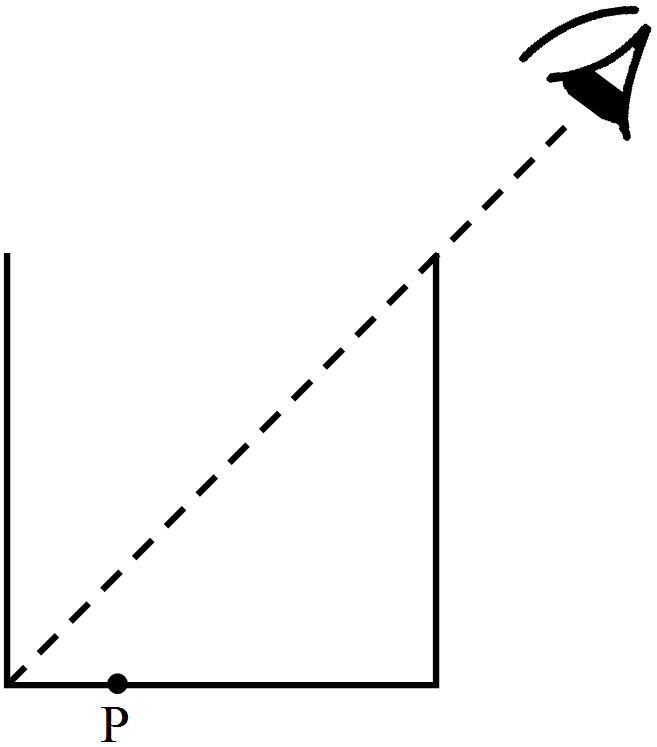
A cylindrical vessel, whose diameter and height both are equal to 30cm, is placed on a horizontal surface and a small particle P is placed in it at a distance of 5.0cm from the centre. An eye is placed at a position such that the edge of the bottom is just visible. The particle P is in the plane of drawing. Up to what minimum height should water be poured in the vessel to make the particle P visible?
Suppose the block of the previous problem is pushed down the incline with a force of 4N. How far will the block move in the first two seconds after starting from rest? The mass of the block is 4kg.
The resistance of an iron wire and a copper wire at 20°C are $3.9\Omega$ and $4.1\Omega,$ respectively. At what temperature will the resistance be equal? Temperature coefficient of resistivity for iron is $5.0\times10^{-3}\text{K}^{-1}$ and for copper, it is $4.0\times10^{-3}\text{K}^{-1}.$ Neglect any thermal expansion.
The plates of a capacitor of capacitance $10\mu\text{F},$ charged to $60\mu\text{C},$ are joined together by a wire of resistance $10\Omega$ at t = 0. Find the charge on the capacitor in the circuit at (a) t = 0 (b) $\text{t}=30\mu\text{s}$ (c) $\text{t}=120\mu\text{s}$ and (d) t = 1.0ms.