Question
Suppose the medium in the previous question is water. Select the correct option(s) from the list given in that question.
  1. vA > vB > vC
  2. vA < vB < vC
  3. vA = vB = vC
  4. $\text{v}_\text{B}=\frac{1}{2}(\text{v}_\text{A}+\text{v}_\text{C})$
Answer

  1.  $\text{v}_\text{A}>\text{v}_\text{B}>\text{v}_\text{C}$

  2. $\text{v}_\text{B}=\frac{1}{2}(\text{v}_\text{A}+\text{v}_\text{C})$
Explanation:

Since the speed of light is a universal constant,

$\text{v}_\text{A}=\text{v}_\text{B}=\text{v}_\text{C}=3\times 10^8\text{m/s}$

$\text{v}_\text{B}=\frac{1}{2}(\text{u}_\text{A}+\text{u}_\text{C})$ This expression also implies that vA = vB = vC 

Need a full question paper?

Generate a complete, print-ready paper with questions like this in minutes — across 16+ boards, with answer keys.

Start Generating Free

Similar questions

A uniform solid sphere of mass $m$ and radius $r$ rolls without slipping down a inclined  plane, inclined at an angle $45^o$ to the horizontal. Find the magnitude of minimum  frictional coefficient at which slipping is absent-
A bag (mass $M$) hangs by a long thread and a bullet (mass $m$) comes horizontally with velocity $v$ and gets caught in the bag. Then for the combined (bag $+$ bullet) system
A ball of mass $0.5\, kg$ moving with a velocity of $2\, m/sec$ strikes a wall normally and bounces back with the same speed. If the time of contact between the ball and the wall is one millisecond, the average force exerted by the wall on the ball is ........ $newton$
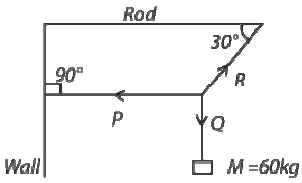
A body of mass $60\,kg$ is suspended by means of three strings $P, Q$ and $R$ as shown in the figure is in equilibrium. The tension in the string $P$ is $..........g\,N$
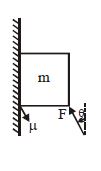
A block of mass $m$ (initially at rest) is sliding up (in vertical direction) against a rough vertical wall with the help of a force $F$ whose magnitude is constant but direction is changing. $\theta  = {\theta _0}t$  where $t$ is time in sec. At $t$ = $0$ , the force is in vertical upward direction and then as time passes its direction is getting along normal, i.e., $\theta  = \frac{\pi }{2}$ .The value of $F$ so that the block comes to rest when $\theta  = \frac{\pi }{2}$ , is 
One nanometre is equal to
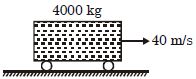
A trolley containing water has total mass $4000\, kg$ and is moving at a speed of $40\, m/s$. Now water start coming out of a hole at the bottom of the trolley at the rate of $8\,kg/s$. Speed of trolley after $50\, s$ is ............ $m/s$
Three particles each of mass $m$ are located at the vertices of an equilateral triangle $ABC$. They start moving with equal speeds $v$ each along the medians of the triangle and collide at its centroid $G$. If after collision, $A$ comes to rest and $B$ retraces its path along $GB,$ then $C$
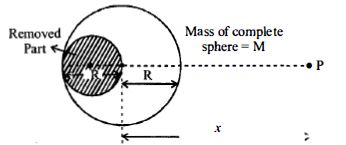
The gravitational field, due to the 'left over part' of a uniform sphere (from which a part as shown, has been 'removed out'), at a very far off point , $P$, located as shown, would be (nearly)
Pressure at a point inside a liquid does not depend on: