Question types

Light Waves question types

79 questions across 6 question groups — pick any mix to generate a Physics paper with step-by-step answer keys.

79
Questions
6
Question groups
5
Question types
Sample Questions

Light Waves questions

One sample from each question group in this chapter. Select any group above to see the full set with answer keys.
Two coherent sources of different intensities send waves which interfere. The ratio of maximum intensity to the minimum intensity is 25. The intensities of the sources are in the ratio:
  1. 25 : 1
  2. 5 : 1
  3. 9 : 4
  4. 625 : 1
View full solution
A Young's double slit experiment is performed with white light:
  1. The central fringe will be white.
  2. There will not be a completely dark fringe.
  3. The fringe next to the central will be red.
  4. The fringe next to the central will be violet.
View full solution
Plane microwaves are incident on a long slit having a width of 5.0cm. Calculate the wavelength of the microwaves if the first diffraction minimum is formed at $\theta=30^\circ.$
View full solution
Find the thickness of a plate which will produce a change in optical path equal to half the wavelength $\lambda$ of the light passing through it normally. The refractive index of the plate is $\mu$.
View full solution
Consider the situation of the previous problem. If the mirror reflects only 64% of the light energy falling on it, what will be the ratio of the maximum to the minimum intensity in the interference pattern observed on the screen?
View full solution
A source emitting light of wavelengths 480nm and 600nm is used in. a double slit interference experiment. The separation between the slits is 0.25mm and the interference is observed on a screen placed at 150cm from the slits. Find the linear separation between the first maximum (next to the central maximum) corresponding to the two wavelengths.
View full solution
A plate of thickness t made of a material of refractive index $\mu$ is placed in front of one of the slits in a double slit experiment.
  1. Find the change in the optical path due to introduction of the plate.
  2. What should be the minimum thickness t which will make the intensity at the centre of the fringe pattern zero? Wavelength of the light used is $\lambda$. Neglect any absorption of light in the plate.
View full solution
A parallel beam of monochromatic light is used in a Young's double slit experiment. The slits are separated by a distance d and the screen is placed parallel to the plane of the slits. Show that if the incident beam makes an angle $\theta=\sin^{-1}\Big(\frac{\lambda}{2\text{D}}\Big)$ with the normal to the plane of the slits, there will be a dark fringe at the centre P0 of the pattern.
View full solution
A convex lens of diameter 8.0cm is used to focus a parallel beam of light of wavelength 620nm. If the light be focused at a distance of 20cm from the lens, what would be the radius of the central bright spot formed?
View full solution
Q 143 Marks Question3 Marks
The index of refraction of fused quartz is 1.472 for light of wavelength 400nm and is 1.452 for light of wavelength 760nm. Find the speeds of light of these wavelengths in fused quartz.
View full solution
Q 153 Marks Question3 Marks
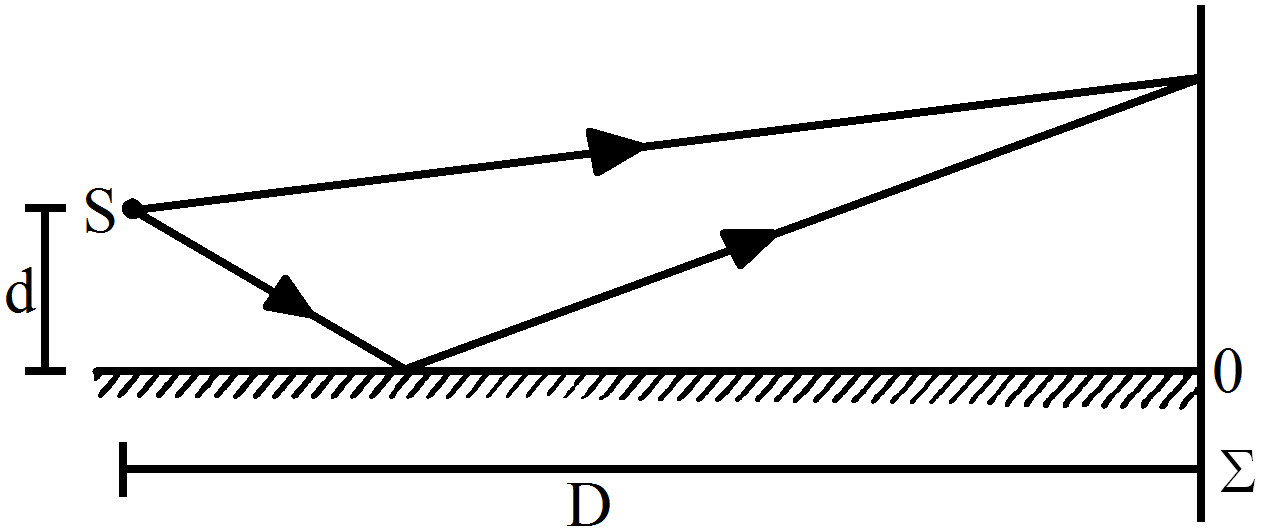
A narrow slit S transmitting light of wavelength $\lambda$ is placed a distance d above a large plane mirror as shown in figure (17-E1). The light coming directly from the slit and that coming after the reflection interfere at a screen $\sum$ placed at a distance D from the slit.

  1. What will be the intensity at a point just above the mirror, i.e., just above O?
  2. At what distance from 0 does the first maximum occur?
View full solution
Q 173 Marks Question3 Marks
Suppose white light falls on a double slit but one slit is covered by a violet filter (allowing $\lambda=400\text{nm}$). Describe the nature of the fringe pattern observed.
View full solution
Q 183 Marks Question3 Marks
Is the colour of 620nm light and 780nm light same? Is the colour of 620nm light and 621nm light same? How many colours are there in white light?
View full solution
Q 194 Marks Question4 Marks
TV signals broadcast by Delhi studio cannot be directly received at Patna which is about 1000km away. But the same signal goes some 36000km away to a satellite, gets reflected and is then received at Patna. Explain.
View full solution
Q 204 Marks Question4 Marks
Why don't we have interference when two candles are placed close to each other and the intensity is seen at a distant screen? What happens if the candles are replaced by laser sources?
View full solution
A mica strip and a polysterene strip are fitted on the two slits of a double slit apparatus. The thickness of the strips is 0.50mm and the separation between the slits is 0.12cm. The refractive index of mica and polysterene are 1.58 and 1.55 respectively for the light of wavelength 590nm which is used in the experiment. The interference is observed on a screen a distance one meter away.
  1. What would be the fringe-width?
  2. At what distance from the centre will the first maximum be located?
View full solution
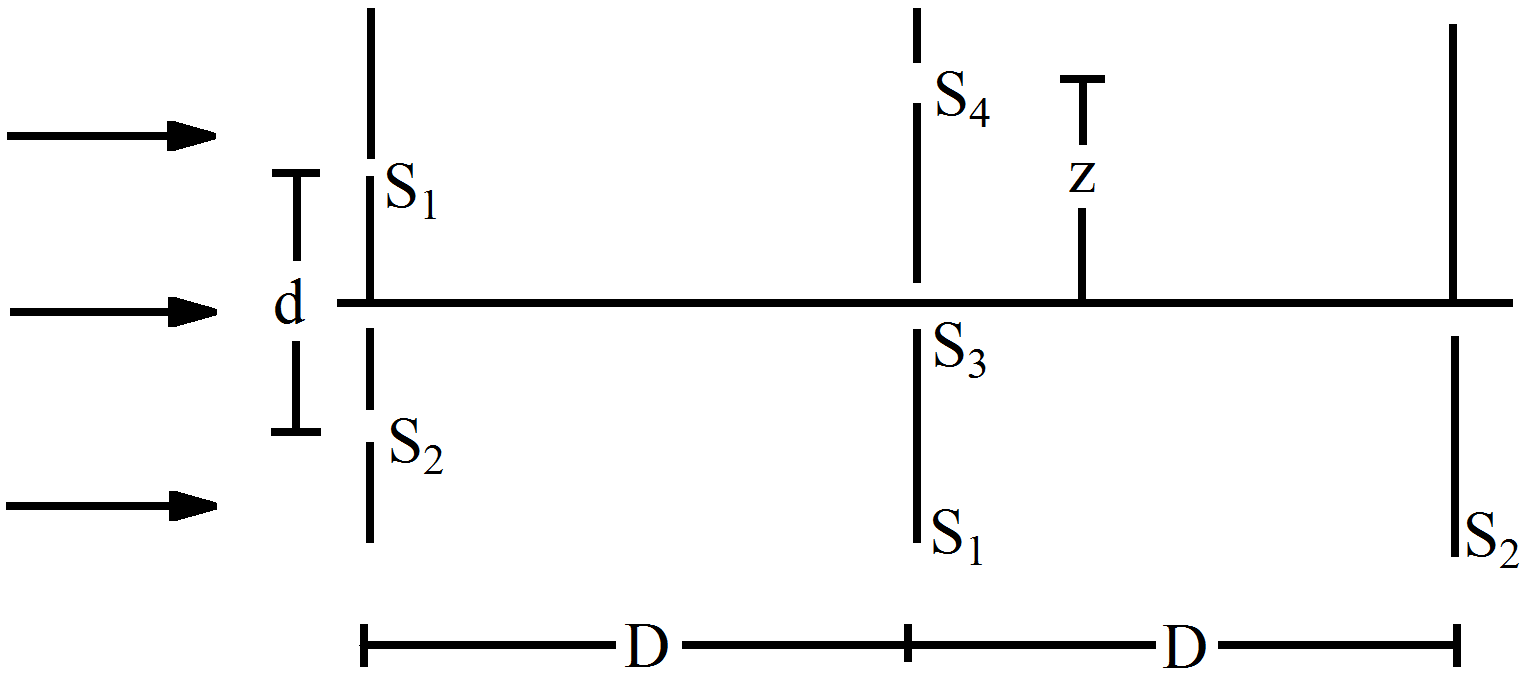
Consider the situation shown in figure (17-E6). The two slits S1 and S2 p laced symmetrically around the central line are illuminated by a monochromatic light of wavelength $\lambda.$ The separation between the slits is d. The light transmitted by the slits falls on a screen E1 placed at a distance D from the slits. The slit S3 is at the central line and the slit S4 is at a distance z from S3. Another

screen $\sum_2$ is placed a further distance D away from $\sum_1$. Find the ratio of the maximum to minimum intensity observed on $\sum_2$, if z is equal to,

  1. $\text{z}=\frac{\lambda\text{D}}{2\text{d}}$

  2. $\frac{\lambda\text{D}}{\text{d}}$

  3. $\frac{\lambda\text{D}}{4\text{d}}$

View full solution
In a Young's double slit interference experiment the fringe pattern is observed on a screen placed at a distance D from the slits. The slits are separated by a distance d and are illuminated by monochromatic light of wavelength $\lambda$. Find the distance from the central point where the intensity falls to,
  1. Half the maximum.
  2. One fourth of the maximum.
View full solution
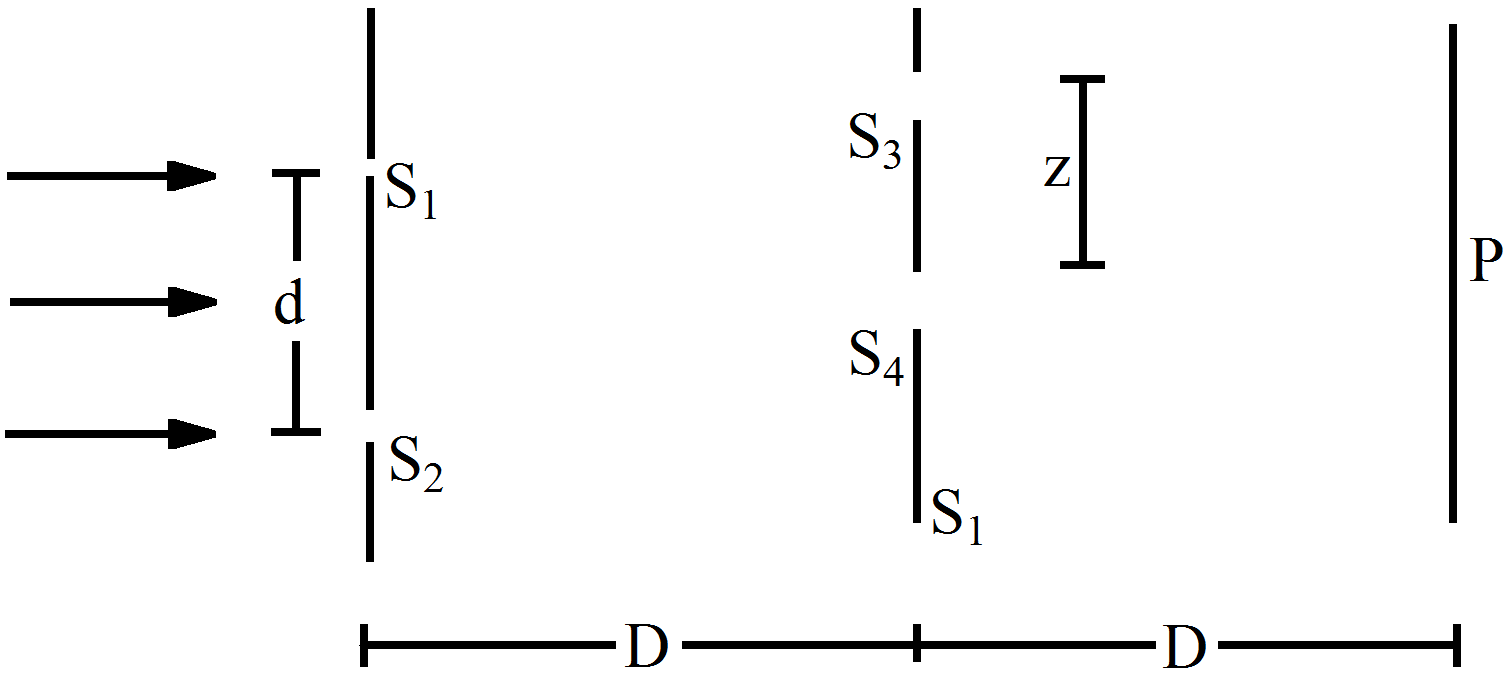
Consider the arrangement shown in figure. By some mechanism, the separation between the slits S3 and S4 can be changed. The intensity is measured at the point P which is at the common perpendicular bisector

of S1S2 and S3S4. When $\text{z}=\frac{\text{D}\lambda}{2\text{d}},$ intensity measured at P is I. Find this intensity when z is equal to:

  1. $\frac{\text{D}\lambda}{\text{d}}$

  2. $\frac{3\text{D}\lambda}{2\text{d}}$

  3. $\frac{2\text{D}\lambda}{\text{d}}$

View full solution
A thin paper of thickness 0.02mm having a refractive index 1.45 is pasted across one of the slits in a Young's double slit experiment. The paper transmits $\frac{4}{9}$ of the light energy falling on it.
  1. Find the ratio of the maximum intensity to the minimum intensity in the fringe pattern.
  2. How many fringes will cross through the centre if an identical paper piece is pasted on the other slit also? The wavelength of the light used is 600nm.
View full solution

Generate a Light Waves paper free

Pick question groups from the list above, set marks and difficulty, and export a branded PDF with step-by-step answer keys. First 3 chapters free — no signup.

Download App