Question
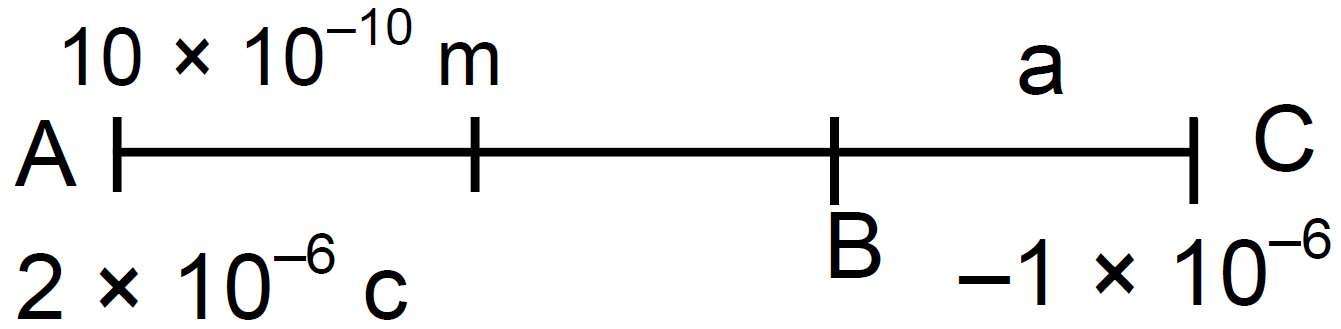
Suppose the second charge in the previous problem is -1.0 × 10-6C. Locate the position where a third charge will not experience a net force.
Answer


By coulomb's Law, force,
$\text{F}=\frac{1}{4\pi\in_0}\frac{\text{Q}_1\text{Q}_2}{\text{r}_2}$
So, force on charge q due to q1,
$\text{F}=\frac{9\times10^{9}\times2.0\times10^{-6}\times\text{q}}{\text{x}^2}$
Force on charge q due to q2
$\text{F}'=\frac{9\times10^9\times10^{-6}\times\text{q}}{(10-\text{x})^2}$
According to the question,
$\Rightarrow\text{F}-\text{F}'=0$
$\Rightarrow\frac{9\times10^{9}\times2.0\times10^{-6}\times\text{q}}{\text{x}^2}=\frac{9\times10^9\times10^{-6}\times\text{q}}{(\text{x}-10)^2}$
$\Rightarrow\text{x}^2=2(\text{x}-10)^2$
$\Rightarrow\text{x}^2-40\text{x}+200=0$
$\Rightarrow\text{x}=20\pm10\sqrt{2}\text{m}$
$\Rightarrow\text{x}=34.14\text{cm}$ $\Big(\because\ \text{x}\neq20-10\sqrt{2}\Big)$

Need a full question paper?

Generate a complete, print-ready paper with questions like this in minutes — across 16+ boards, with answer keys.
Start Generating Free

Similar questions

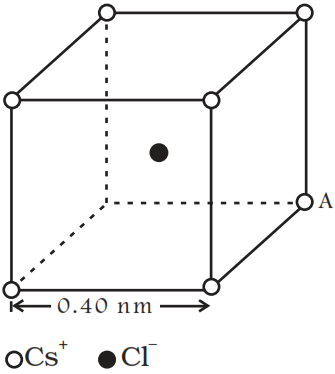
Fig. represents a crystal unit of cesium chloride, CsCl. The cesium atoms, represented by open circles are situated at the corners of a cube of side 0.40nm, whereas a Cl atom is situated at the centre of the cube. The Cs atoms are deficient in one electron while the Cl atom carries an excess electron.

  1. What is the net electric field on the Cl atom due to eight Cs atoms?
  2. Suppose that the Cs atom at the corner A is missing. What is the net force now on the Cl atom due to seven remaining Cs atoms?

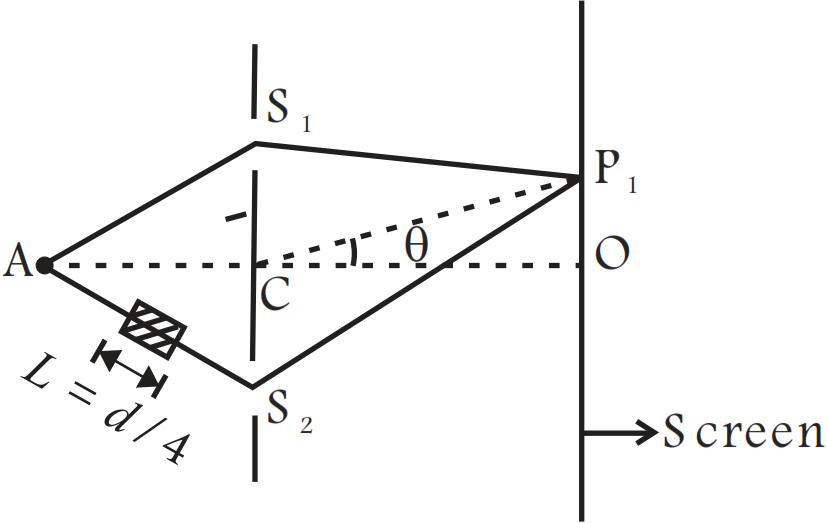
AC = CO = D, S1C = S2C = d < < D

A small transparent slab containing material of μ = 1.5 is placed along AS2 (Fig). What will be the distance from O of the principal maxima and of the first minima on either side of the principal maxima obtained in the absence of the glass slab.
A system has two charges qA = 2.5 × 10⁻⁷ C and qB = –2.5 × 10⁻⁷ C located at points A: (0, 0, –15 cm) and B: (0, 0, +15 cm), respectively. What are the total charge and electric dipole moment of the system?
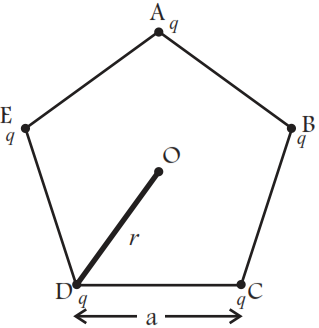
Five charges, q each are placed at the corners of a regular pentagon of side 'a' (Fig.).

  1.  
  1. What will be the electric field at O, the centre of the pentagon?
  2. What will be the electric field at O if the charge from one of the corners (say A) is removed?
  3. What will be the electric field at O if the charge q at A is replaced by -q?
  1. How would your answer to (a) be affected if pentagon is replaced by n-sided regular polygon with charge q at each of its corners?
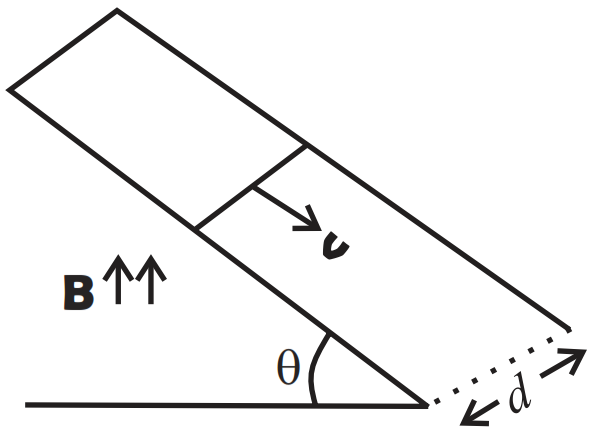
A rod of mass m and resistance R slides smoothly over two parallel perfectly conducting wires kept sloping at an angle θ with respect to the horizontal (Fig). The circuit is closed through a perfect conductor at the top. There is a constant magnetic field B along the vertical direction. If the rod is initially at rest, find the velocity of the rod as a function of time.

A pitcher with 1mm thick porous walls contains 10kg of water. Water comes to its outer surface and evaporates at the rate of 0.1gs-1. The surface area of the pitcher (one side)= 200cm2. The room temperature = 42°C, latent heat of vaporization $ =2.27\times10^6\text{Jkg}^{-1},$ and the thermal conductivity of the porous walls $=0.80\text{Js}^{-1}\text{m}^{-1}{^{\circ}}\text{C}^{-1}.$ Calculate the temperature of water in the pitcher when it attains a constant value.
Two charges 5 × 10⁻⁸ C and –3 × 10⁻⁸ C are located 16 cm apart. At what point(s) on the line joining the two charges is the electric potential zero? Take the potential at infinity to be zero.
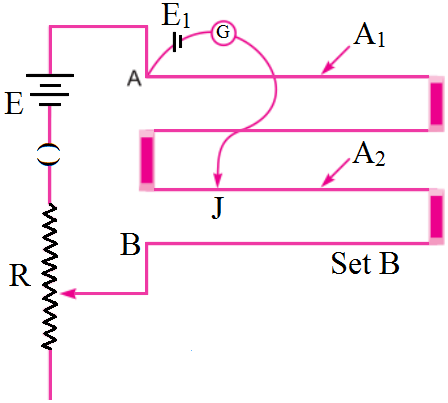
You are given two sets of potentiometer circuits to measure the emf E1 of a cell.

Set A: consists of a potentiometer wire of a material of resistivity $\rho_1$, area of cross-section A1 and length l.

Set B: consists of a potentiometer of two composite wire of equal lengths $\frac{\text{l}}2{}$ each, of resistivity $\rho_1,\rho_2$ and area of cross-section A1, A2 respectively.

Find the relation between resistivity of the two wires with respect to their area of cross section, if the current flowing in the two sets is same.

Compare the balancing length obtained in the two sets.

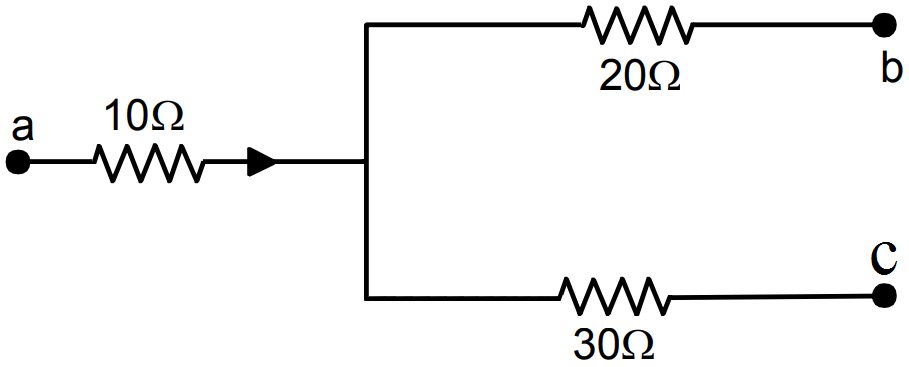
Figure. showa a part of an electric circuit. The potentials at the point a, b and c are 30V, 12V and 2V respectively. Find the currents through the three resistors.

Explain AC generator by drawing a labelled diagram. Obtain an expression for instantaneous magnitude of induced electromotive force.