A wire is bent in the form of a regular hexagon and a total charge q is distributed uniformly on it. What is the electric field at the centre? You may answer this part without making any numerical calculations.
Question types
Electric Field and Potential question types
107 questions across 5 question groups — pick any mix to generate a Physics paper with step-by-step answer keys.
107
Questions
5
Question groups
5
Question types
01
2 Marks Questions
23 Q→023 Marks Question
27 Q→031 Marks Question
5 Q→04M.C.Q (1 Marks)
17 Q→055 Marks Questions
35 Q→Sample Questions
Electric Field and Potential questions
One sample from each question group in this chapter. Select any group above to see the full set with answer keys.
View full solution →
Why does a phonograph-record attract dust particles just after it is cleaned?
A positive charge q is placed in front of a conducting solid cube at a distance d from its centre. Find the electric field at the centre of the cube due to the charges appearing on its surface.
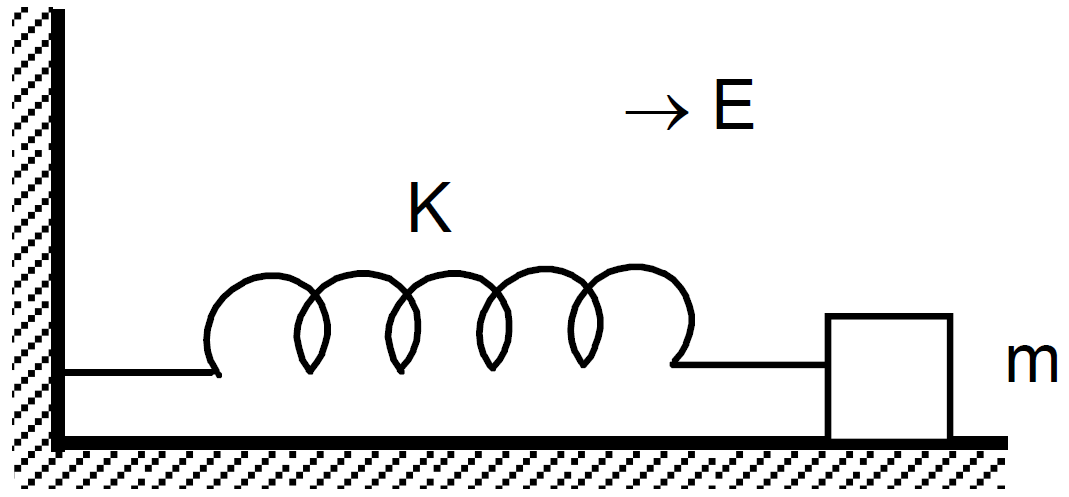
A block of mass m having a charge q is placed on a smooth horizontal table and is connected to a wall through an unstressed spring of spring constant k as shown in figure. A horizontal electric field E parallel to the spring is switched on. Find the amplitude of the resulting SHM of the block.
A hydrogen atom contains one proton and one electron. It may be assumed that the electron revolves in a circle of radius 0.53 angstrom (1 angstrom = 10-10m and is abbreviated as A) with the proton at the centre. The hydrogen atom is said to be in the ground state in this case. Find the magnitude of the electric force between the proton and the electron of a hydrogen atom in its ground state.
A water particle of mass 10.0mg and having a charge of 1.50 × 10⁻⁶C stays suspended in a room. What is the magnitude of electric field in the room? What is its direction?
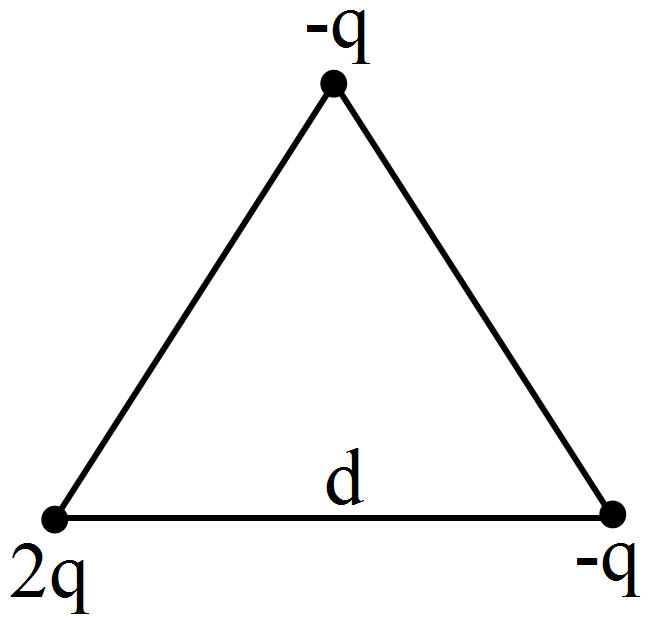
Three charges are arranged on the vertices of an equilateral triangle as shown in figure. Find the dipole moment of the combination.
Two identical particles, each having a charge of 2.0 × 10⁻⁴C and mass of 10g, are kept at a separation of 10cm and then released. What would be the speeds of the particles when the separation becomes large?
Two particles have equal masses of 5.0g each and opposite charges of +4.0 × 10⁻⁵ C and -4.0 × 10⁻⁵C. They are released from rest with a separation of 1.0m between them. Find the speeds of the particles when the separation is reduced to 50cm.
Assume that each atom in a copper wire contributes one free electron. Estimate the number of free electrons in a copper wire having a mass of 6.4g (take the atomic weight of copper to be 64g mol-1.
NaCl molecule is bound due to the electric force between the sodium and the chlorine ions when one electron. of sodium is transferred to chlorine. Taking the separation between the ions to be 2.75 × 10cm, find the force of attraction between them· State the assumptions (if any) that you have made.
A sample of HCI gas is placed in an electric field of 2.5 × 10⁴NC-1. The dipole moment of each HCI molecule is 3.4 × 10⁻³⁰Cm. Find the maximum torque that can act on a molecule.
Two charged particles are placed at a distance 1.0cm apart. What is the minimum possible magnitude of the electric force acting on each charge?
Find the dimensional formula of $\in_0.$
View full solution →Two charged particles having charge 2.0 × 10⁻⁸C each are joined by an insulating string of length 1m and the system is kept on a smooth horizontal table. Find the tension in the string.
If a body is charged by rubbing it, its weight
- Remains precisely constant.
- Increases slightly.
- Decreases slightly.
- May increase slightly or may decrease slightly.
The electric potential decreases uniformly from 120V to 80V as one moves on the x-axis from x = -1cm to x = + 1cm. The electric field at the origin.
- Must be equal to 20Vcm-1
- May be equal to 20Vcm-1
- May be greater than 20Vcm-1
- May be lees than 20Vcm-1
The electric field and the electric potential at a point are E and V respectively.
View full solution →- If E = 0, V must be zero.
- If V = 0, E must be zero.
- If $\text{E}\neq0,$ V cannot be zero.
- If $\text{V}\neq0,$ E cannot be zero.
Figure, shows some of the electric field lines corresponding to an electric field. The figure suggests that,
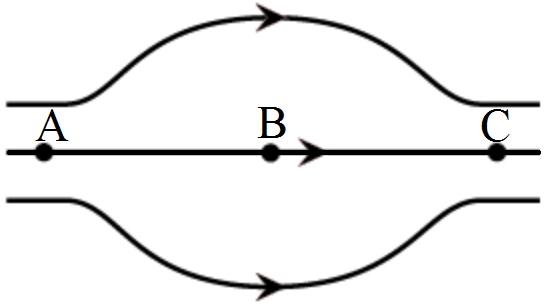
- EA > E8 > Ee
- EA = EB = Ee
- EA = Ec > EB
- EA = Ec < EB.
When the separation between two charges is increased the electric potential energy of the charges.
- Increases.
- Decreases.
- Remains the same.
- May increase or decrease.
Consider a uniformly charged ring of radius R. Find the point on the axis where the electric field is maximum.
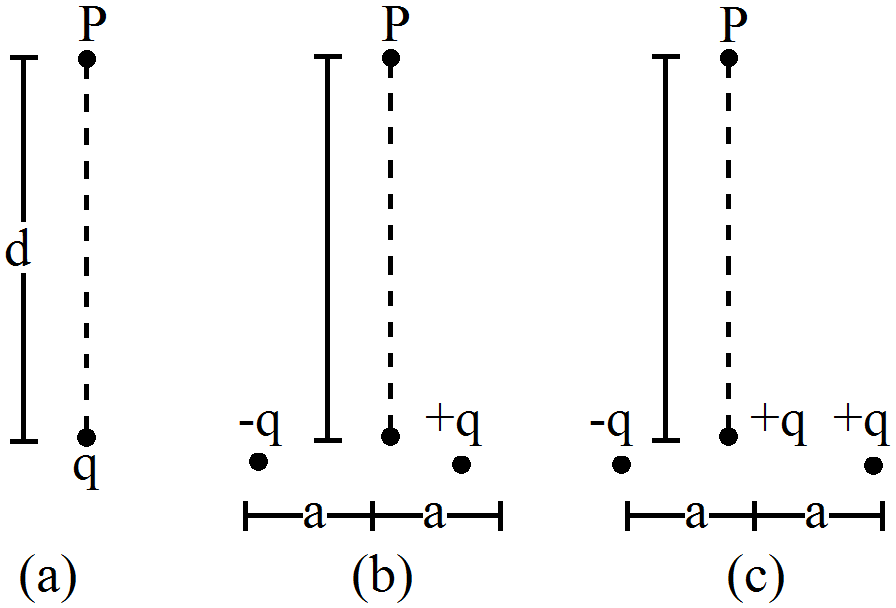
Find the magnitude of the electric field at the point P in the configuration shown in figure for d >> a. Take 2qa = p.
Consider a circular ring of radius r, uniformly charged with linear charge density $\lambda.$ Find the electric potential at a point on the axis at a distance x from the centre of the ring. Using this expression for the potential, find the electric field at this point.
View full solution →A particle A having a charge of 2.0 × 10⁻⁶C is held fixed on a horizontal table. A second charged particle of mass 80g stays in equilibrium on the table at a distance of 10cm from the first charge. The coefficient of friction between the table and this second particle is $\mu=0.2.$ Find the range within which the charge of this second particle may lie.
View full solution →The bob of a simple pendulum has a mass of 40g and a positive charge of 4.0 × 10⁻⁶C. It makes 20 oscillations in 45s. A vertical electric field pointing upward and of magnitude 2.5 × 10⁴NC-1 is switched on. How much time will it now take to complete 20 oscillations?
Generate a Electric Field and Potential paper free
Pick question groups from the list above, set marks and difficulty, and export a branded PDF with step-by-step answer keys. First 3 chapters free — no signup.