Question
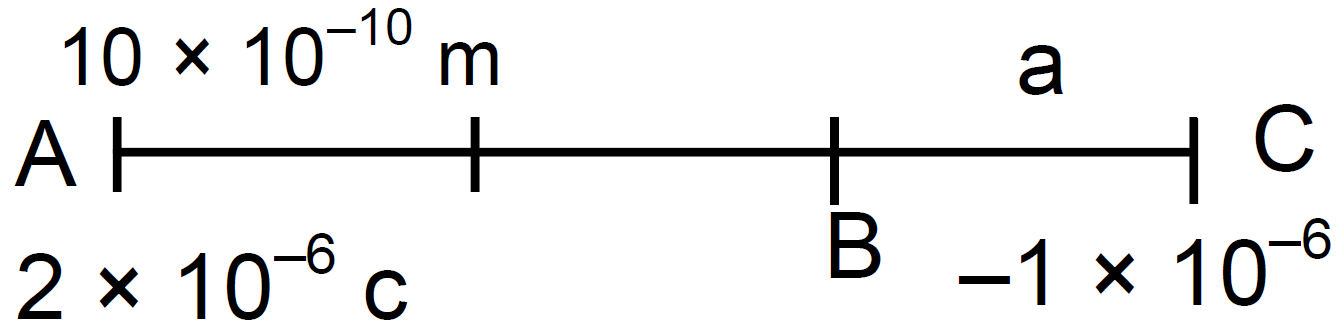
Suppose the second charge in the previous problem is $-1.0 \times 10^{-6}C$. Locate the position where a third charge will not experience a net force.
Answer


By coulomb's Law, force,
$\text{F}=\frac{1}{4\pi\in_0}\frac{\text{Q}_1\text{Q}_2}{\text{r}_2}$
So, force on charge q due to $q_1,$
$\text{F}=\frac{9\times10^{9}\times2.0\times10^{-6}\times\text{q}}{\text{x}^2}$
Force on charge q due to $q_2$
$\text{F}'=\frac{9\times10^9\times10^{-6}\times\text{q}}{(10-\text{x})^2}$
According to the question,
$\Rightarrow\text{F}-\text{F}'=0$
$\Rightarrow\frac{9\times10^{9}\times2.0\times10^{-6}\times\text{q}}{\text{x}^2}=\frac{9\times10^9\times10^{-6}\times\text{q}}{(\text{x}-10)^2}$
$\Rightarrow\text{x}^2=2(\text{x}-10)^2$
$\Rightarrow\text{x}^2-40\text{x}+200=0$
$\Rightarrow\text{x}=20\pm10\sqrt{2}\text{m}$
$\Rightarrow\text{x}=34.14\text{cm}$ $\Big(\because\ \text{x}\neq20-10\sqrt{2}\Big)$

Need a full question paper?

Generate a complete, print-ready paper with questions like this in minutes — across 16+ boards, with answer keys.
Start Generating Free

Similar questions

A particle is fired vertically upward with a speed of 15km/s. With what speed will it move in intersteller space. Assume only earth's gravitational field.
In a Young's double slit experiment using monochromatic light, the fringe pattern shifts by a certain distance on the screen when a mica sheet of refractive index 1.6 and thickness 1.964 micron $(1$ micron $= 10^{-6}m)$ is introduced in the path of one of the interfering waves. The mica sheet is then removed and the distance between the screen and the slits is doubled. It is found that the distance between the successive maxima now is the same as the observed fringe-shift upon the introduction of the mica sheet. Calculate the wavelength of the monochromatic light used in the experiment.
Solve the previous problem if the coefficient of restitution is e. Use $\theta=45^\circ,\ \text{e}=\frac{3}{4}$ and h = 5m
Answer the following question:
If the earth did not have an atmosphere, would its average surface temperature be higher or lower than what it is now?
Write Gauss' law in electrostatics. With the help of a suitable example and a diagram, show that the outward flux due to point charge ' $q$ ' in a closed surface in vaccum does not depend on the size and shape of the surface and its magnitude is $\frac{q}{\epsilon_0}$.
  1. Define mutual inductance and write its S.I. unit.
  2. Derive an expression for the mutual inductance of two long co-axial solenoids of same length wound one over the other.
  3. In an experiment, two coils $c_1 $ and $c_2$ are placed close to each other. Find out the expression for the emf induced in the coil $c_1$ due to a change in the current through the coil $c_2.$
An electric field of magnitude $1000NC^{-1}$ is produced between two parallel plates having a separation of 2.0cm as shown in figure.
  1. What is the potential difference between the plates?
  2. With what minimum speed should an electron be projected from the lower plate in the direction of the field so that it may reach the upper plate?
  3. Suppose the electron is projected from the lower plate with the speed calculated in part (b). The direction of projection makes an angle of 60° with the field. Find the maximum height reached by the electron.
Three coplanar parallel wires, each carrying a current of 10A along the same direction, are placed with a separation 5.0cm between the consecutive ones. Find the matnitude ol the magnetic force per unit lenght acting on the wires.
It is required to construct a $10\mu\text{F}$ capacitor which can be connected across a 200V battery. Capacitors of capacitance $10\mu\text{F}$ are available but they can withstand only 50V. Design a combination which can yield the desired result.
Monochromatic radiation of wavelength 640.2 nm $(1nm = 10^{–9} m)$ from a neon lamp irradiates photosensitive material made of caesium on tungsten. The stopping voltage is measured to be 0.54 V. The source is replaced by an iron source and its 427.2 nm line irradiates the same photo-cell. Predict the new stopping voltage.