Question
Suppose the space between the two inner shells of the previous problem is filled with a dielectric of dielectric coastant K. Find the capacitance of the system between A and B.

Answer

Here we should consider two spherical capacitor of capacitance
cab and cbc in series
$\text{Cab}=\frac{4\pi\epsilon_0\text{abk}}{(\text{b}-\text{a})}$
$\text{Cbc}=\frac{4\pi\epsilon_0\text{bc}}{(\text{c}-\text{b})}$
$\frac{1}{\text{C}}=\frac{1}{\text{Cab}}+\frac{1}{\text{Cbc}}$
$=\frac{(\text{b}-\text{a})}{4\pi\epsilon_0\text{abk}}+\frac{(\text{c}-\text{b})}{4\pi\epsilon_0\text{bc}}$
$=\frac{\text{c}(\text{b}-\text{a})+\text{ka}(\text{c}-\text{b})}{\text{k}4\pi\epsilon_0\text{abc}}$
$\text{C}=\frac{\text{k}4\pi\epsilon_0\text{abc}}{\text{c}(\text{b}-\text{a})+\text{ka}(\text{c}-\text{b})}$

Need a full question paper?

Generate a complete, print-ready paper with questions like this in minutes — across 16+ boards, with answer keys.
Start Generating Free

Similar questions

Compute induced current and induced charge in electromagnetic induction and also write Fleming's right hand rule.
A resistor of $400 \Omega$, an inductor of $\frac{5}{\pi} H$ and a capacitor of $\frac{50}{\pi} \mu F$ are connected in series across a source of alternating voltage of $140 \sin 100 \pi t V$. Find the voltage $($rms$)$ across the resistor, the inductor and the capacitor. Is the algebraic sum of these voltages more than the source voltage? If yes, resolve the paradox. (Given, $\sqrt{2}=1.414 ).$
The short-wavelength limit shifts by 26pm when the operating voltage in an X-ray tube is increased to 1.5 times the original value. What was the original value of the operating voltage?
In many experimental set-ups the source and screen are fixed at a distance say D and the lens is movable. Show that there are two positions for the lens for which an image is formed on the screen. Find the distance between these points and the ratio of the image sizes for these two points.
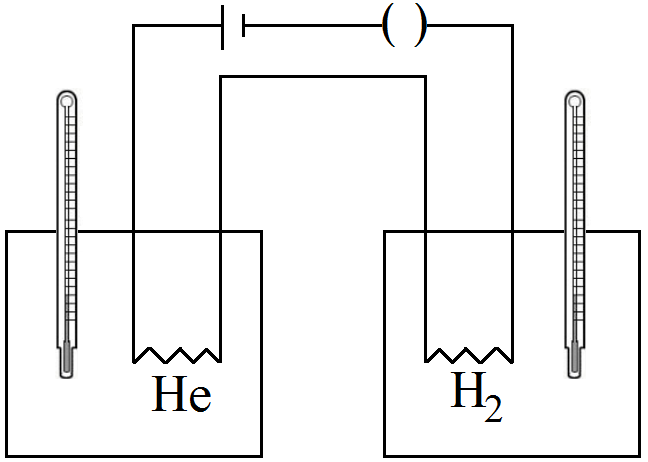
The figure shows two vessels with adiabatic walls, one containing $0.1g$ of helium $\big(\gamma=1.67,\text{M}=4\text{g-mol}^{-1}\big)$ and the other containing some amount of hydrogen $\big(\gamma=1.4,\text{M}=2\text{g-mol}^{-1}\big).$ Initially, the temperatures of the two gases are equal. The gases are electrically heated for some time during which equal amounts of heat are given to the two gases. It is found that the temperatures rise through the same amount in the two vessels. Calculate the mass of hydrogen.
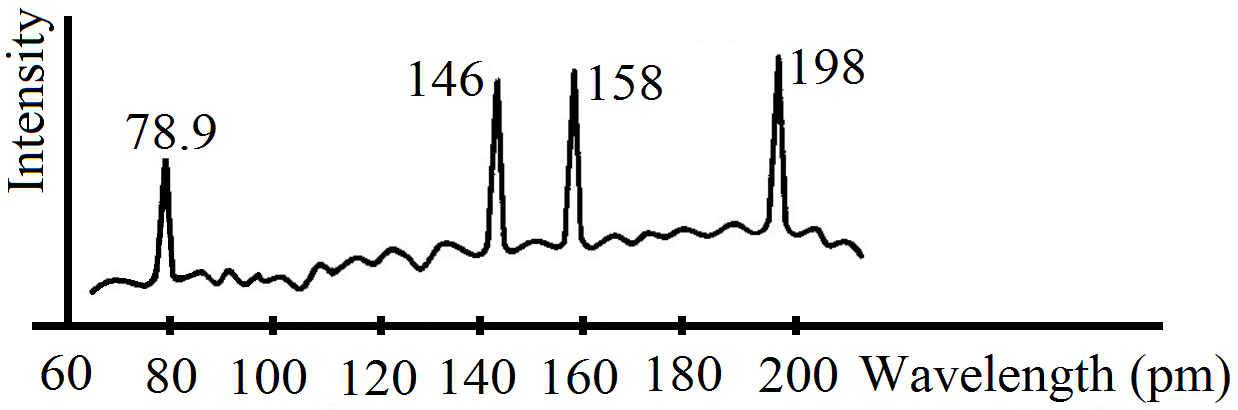
Continuous $X-$rays are made to strike a tissue paper soaked with polluted water. The incoming $X-$rays excite the atoms of the sample by knocking out the electrons from the inner shells. Characteristic $X-$rays are analysed and the intensity is plotted against the wavelength. Assuming that only $\text{K}_\alpha$ intensities are detected, list the elements present in the sample from the plot. Use Moseley's equation $v - (25 \times 10^{14}Hz)(Z - 1)^2.$​​​​​​​
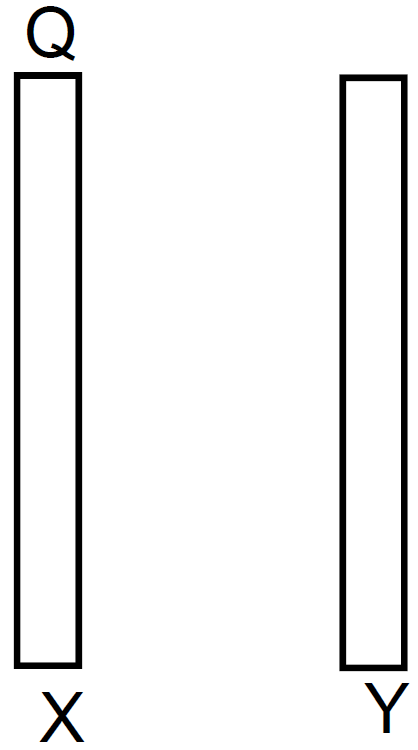
Two conducting plates X and Y, each having large surface area A (on one side), are placed parallel to each other as shown in figure. The plate X is given a charge Q whereas the other is neutral. Find:
  1. The surface charge density at the inner surface of the plate X.
  2. The electric field at a point to the left of the plates.
  3. The electric field at a point in between the plates.
  4. The electric field at a point to the right of the plates.
A biconvex thick lens is constructed with glass $(\mu=1.50)$ Each of the surfaces has a radius of $10\ cm$ and the thickness at the middle is $5\ cm.$ Locate the image of an object placed far away from the lens.
The plates of a capacitor are 2.00cm apart. An electronproton pair is released somewhere in the gap between the plates and it is found that the proton reaches the negative plate at the same time as the electron reaches the positive plate. At what distance from the negative plate was the pair released?
Obtain the answers to (a) and (b) in Exercise 7.15 if the circuit is connected to a 110V, 12kHz supply? Hence, explain the statement that a capacitor is a conductor at very high frequencies. Compare this behaviour with that of a capacitor in a dc circuit after the steady state.