Question
Two conducting plates X and Y, each having large surface area A (on one side), are placed parallel to each other as shown in figure. The plate X is given a charge Q whereas the other is neutral. Find:
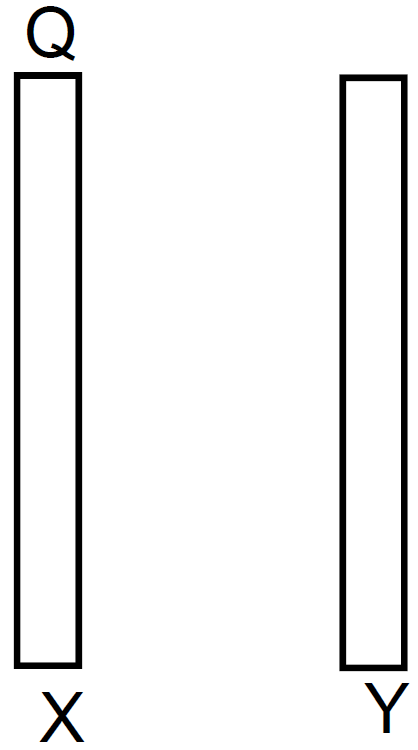
  1. The surface charge density at the inner surface of the plate X.
  2. The electric field at a point to the left of the plates.
  3. The electric field at a point in between the plates.
  4. The electric field at a point to the right of the plates.
Answer

  1. Given that the charge present on the plate is Q. The other plate will get the same charge Q due to convection.
Let the surface charge densities on both sides of the plate be $\sigma_1$ and $\sigma_2.$
Now, electric field due to a plate,
$\text{E}=\frac{\sigma}{2\epsilon_0}$
So, the magnitudes of the electric fields due to this plate on each side $=\frac{\sigma_1}{2\epsilon_0}$ and $\frac{\sigma_2}{2\epsilon_0}$
The plate has two sides, each of area A. So, the net charge given to the plate will be equally distributed on both the sides.This implies that the charge developed on each side will be:
$\text{q}_1=\text{q}_2=\frac{\text{Q}}{2}$
This implies that the net surface charge density on each side $=\frac{\text{Q}}{2\text{A}}$
  1. Electric field to the left of the plates
On the left side of the plate surface, charge density,
$\sigma=\frac{\text{Q}}{2\text{A}}$
Hence, electric field $=\frac{\text{Q}}{2\text{A}\epsilon_0}$
This must be directed towards the left, as 'X' is the positively-charged plate.
  1. Here, the charged plate 'X' acts as the only source of electric field, with positive in the inner side. Plate Y is neutral. So, a negative charge will be induced on its inner side. 'Y' attracts the charged particle towards itself. So, the middle portion E is towards the right and is equal to $\frac{\text{Q}}{2\text{A}\epsilon_0}.$
  2. Similarly for the extreme right, the outer side of plate 'Y' acts as positive and hence it repels to the right with $\text{E}=\frac{\text{Q}}{2\text{A}\epsilon_0}.$

Need a full question paper?

Generate a complete, print-ready paper with questions like this in minutes — across 16+ boards, with answer keys.

Start Generating Free

Similar questions

Answer the following question:
If the earth did not have an atmosphere, would its average surface temperature be higher or lower than what it is now?
A parallel$-$plate capacitor has plate area $20\ cm^2,$ plate separation $1.0\ mm$ and a dielectric slab of dielectric constant $5.0$ filling up the space between the plates. This capacitor is joined to a battery of emf $6.0V$ through a $100\text{k}\Omega$ resistor. Find the energy of the capacitor $8.9\mu\text{s}$ after the connections are made.
Explain with a neat diagram construction and working of a compound microscope. Obtain an expression for its magnifying power.

Identify which logic gate OR, AND and NOT is represented by the circuits in the dotted line boxes 1, 2 and 3. Give the truth table for the entire circuit for all possible values of A and B.
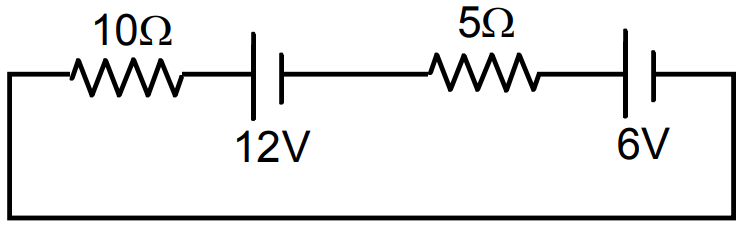
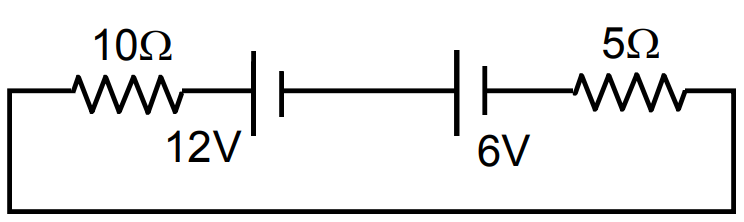
Consider the circuit shown in the figure. Find (a) the current in the circuit (b) the potential drop across the $5\Omega$ resistor (c) the potential drop across the $10\Omega$ resistor. (d) Answer the parts (a), (b) and (c) with reference to the figure.

A long solenoid with $15 $ turns per $\ cm$ has a small loop of area $2.0 \ cm^2$ placed inside the solenoid normal to its axis. If the current carried by the solenoid changes steadily from $2.0A$ to $4.0A$ in $0.1s,$ what is the induced emf in the loop while the current is changing?
An electron of kinetic energy 100eV circulates in a path of radius 10cm in a magnetic field. Find the magnetic field and the number of revolutions per second made by the electron.
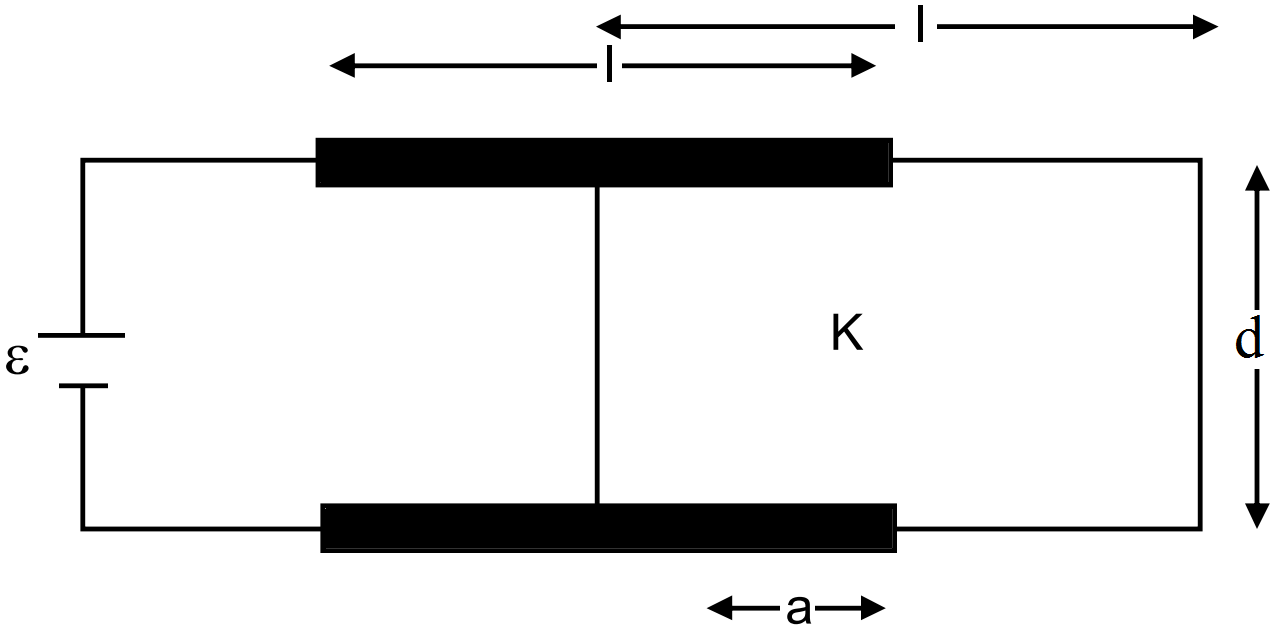
Consider the situation shown in figure. The plates of the capacitor have plate area A and are clamped in the laboratory. The dielectric slab is released from rest with a length a inside the capacitor. Neglecting any effect of friction or gravity, show that the slab will execute periodic motion and find its time period.
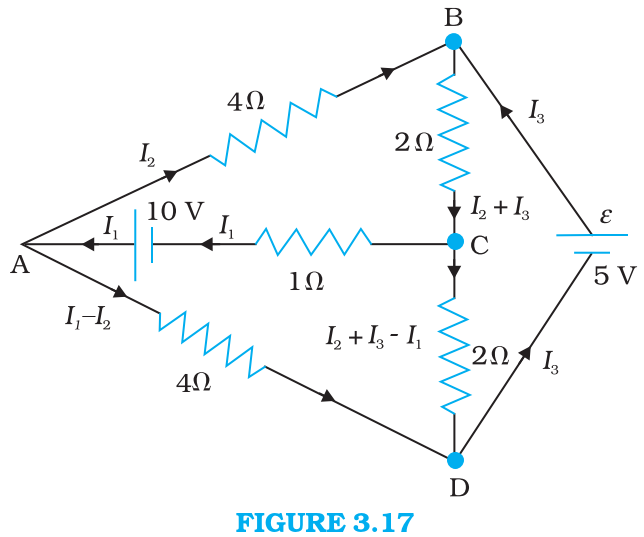
Determine the current in each branch of the network shown in Fig. $3.17$.
Image
A bullet of mass $10g$ moving horizontally at a speed of $5017m/s$ strikes a block of mass $490g$ kept on a frictionless track as shown in figure. The bullet remains inside the block and the system proceeds towards the semicircular track of radius $0.2m$. Where will the block strike the horizontal part after leaving the semicircular track ?