Question
In a Young's double slit interference experiment the fringe pattern is observed on a screen placed at a distance D from the slits. The slits are separated by a distance d and are illuminated by monochromatic light of wavelength $\lambda$. Find the distance from the central point where the intensity falls to,
  1. Half the maximum.
  2. One fourth of the maximum.

Answer

  1. When intensity is half the maximum $\frac{\text{I}}{\text{I}_\text{max}}=\frac{1}{2}$
$\Rightarrow\frac{4\text{a}^2\cos^2\big(\frac{\phi}{2}\big)}{4\text{a}^2}=\frac{1}{2}$
$\Rightarrow\cos^2\Big(\frac{\phi}{2}\Big)=\frac{1}{2}\Rightarrow\cos\Big(\frac{\phi}{2}\Big)=\frac{1}{\sqrt{2}}$
$\Rightarrow\frac{\phi}{2}=\frac{\pi}{4}\Rightarrow\phi=\frac{\pi}{2}$
$\Rightarrow$ Path difference, $\text{x}=\frac{\lambda}{4}$
$\Rightarrow\text{y}=\frac{\text{xD}}{\text{d}}=\frac{\lambda\text{D}}{4\text{d}}$
  1. When intensity is $\frac{1}{4}\text{th}$ of the maximum $\frac{\text{I}}{\text{I}_\text{max}}=\frac{1}{4}$
$\Rightarrow\frac{4\text{a}^2\cos^2\Big(\frac{\phi}{2}\Big)}{4\text{a}^2}=\frac{1}{4}$
$\Rightarrow\cos^2\Big(\frac{\phi}{2}\Big)=\frac{1}{4}\Rightarrow\cos\Big(\frac{\phi}{2}\Big)=\frac{1}{2}$
$\Rightarrow\frac{\phi}{2}=\frac{\pi}{3}\Rightarrow\phi=\frac{2\pi}{3}$
$\Rightarrow$ Path difference, $\text{x}=\frac{\lambda}{3}$
$\Rightarrow\text{y}=\frac{\text{xD}}{\text{d}}=\frac{\lambda\text{D}}{3\text{d}}$

Need a full question paper?

Generate a complete, print-ready paper with questions like this in minutes — across 16+ boards, with answer keys.

Start Generating Free

Similar questions

A 50-turn circular coil of radius 2.0cm carrying a current of 5.0A is rotated in a magnetic field of strength 0.20T.
  1. What is the maximum torque that acts on the coil?
  2. In a particular position of the coil, the torque acting on it is half of this maximum. What is the angle between the magnetic field and the plane of the coil?
Explain with the help of a diagram the formation of depletion region and barrier potential in a $p-n$ junction diode.
How did de Broglie hypothesis lead to Bohr’s quantum condition of atomic orbits?
Find the diameter of the image of the moon formed by a spherical concave mirror of focal length $7.6m.$ The diameter of the moon is $3450\ km$ and the distance between the earth and the moon is $3.8 \times 10^5\ km$.
Write the nature, properties and difference among $\alpha$-, $\beta$- and $\gamma$-rays.
Explain Oersted's experiment. What conclusions were drawn from it? What do you understand by magnetic field? How direction and intensity of magnetic field determined?
A point source emitting alpha particles is placed at a distance of $1m$ from a counter which records any alpha particle falling on its $1\ cm^2$ window. If the source contains $6.0 \times 10^{16}$ active nuclei and the counter records a rate of $50000$ counts/ second, find the decay constant. Assume that the source emits alpha particles uniformly in all directions and the alpha particles fall nearly normally on the window.
Draw a ray diagram to show the formation of real image of the same size as that of the object placed in front of a converging lens. Using this ray diagram establish the relation between u, v and f for this lens.
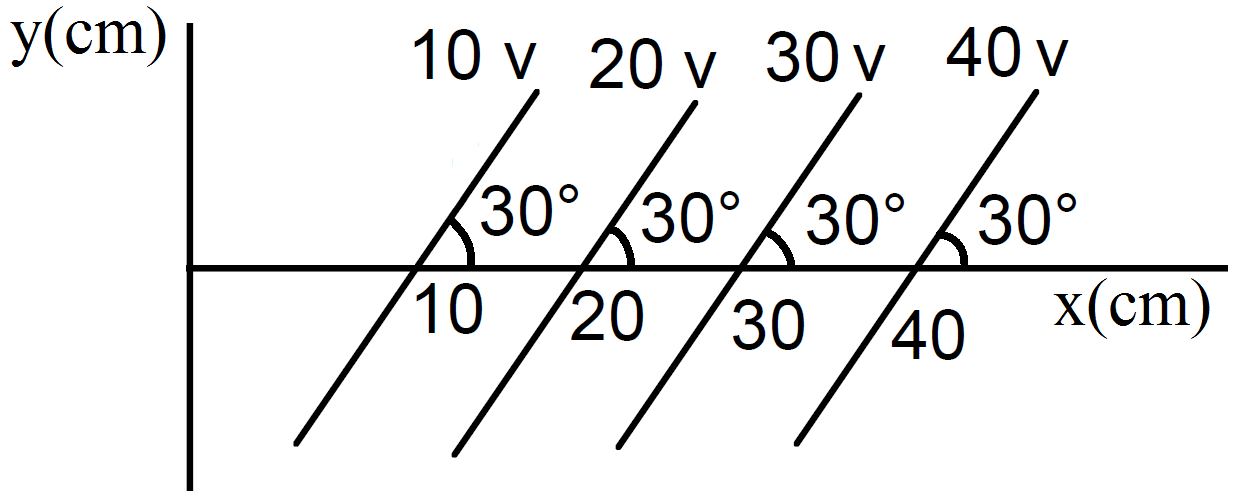
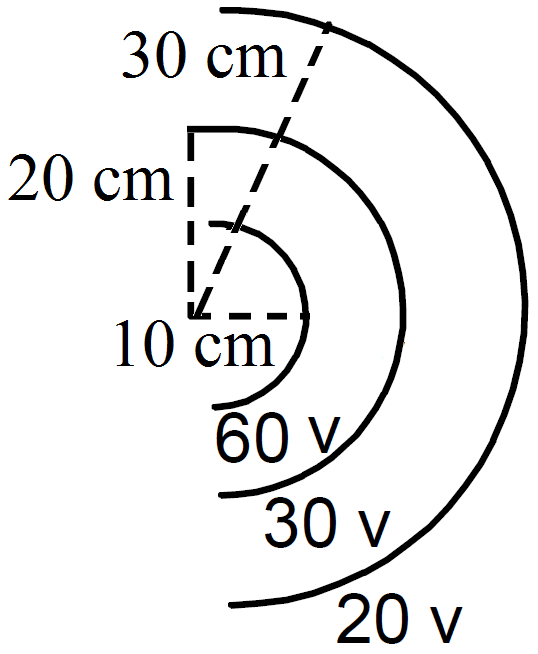
Some equipotential surfaces are shown in figure. What can you say about the magnitude and the direction of the electric field?

(a) For circuits used for transporting electric power, a low power factor implies large power loss in transmission. Explain.
(b) Power factor can often be improved by the use of a capacitor of appropriate capacitance in the circuit. Explain.