Question
Suppose you are given a chance to repeat the alpha-particle scattering experiment using a thin sheet of solid hydorgen in place of the gold foil. (Hydrogen is a solid at temperatures below 14 K.) What results do you expect?

Answer

Proton is nucleus of hydrogen atom. Its mass is 1.67 ×10 -27 kg while mass of incident a-particle is 6.64 ×10⁻²⁷ kg. Since mass of scattered particle is more than the nucleus of target (proton), therefore, a-particle will not returned even in direct collision. 
It is analogous to the football collides with the tenis ball in the rest. 
Therefore scattering will not be able at large angles.

Need a full question paper?

Generate a complete, print-ready paper with questions like this in minutes — across 16+ boards, with answer keys.
Start Generating Free

Similar questions

A magnetic dipole is under the influence of two magnetic fields. The angle between the field directions is $60^\circ ,$ and one of the fields has a magnitude of $1.2 \times 10^{–2} T$. If the dipole comes to stable equilibrium at an angle of $15^\circ$ with this field, what is the magnitude of the other field?
A railroad car of mass $M$ is at rest on frictionless rails when a man of mass $m$ starts moving on the car towards the engine. If the car recoils with a speed $v$ backward on the rails, with what velocity is the man approaching the engine?
What happens to the energy of light waves in interference?
Think over the experiment number 2 of Faraday and Henry and tell :
(a) What will you do to obtain more deflection in the galvanometer?
(b) How will you show the presence of current in the absence of a galvanometer?
Define electric field intensity and equipotential surface in current carrying conductor.
A free neutron beta $-$ decays to a proton with a half $-$ life of $14$ minutes.
  1. What is the decay constant?
  2. Find the energy liberated in the process.
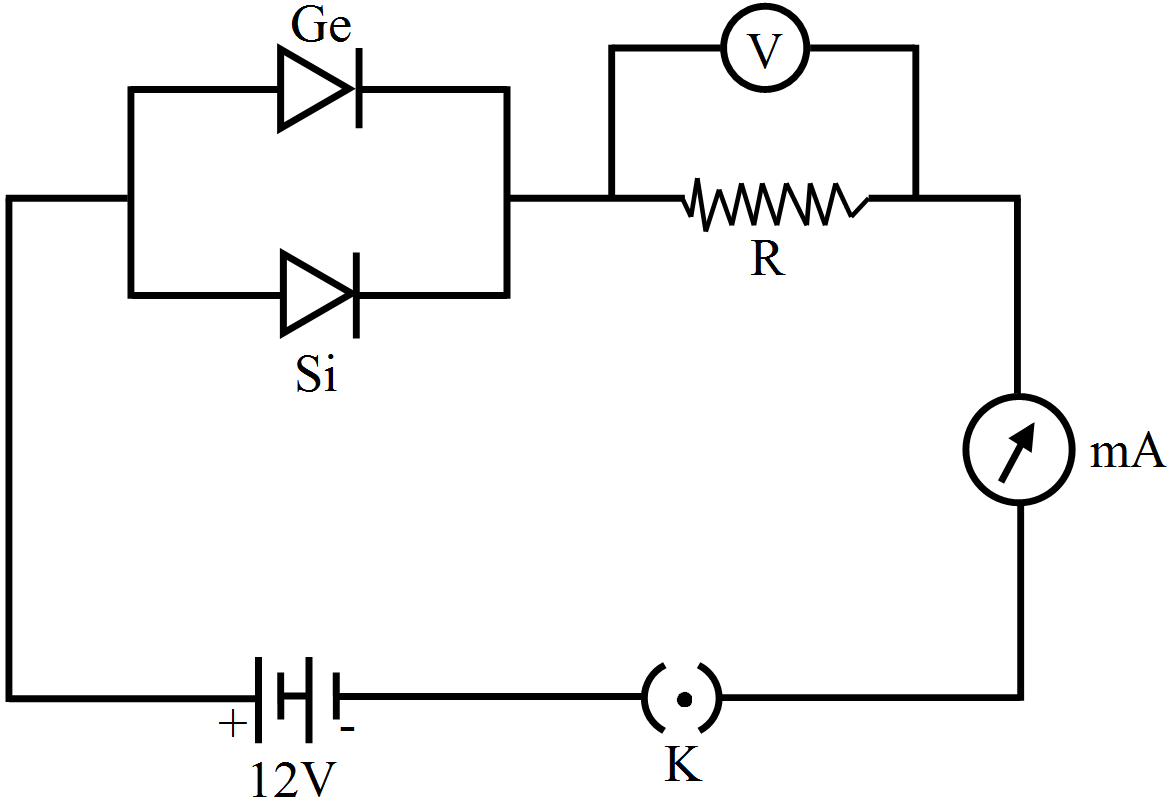
Germanium and silicon junction diodes are connected in parallel. A resistance R, a 12V battery, a milliammeter (mA) and key (K) are connected in series with them (figure). When key (K) is closed, a current begins to flow in the milliammeter. What will be the maximum reading of voltmeter connected across resistance R?
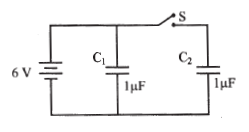
Figure shows two identical capacitors, $C_1$ and $C_2,$ each of $1 \mu F$ capacitance connected to a battery of $6 V.$ Initially switch $'S\ '$ is closed. After sometime $'S\ '$ is left open and dielectric slabs of dielectric constant $K = 3$ are inserted to fill completely the space between the plates of the two capacitors. How will the $(i)$ charge and $(ii)$ potential difference between the plates of the capacitors be affected after the slabs are inserted?
On a cold winter night you are asked to sit on a chair. Would you like to choose a metal chair or a wooden chair? Both are kept in the same lawn and are at the same temperature.
Write two important limitations of Rutherford nuclear model of the atom.