Questions

2 Marks Questions

Take a timed test

19 questions · self-marked practice — reveal the answer and mark yourself.

Question 12 Marks
Define the ionisation energy. What is the value of it for hydrogen atom?
Answer
Ionisation Energy : In any atom, that minimum energy of electron given to it for transition, so that it go out from the atom, this required energy is called ionisation energy. Ionisation energy of hydrogen atom is 13.6 eV .
View full question & answer
Question 22 Marks
Write the formula to find the Rydberg's constant and what is the value of their constant?
Answer
$R=\frac{m e^4}{8 \epsilon_0^2 h^3 c}$
Putting the values of constants, the value of $R$ will be :
$R=1.03 \times 10^7 m^{-1}$
View full question & answer
Question 32 Marks
What facts are obtained by the scattering with angle more than $90^{\circ}$.
Answer
(i) For scattering of positively charged $\alpha$-particles with angle more than $90^{\circ}$, it is necessary that positively charge is concentrated at tiny space of atom in gold foil.
(ii) It cannot explain the spectrum of atom.
View full question & answer
Question 42 Marks
How the radii of different stable orbits are related to principal quantum number?
Answer
We know that :
$\begin{array}{ll}
r_n=\frac{n^2 h^2}{Ke^2 4 \pi^2 m} \\
\text { i.e. } \quad r_n \propto n^2
\end{array}$
The orbital radius of an orbit is inversely proportional to the principal quantum number.
View full question & answer
Question 52 Marks
The total energy of electron is negative. What do you mean by this fact? It is positive then what is the indication?
Answer
The total energy of electron is
$E=K+U=\frac{-e^2}{8 \pi \epsilon_0 r}$
Here, negative fact shows that electron is bound to nucleus. If the value of $E$ is positive, then electron cannot revolves around the nucleus in closed orbit.
View full question & answer
Question 62 Marks
Explain the Bohr's Quantum condition of angular momentum. What will be the value of it, for the second orbit of electron?
Answer
According to this, the angular momentum of electron is multiple integer of $\frac{h}{2 \pi}$.
i.e. $L =n \cdot \frac{h}{2 \pi}$ where, $n=1,2,3, \ldots \ldots$.
For second order orbit, $n=2$
$\therefore L=\frac{2 h}{2 \pi}=\frac{h}{\pi}=\frac{6.63 \times 10^{-34}}{3.14}=2.11 \times 10^{-34} Js$
View full question & answer
Question 72 Marks
How the speed of revolving electron in stable orbit is related to principal quantum number?
Answer
Speed of electron in $n ^{\text {th }}$ orbit, is given by :
$v_n=K \cdot \frac{2 \pi e^2}{n h} . \text { So, } v_n \propto \frac{1}{n}$
Therefore, speed is inversely proportional to quantum number.
View full question & answer
Question 82 Marks
Define the distance of closest approach.
Answer
The minimum distance upto which an energetic $\alpha$-particle travelling directly towards a nucleus can move before coming to rest and then retracing its path is known as distance of closest approach.
$F=\frac{1}{4 \pi \epsilon_0} \frac{(2 e)(Ze)}{r^2}$
Where $r$ is the distance of $\alpha$-particle from nucleus.
View full question & answer
Question 92 Marks
What is energy levels? How these are represented?
Answer
In a stable energy level of atom, the energy level diagram will be represented as a series of horizontal lines, which is called energy levels. It can be represented with horizontal lines and suitable energy scale.
View full question & answer
Question 102 Marks
Write formula for Bohr's frequency.
Answer
Frequency of emitted radiation of electron of atom to jump from outer orbit to inner orbit is $v$.
$E=h \nu=E_2-E_1$
Here, $E _1=$ Total energy of electron in inner orbit.
$E _2=$ Total energy of electron in outer orbit.
View full question & answer
Question 112 Marks
Define the absorption transition and emission transition.
Answer
When the electrons in the ground state to reach higher energy states is called absorption transition and moving of electrons from lower energy levels to higher energy levels is called emission transition.
View full question & answer
Question 122 Marks
What is nucleus?
Answer
The most part of mass and positive charge of atom is concentrated at a tiny (space) volume, which is nucleus and around it electrons revolves just like planets revolves around the sun.
View full question & answer
Question 132 Marks
Write formula for Bohr's orbit radius for hydrogen atom.
Answer
$r_n=\left(\frac{\epsilon_0 h^2}{\pi m Z e^2}\right) n^2 ;$ where, $n=$ number of orbits and all constants are usual.
View full question & answer
Question 142 Marks
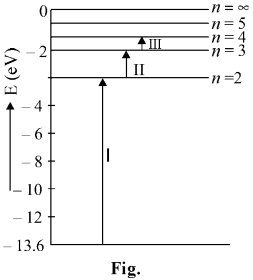
The photons of continuous frequency range are passing through rarafied hydrogen pattern. Three absorbed lines are shown in Fig.
Image
(i) To which series of hydrogen spectrum, these lines are related?
(ii) Out of them which has maximum wavelength?
Answer
(i) I = Lyman series, II = Balmer series, III = Paschen series.
(ii) Since $\lambda=\frac{h c}{\Delta E }$; For maximum wavelength, $\Delta E$ should be minimum. It is for III line. So its wavelength will be maximum.
View full question & answer
Question 152 Marks
What is the ratio of first excited state and corresponding orbital radius of ground state in hydrogen atom?
Answer
We know that, $\quad r_n \propto n^2$
$n=1$ for ground level and $n=2$ for first excited level.
$\therefore \frac{\text { Radius of first excited level }\left(r_2\right)}{\text { Radius of ground level }\left(r_1\right)}=\frac{(2)^2}{(1)^2}$
$\Rightarrow \quad \frac{r_2}{r_1}=\frac{4}{1}$
$r_2: r_1=4: 1$
View full question & answer
Question 162 Marks
What is the physical significance of negative energy of electron in Bohr's atom?
Answer
The potential energy is positive and kinetic energy is negative of electron. Potential energy is greater than kinetic energy. So the total energy is negative which indicates the stability of atom. To remove the electron from the atom, energy will required from outside.
View full question & answer
Question 172 Marks
The radius of the innermost electron orbit of a hydrogen atom is 5.3 ×10⁻¹¹ m. What are the radii of the n = 2 and n = 3 orbits? 
Answer
We know that : $r_n \propto n^2$ and
given that $r_1=5.3 \times 10^{-11} m$
$\frac{r_2}{r_1}=\left(\frac{2}{1}\right)^2=4$
or $\quad r_2=4 r_1=4 \times 5.30 \times 10^{-11}$ meter
$=2.12 \times 10^{-10}$ meter =2.12 Å

Again, $\frac{r_3}{r_1}=\left(\frac{3}{1}\right)^2=\frac{9}{1}$
or$\quad$$r_3=9 r_1=9 \times 5.3 \times 10^{-11}$ meter
$=4.77 \times 10^{-10}$ meter
= 4.77 Å
View full question & answer
Question 182 Marks
A different of 2.3 eV separates two energy levels in an atom. What is the frequency of radiation emitted when the atom make a transition from the upper level to the lower level?
Answer
Given that: 
$\begin{aligned} \Delta E = E _2- E _1 & =2.3 eV \\ =2.3 \times 1.6 \times 10^{-19} J\end{aligned}$
Planck's constant, $h=6.63 \times 10^{-34} J- s$
Frequency of emitted radiation, $v=$ ?
We know that Relation, $\Delta E =h v$ or $v=\frac{\Delta E }{h}$
Putting the values, $v=\frac{2.3 \times 1.6 \times 10^{-19}}{6.63 \times 10^{-34}} \simeq 5.6 \times 10^{14} Hz$
View full question & answer
Question 192 Marks
Suppose you are given a chance to repeat the alpha-particle scattering experiment using a thin sheet of solid hydorgen in place of the gold foil. (Hydrogen is a solid at temperatures below 14 K.) What results do you expect?
Answer
Proton is nucleus of hydrogen atom. Its mass is 1.67 ×10 -27 kg while mass of incident a-particle is 6.64 ×10⁻²⁷ kg. Since mass of scattered particle is more than the nucleus of target (proton), therefore, a-particle will not returned even in direct collision. 
It is analogous to the football collides with the tenis ball in the rest. 
Therefore scattering will not be able at large angles.
View full question & answer