Question
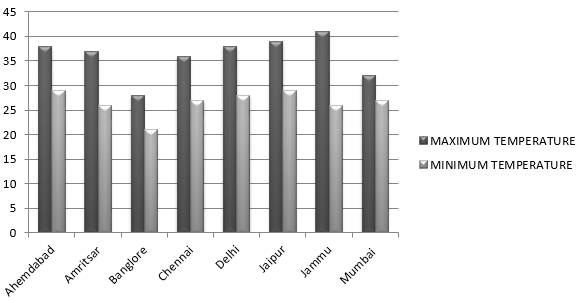
Take the data giving the minimum and the maximum temperature of various cities given in Table. Plot a double bar graph using the data and answer the question: Name the city which has the least difference between its minimum and the maximum temperature.
Temperatures of Cities as on $20.6.2006$
City Max. Min.
Ahmedabad $38^{\circ} \mathrm{C}$ $29^{\circ} \mathrm{C}$
Amritsar $37^{\circ} \mathrm{C}$ $26^{\circ} \mathrm{C}$
Banglore $28^{\circ} \mathrm{C}$ $21^{\circ} \mathrm{C}$
Chennai $36^{\circ} \mathrm{C}$ $27^{\circ} \mathrm{C}$
Delhi $38^{\circ} \mathrm{C}$ $28^{\circ} \mathrm{C}$
Jaipur $39^{\circ} \mathrm{C}$ $28^{\circ} \mathrm{C}$
Jammu $41^{\circ} \mathrm{C}$ $26^{\circ} \mathrm{C}$
Mumbai $32^{\circ} \mathrm{C}$ $27^{\circ} \mathrm{C}$

Answer


From the graph, The least difference between the maximum and minimum bars corresponding to Mumbai.
Hence, it can be concluded that,
Mumbai is city with the least difference in its maximum temperature and minimum temperatures on $20.06.2006$

Need a full question paper?

Generate a complete, print-ready paper with questions like this in minutes — across 16+ boards, with answer keys.

Start Generating Free

Similar questions

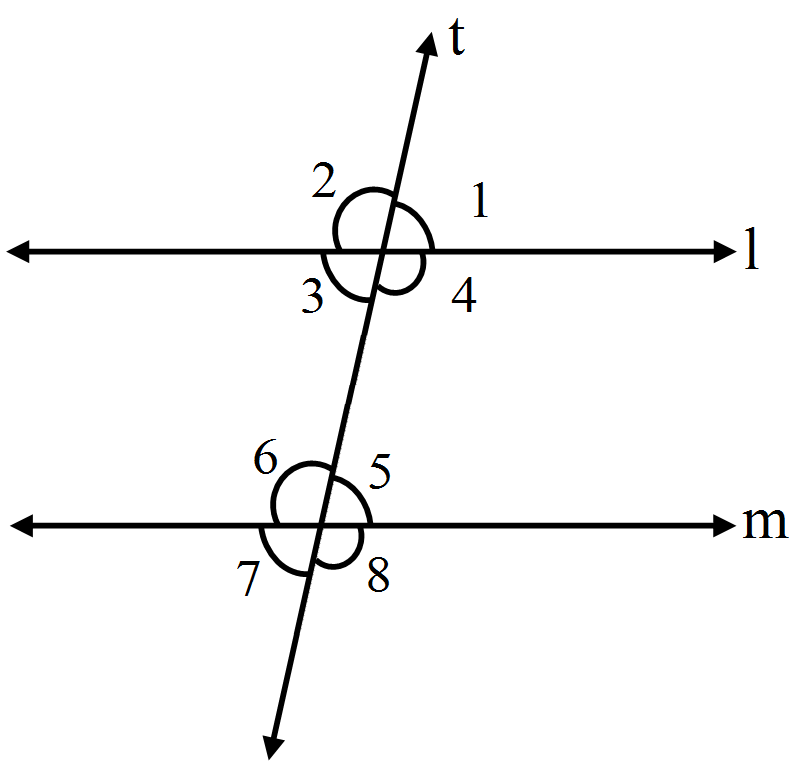
In the given figure $\text{l}\ ||\ \text{m}$ and t is a transversal. If $\angle5=70^\circ$ find the measure of each of the angles $\angle1,\ \angle3,\ \angle4\ \text{and}\ \angle8.$
Set up an equation on the basis of the statement given at the end and solve it to find the unknown quantity in the equation:
Ibenhal thinks of a number. If she adds $19$ to it and divides the sum by $5$, she will get $8.$
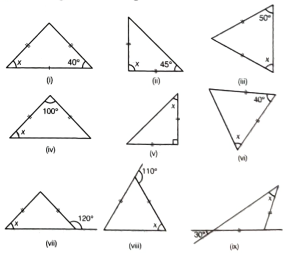
Find angle x in each figure.
Image
Complete the last column of the table.
S.no. Equation Value Say, whether the equation is satisfied. (yes/no)
$(i)$ $x + 3 = 0$ $x = 3$  
$(ii)$ $x + 3 = 0$ $x = 0$  
$(iii)$ $x + 3 = 0$ $x = -3$  
$(iv)$ $x - 7 = 1$ $x = 7$  
$(v)$ $x - 7 = 1$ $x = 8$  
$(vi)$ $5x = 25$ $x = 0$  
$(vii)$ $5x = 25$ $x = 5$  
$(viii)$ $5x = 25$ $x = -5$  
$(ix)$ $\frac{m}{3}=2$ $m = -6$  
$(x)$ $\frac{m}{3}=2$ $m = 0$  
$(xi)$ $\frac{m}{3}=2$ $m = 6$  
Find the reciprocal of the rational number $\Big(\frac{1}{2}\Big)^{2}\div\Big(\frac{2}{3}\Big)^{3}$
The students of class $VII$ have to choose one club from Music, Dance, Yoga, Dramatics, Fine arts and Electronics clubs. The data given below shows the choices made by girls and boys of the class. Study the table and answer the questions that follow:
Clubs
Music
Dance
Yoga
Dramatics
Fine Arts
Electronics
Girls
$15$
$24$
$10$
$19$
$27$
$21$
Boys
$12$
$16$
$8$
$17$
$11$
$30$
$a.$ Draw a double bar graph using appropriate scale to depict the above data.
$b.$ How many students are there in Class $VII?$
$c.$ Which is the most preferred club by boys?
$d.$ Which is the least preferred club by girls?
$e.$ For which club the difference between boys and girls is the least?
$f.$ For which club is the difference between boys and girls the maximum?
Select those rational numbers which can be written as a rational number with numerator 6: $\frac{1}{22}, \frac{2}{3}, \frac{3}{4}, \frac{4}{-5}, \frac{5}{6}, \frac{-6}{7}, \frac{-7}{8}$
Gold prices on $4$ consecutive Tuesdays were as under:
Week First Second Third Fourth
Rate per 10gm (in Rs.) $8500$ $8750$ $9050$ $9250$
Draw a bar graph to show this imformation.
Consider this data collected from a survey of a colony.
Favourite
Sport
CricketBasket BallSwimmingHockeyAthletics
Watching1240470510430250
Participating620320320250105

Choose an appropriate scale and draw a double bar graph. Write down your observations.
Divide the sum of $\frac{-13}{5}$ and $\frac{12}{7}$ by the product of $\frac{-31}{7}$ and $\frac{1}{2}.$