Questions

[5 Mark Question Answer]

🎯

Test yourself on this topic

4 questions · timed · auto-graded

Question 15 Marks
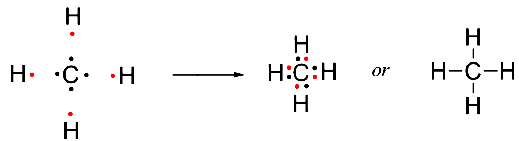
Explain the bonding in methane molecule using electron dot structure.
Answer
Formation of methane molecule – Non-polar covalent compound:
Atom Electronic configuration Nearest noble gas To attain stable electronic the configuration of nearest noble gas
Carbon ${ }_6^{12} C [2,4]$ Neon $[2,8]$ Carbon needs four electrons to complete the octet
Hydrogen ${ }_1^1 H [1]$ Helium [2] Hydrogen needs one electron to complete the duplet
One atom of carbon shares four electron pairs, one with each of the four atoms of hydrogen.
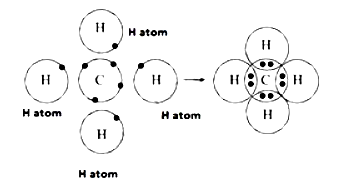
 
Before combination $(4[ H ]$ and 1 $[ C ]$ atom) After combination $( CH 4$ - Methane molecule)
View full question & answer
Question 25 Marks
Potassium (Atomic No. $19$) and chlorine (Atomic No. $17$) react to form a compound. On the basis of electronic concept, explain
(i) oxidation
(ii) reduction
(iii)oxidising agent
(iv)reducing agent
Answer
$2K + Cl_2 \rightarrow 2KCl$​​​​​​​
1.Oxidation: In the electronic concept, oxidation is a process in which an atom or ion loses electron(s).
$K \rightarrow K^++ e^-$​​​​​​​​​​​​​​
2.Reduction: In the electronic concept, the reduction is a process in which an atom or ion accepts electron(s).
$Cl_2 + 2e^-→ 2Cl^-$​​​​​​​​​​​​​​
iii. Oxidising agent
An oxidising agent oxidises other substances either by accepting electrons or by providing oxygen or an electronegative ion, or by removing hydrogen or an electropositive ion.
$Cl_2 + 2e^ \rightarrow 2Cl^-$​​​​​​​​​​​​​​
iv.Reducing agent
A reducing agent reduces other substances either by providing electrons or by providing hydrogen or an electropositive ion, or by removing oxygen or an electronegative ion.
$K \rightarrow K^++ e^-$​​​​​​​
View full question & answer
Question 35 Marks
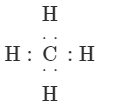
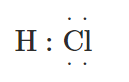
Draw the electron dot structure of covalent compound methane (non polar) and HCL (polar) and give two difference between them.
Answer
Methane (non polar) HCL (polar)
Covalent compounds are non polar when shared pairs of electron(s) are equally distributed between the two atoms. Covalent compounds are said to be polar when the shared pair of electrons are not at equal distance between the two atoms.
No charge separation takes place. The covalent molecule is symmetrical and electrically neutral. Charge separation takes place. The atom which attracts electrons more strongly develops a slight negative charge while the other creates a little positive charge.
Image Image
View full question & answer
Question 45 Marks
Taking $MgCI_2$ as an electrovalent compound, $CCI_4$ as a covalent compound, give four differences between electrovalent and covalent compounds.
Answer
Electrovalent Compounds Covalent compounds
They are made up of ions; $Mg^{2+}$ and $Cl^-$ They are made up of molecules; $1$carbon and $4$ chlorine atoms form a molecule of $CCl_4$.
They are made up of ions;$ Mg^{2+}$ and $Cl^-$​​​​​​​ They are generally gases or liquids under ordinary conditions; $CCl_4$​​​​​​​ is a liquid.
They have high m.p. and b.p. Their m.p. and b.p. are low.
They are easily soluble in water but insoluble in organic solvents, such as benzene, chloroform, etc. They are insoluble in water but are usually soluble in organic solvents, such as benzene, chloroform, etc.
View full question & answer
[5 Mark Question Answer] - Chemistry STD 10 Questions - Vidyadip