Question
Teaching Mathematics through activities is a powerful approach that enhances students' understanding and engagement. Keeping this in mind, Ms. Mukta planned a prime number game for class 5 students. She announces the number 2 in her class and asked the first student to multiply it by a prime number and then pass it to second student. Second student also multiplied it by a prime number and passed it to third student. In this way by multiplying to a prime number, the last student got 173250.
Now. Mukta asked some questions as given below to the students:
(i) What is the least prime number used by students?
(ii) (a) How many students are in the class ?
OR
(b) What is the highest prime number used by students?
(iii) Which prime number has been used maximum times?
Answer


$
173250=2 \times 5^3 \times 3^2 \times 7 \times 11
$
(i) 3
(ii) (a) $173250=2 \times 5^3 \times 3^2 \times 7 \times 11$
Number of students in the class $=3+2+1+1=7$
OR
(ii) (b) $173250=2 \times 5^3 \times 3^2 \times 7 \times 11$
Highest prime number used by students $=11$
(iii) 5

Need a full question paper?

Generate a complete, print-ready paper with questions like this in minutes — across 16+ boards, with answer keys.

Start Generating Free

Similar questions

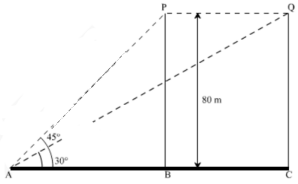
Read the following text carefully and answer the questions that follow: A bird is sitting on the top of a tree, which is $80\ m$ high. The angle of elevation of the bird, from a point on the ground is $45^{\circ}$. The bird flies away from the point of observation horizontally and remains at a constant height. After $2$ seconds, the angle of elevation of the bird from the point of observation becomes $30^{\circ}$. Find the speed of flying of the bird.
Image
$i.$ Find the distance between observer and the bottom of the tree?
$ii$. Find the speed of the bird?
$iii$. Find the distance between second position of bird and observer?
OR
Find the distance between initial position of bird and observer?
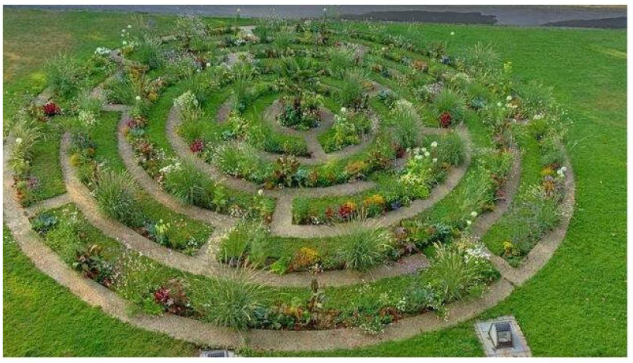
A school has decided to plant some endangered trees on $51^{\text {st }}$ World Environment Day in the nearest park. They have decided to plant those trees in few concentric circular rows such that each succeeding row has $20$ more trees than the previous one. The first circular row has $50$ trees.
Image
Based on the above given information, answer the following questions:
$(i)$ How many trees will be planted in the $10^{\text {th }}$ row?
$(ii)$ How many more trees will be planted in the $8^{\text {th }}$ row than in the $5^{\text {th }}$ row ?
$(iii)\  (a)$ If $3200$ trees are to be planted in the park, then how many rows are required ?
OR
$(b)$ If $3200$ trees are to be planted in the park, then how many trees are still left to be planted after the $11^{\text {th }}$ row ?
Read the text carefully and answer the questions:
Deepa has to buy a scooty.
She can buy scooty either making cashdown payment of $₹ 25,000$ or by making $15$ monthly instalments as below.
Ist month $- ₹ 3425, II^{nd}$ month $- ₹ 3225, III^{rd}$ month $- ₹ 3025, IV^{th}$ month $ - ₹ 2825$ and so on

Image

$(a)$ Find the amount of $6^{th}$ instalment.
$(b)$ Total amount paid in $15$ instalments.
OR
If Deepa pays $₹ 2625$ then find the number of instalment.
$(c)$ Deepa paid $10^{th}$ and $11^{th}$ instalment together find the amount paid that month.
Read the following text carefully and answer the questions that follow:
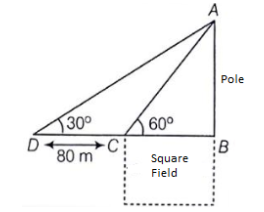
Basant Kumar is a farmer in a remote village of Rajasthan. He has a small square farm land. He wants to do fencing of the land so that stray animals may not enter his farmland. For this, he wants to get the perimeter of the land. There is a pole at one corner of this field. He wants to hang an effigy on the top of it to keep birds away. He standing in one corner of his square field and observes that the angle subtended by the pole in the corner just diagonally opposite to this corner is $60^{\circ}$. When he retires 80 m from the corner, along the same straight line, he finds the angle to be $30^{\circ}$.
Image
$i$. Find the height of the pole too so that he can arrange a ladder accordingly to put an effigy on the pole. 
$ii$. Find the length of his square field so that he can buy material to do the fencing work accordingly. 
$iii$. Find the Distance from Farmer at position $C$ and top of the pole? 
OR
Find the Distance from Farmer at position $D$ and top of the pole?
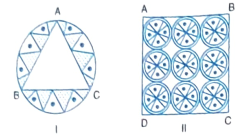
Pookalam is the flower bed or flower pattern designed during Onam in Kerala. It is similar as Rangoli in North India and Kolam in Tamil Nadu. During the festival of Onam, your school is planning to conduct a Pookalam competition. Your friend whose partner in competition, suggests two design given below:
Design I: This design is made with a circle of radius 32 cm having equilateral triangle $A B C$ in the middle as shown in Fig. 12.11.
Design II: This Pookalam is made with 9 circular designs each of radius 7 cm .
Image
(i) In design-1, the side of equilateral triangle is
(a) $12 \sqrt{3} cm$ $\qquad$ (b) $32 \sqrt{3} cm$ $\qquad$ (c) 48 cm $\qquad$ (d) 64 cm
(ii) In devign-1, the altitude of the equilaleral triangle is
(a) 8 cm $\qquad$ (b) 12 cm $\qquad$ (c) 48 cm $\qquad$ (d) 52 cm
(iii) In design-II, the area of square $A B C D$ is
(a) $1264 cm^2$ $\qquad$ (b) $1764 cm^2$ $\qquad$ (c) $1830 cm^2$ $\qquad$ (d) $1944 cm^2$
(iv) In desgn-II, the area of cach circular region is
(a) $124 cm^2$ $\qquad$ (b) $132 cm^2$ $\qquad$ (c) $144 cm^2$ $\qquad$ (d) $154 cm^2$
Read the text carefully and answer the questions:
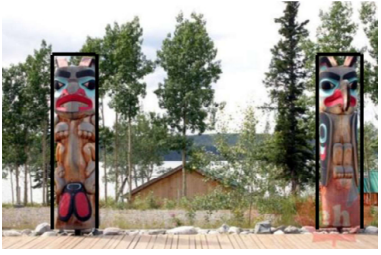
Totem poles are made from large trees. These poles are carved with symbols or figures and mostly found in western Canada and northwestern United States.
In the given picture, two such poles of equal heights are standing $28 m$ apart. From a point somewhere between them in the same line, the angles of elevation of the top of the two poles are $60^{\circ}$ and $30^{\circ}$ respectively.

Image

$(a)$ Draw a neat labelled diagram.
$(b)$ Find the height of the poles.
OR
Find the location of the point of observation.
$(c)$ If the distances of the top of the poles from the point of observation are taken as $p$ and $q,$ then find a relation between $p$ and $q$ .
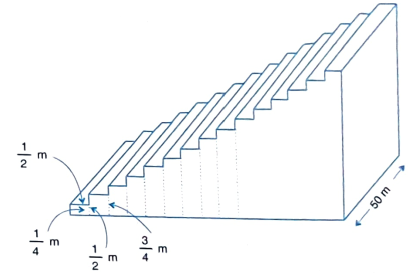
A small terrace at a football ground comprises of 15 steps each of which is 50 m long and built of solid concrete. Each step rises of $\frac{1}{4} m$ and a tread of $\frac{1}{2} m$ (see Fig. 5.8). Let $V_1, V_2, V_3, \ldots, V_{15}$ denote respectively the volumes of concrete required to build the first, second, third, ... fifteenth step. Based on the above information answer the following questions:
Image
(i) Heights of first, second, third, $\ldots, 15^{\text {th }}$ steps form an A.P. with common difference
(a) $\frac{1}{4} m$ $\qquad$ $\qquad$ (b) $\frac{1}{2} m$ $\qquad$ (c) $\frac{3}{4} m$ $\qquad$ (d) $-\frac{1}{4} m$.
(ii) The value of $V_2$ is
(a) $25 m^3$ $\qquad$ (b) $50 m^3$ $\qquad$ c) $12.5 m^3$ $\qquad$ (d) $6.25 m^3$
(iii) The volume of concrete used in the middle step is
(a) $25 m^3$ $\qquad$ (b) $50 m^3$ $\qquad$ c) $75 m^3$ $\qquad$ (d) $6.25 m^3$
(iv) The sum of the surface areas of 15 treads is
(a) $350 m^2$ $\qquad$ (b) $400 m^2$ $\qquad$ (c) $375 m^2$ $\qquad$ (d) $475 m^2$