MCQ
Temperature above which a ferromagnetic substance becomes paramagnetic is called
  • A
    Critical temperature
  • B
    Boyle's temperature
  • C
    Debye's temperature
  • Curie temperature

Answer

Correct option: D.
Curie temperature
 Curie temperature

Need a full question paper?

Generate a complete, print-ready paper with questions like this in minutes — across 16+ boards, with answer keys.
Start Generating Free

Similar questions

When white light enters a prism, it gets split into its constituent colours. This is due to
Two identical thin bar magnets each of length $l $ and pole strength $m$  are placed at right angle to each other with north pole of one touching south pole of the other. Magnetic moment of the system is
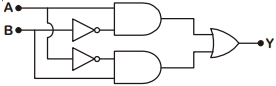
In the combination of the following gates the output $Y$ can be written in terms of inputs $A$ and $B$ as
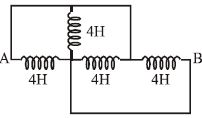
The equivalent inductance between $\mathrm{A}$ and $\mathrm{B}$ is.....$H$
Two strings A and B, made of same material, are stretched by same tension. The radius of string A is double of the radius of B. A transverse wave travels on A with speed $\nu_\text{A}$ and on B with speed $\nu_\text{B}.$ The ratio $\frac{\nu_\text{A}}{\nu_\text{B}}$ is:
Consider an electromagnetic wave propagating in vacuum . Choose the correct statement
Two capacitors of capacitance $2C$ and $C$ are joined in parallel and charged to potential $V$. The battery is now removed and the capacitor $C$ is filled with a medium of dielectric constant $K$. The potential difference across each capacitor will be
Ray optics is valid, when characteristic dimensions are
The current voltage relation of a diode is given by $I=(e^{1000V/T} -1)mA$ where the applied voltage $V$ is in volts and the temperature $T$ is in degree kelvin. If a student makes an error measuring $±0.01\ V$ while measuring the current of $5\ mA$ at $300\ K$, what will be the error in the value of current in $mA?$
A particle of mass $\mathrm{m}$ and charge $\mathrm{q}$ is released from rest in a uniform electric field. If there is no other force on the particle, the dependence of its speed $v$ on the distance $x$ travelled by it is correctly given by (graphs are schematic and not drawn to scale)