MCQ
Consider an electromagnetic wave propagating in vacuum . Choose the correct statement
  • A
    For an electromagnetic wave propagating in $+y$ direction the electric field is $\vec E = \frac{1}{{\sqrt 2 }}\,{E_{yz}}\,\left( {x,t} \right)\,\hat z$ and the magnetic field is $\vec B = \frac{1}{{\sqrt 2 }}\,{B_z}\,\left( {x,t} \right)\hat y$ 
  • B
    For an electromagnetic wave propagating in $+y$ direction the electric field is $\vec E = \frac{1}{{\sqrt 2 }}\,{E_{yz}}\,\left( {x,t} \right)\,\hat y$ and the magnetic field is $\vec B = \frac{1}{{\sqrt 2 }}\,B_{yz}\,\left( {x,t} \right)\hat z$
  • C
    For an electromagnetic wave propagating in $+x$ direction the electric field is $\vec E = \frac{1}{{\sqrt 2 }}\,{E_{yz}}\,\left( {y,z,t} \right)\,\left( {\hat y + \hat z} \right)$ and the magnetic field is $\vec B = \frac{1}{{\sqrt 2 }}\,B_{yz}\,\left( {y,z,t} \right)\,\left( {\hat y + \hat z} \right)$
  • For an electromagnetic wave propagating in $+x$ direction the electric field is $\vec E = \frac{1}{{\sqrt 2 }}\,{E_{yz}}\,\left( {x,t} \right)\,\left( {\hat y - \hat z} \right)$ and the magnetic field is $\vec B = \frac{1}{{\sqrt 2 }}\,B_{yz}\,\left( {x,t} \right)\,\left( {\hat y + \hat z} \right)$
Answer

Correct option: D.
For an electromagnetic wave propagating in $+x$ direction the electric field is $\vec E = \frac{1}{{\sqrt 2 }}\,{E_{yz}}\,\left( {x,t} \right)\,\left( {\hat y - \hat z} \right)$ and the magnetic field is $\vec B = \frac{1}{{\sqrt 2 }}\,B_{yz}\,\left( {x,t} \right)\,\left( {\hat y + \hat z} \right)$
d
Wave in $X-$ direction means $E$ and $B$ should be function of $x$ and $t$

$\overset\frown{y}-\overset\frown{z}\,\bot \,\overset\frown{y}+\overset\frown{z}\,$

Need a full question paper?

Generate a complete, print-ready paper with questions like this in minutes — across 16+ boards, with answer keys.

Start Generating Free

Similar questions

Given below are two statements: one is labelled as Assertion $A$ and the other is labelled as Reason $R$.

Assertion $A$: The potential ( $V$ ) at any axial point, at $2 \mathrm{~m}$ distance ( $r$ ) from the centre of the dipole of dipole moment vector $\vec{P}$ of magnitude, $4 \times 10^{-6} \mathrm{C} \mathrm{m}$, is $\pm 9 \times 10^3 \mathrm{~V}$.

(Take $\frac{1}{4 \pi \in_0}=9 \times 10^9 \mathrm{Sl}$ units)

Reason $R$: $V= \pm \frac{2 P}{4 \pi \in_0 r^2}$, where $r$ is the distance of any axial point, situated at $2 \mathrm{~m}$ from the centre of the dipole.

In the light of the above statements, choose the correct answer from the options given below:

A long straight wire in the horizontal plane carries a current of $50\, A$ in north to south direction. Give the magnitude and direction of $B$ at a point $2.5\,m$ east of the wire
The cut-in voltage for silicon diode is approximately
A parallel plate capacitor is charged to a potential difference of $50\, V$. It is discharged through a resistance. After $1$ second, the potential difference between plates becomes $40 \,V$. Then
When a ferromagnetic material goes through a hysteresis loop, the magnetic susceptibility:
Some radioactive nucleus may emit
Two point charges +9e and +e are at 16 cm away from each other. Where should another charge q be placed between them so that the system remains in equilibrium
Assertion : There exists two angles of incidence for the same magnitude of deviation (except minimum deviation) by a prism kept in air.

Reason : In a prism kept in air, a ray is incident on first surface and emerges out of second surface. Now if another ray is incident on second surface (of prism) along the previous emergent ray, then this ray emerges out of first surface along the previous incident ray. This particle is called principle of reversibility of light.

Energy released in the fission of a single $_{92}{U^{235}}$ nucleus is $200\, MeV$. The fission rate of a $_{92}{U^{235}}$ fuelled reactor operating at a power level of $5\,W$ is
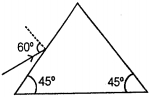
In the diagram the ray passing through prism is parallel to the base. Refractive index of material of prism is