Temperature of a black body increases from ${327^o}C\,{\rm{to}}\,{\rm{92}}{{\rm{7}}^{\rm{o}}}C$, the initial energy possessed is $ 2KJ$ , what is its final energy ..... $KJ$
Medium
Download our app for free and get started
(a) $\frac{{{Q_2}}}{{{Q_1}}} = {\left( {\frac{{{T_2}}}{{{T_1}}}} \right)^4} = {\left( {\frac{{273 + 927}}{{273 + 327}}} \right)^4} = {\left( {\frac{{1200}}{{600}}} \right)^4} = 16$
==> $Q2$ $ = 32\;KJ$

Download our appand get started for free
Experience the future of education. Simply download our apps or reach out to us for more information. Let's shape the future of learning together!No signup needed.*
Similar Questions
- 1Two materials having coefficients of thermal conductivity $3K$ and $K$ and thickness $d$ and $3d$, respectively, are joined to form a slab as shown in the figure. The temperatures of the outer surfaces are $\theta_2$ and $\theta_1$ respectively $\left( {\theta _2} > {\theta _1} \right)$ . The temperature at the interface isView Solution

- 2A body takes $4\, {min}$. to cool from $61^{\circ} {C}$ to $59^{\circ} {C}$. If the temperature of the surroundings is $30^{\circ} {C}$, the time taken by the body to cool from $51^{\circ} {C}$ to $49^{\circ} {C}$ is $....\,min$View Solution
- 3Two rods $A$ and $B$ of different materials are welded together as shown in figure.Their thermal conductivities are $K_1$ and $K_2$ The thermal conductivity of the composite rod will beView Solution

- 4View SolutionThe layers of atmosphere are heated through
- 5Two thin metallic spherical shells of radii ${r}_{1}$ and ${r}_{2}$ $\left({r}_{1}<{r}_{2}\right)$ are placed with their centres coinciding. A material of thermal conductivity ${K}$ is filled in the space between the shells. The inner shell is maintained at temperature $\theta_{1}$ and the outer shell at temperature $\theta_{2}\left(\theta_{1}<\theta_{2}\right)$. The rate at which heat flows radially through the material is :-View Solution
- 6Assuming the Sun to be a spherical body of radius $R$ at a temperature of $T\ K$, evaluate the total radiant powerd incident of Earth at a distance $r$ from the SunView Solution
Where $r_{0}$ is the radius of the earth and $\sigma$ is Stefan's constant.
- 7If the radius of a star is $R$ and it acts as a black body, what would be the temperature of the star, in which the rate of energy production is $Q$?View Solution
($\sigma$ stands for Stefan's constant)
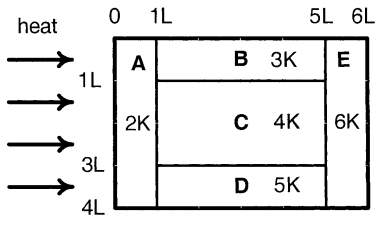
- 8A composite block is made of slabs $A, B, C, D$ and $E$ of different thermal conductivities (given in terms of a constant $K$ ) and sizes (given in terms of length, $L$ ) as shown in the figure. All slabs are of same width. Heat $'Q'$ flows only from left to right through the blocks. Then in steady state $Image$View Solution
$(A)$ heat flow through $A$ and $E$ slabs are same.
$(B)$ heat flow through slab $E$ is maximum.
$(C)$ temperature difference across slab $E$ is smallest.
$(D)$ heat flow through $C =$ heat flow through $B +$ heat flow through $D$.
- 9Surface of the lake is at $2^{\circ} C$. The temperature of the bottom of the lake is ....... $^{\circ} C$View Solution
- 10A solid cylinder of length $L$ and radius $r$ is heat upto same temperature as that of a cube of edge length $a$. If both have same material, volume and allowed to cool under similar conditions, then ratio of amount of radiations radiated will be (Neglect radiation emitted from flat surfaces of the cylinder)View Solution