MCQ
The layers of atmosphere are heated through
  • Convection
  • B
    Conduction
  • C
    Radiation
  • D
    $(b)$ and $(c)$ both

Answer

Correct option: A.
Convection
a
(a)

Need a full question paper?

Generate a complete, print-ready paper with questions like this in minutes — across 16+ boards, with answer keys.
Start Generating Free

Similar questions

The ionisation potential of hydrogen atom is $13.6\, volt$. The energy required to remove an electron in the $n = 2$ state of the hydrogen atom is.....$eV$
The half life $(T)$ and the disintegration constant $(\lambda )$ of a radioactive substance are related as
An $X$-ray tube has a short wavelength end at $0.45 \mathring A$. The voltage of tube is ........ $V$
In a Fresnel’s diffraction arrangement, the screen is at a distance of $2$ meter from a circular aperture. It is found that for light of wavelengths ${\lambda _1}$ and ${\lambda _2},$ the radius of $4^{th}$ zone for ${\lambda _1}$ coincides with the radius of $5^{th}$ zone for ${\lambda _2}.$ Then the ratio ${\lambda _1}:{\lambda _2}$ is
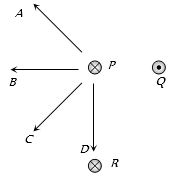
In figure shows three long straight wires $P, Q$ and $R$ carrying currents normal to the plane of the paper. All three currents have the same magnitude. Which arrow best shows the direction of the resultant force on the wire $P$
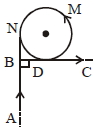
A very long wire $ABDMNDC$ is shown in figure carrying current $I. AB$ and $BC$ parts are straight, long and at right angle. At $D$ wire forms a circular turn $DMND$ of radius $R. AB.$ $\mathrm{BC}$ parts are tangential to circular turn at $\mathrm{N}$ and $D$. Magnetic field at the centre of circle is
An electric charge ${10^{ - 3}}\,\mu \,C$ is placed at the origin $(0, 0)$ of $X -Y$ co-ordinate system. Two points $A$ and $B$ are situated at $\left( {\sqrt {2\,} \,,\,\,\sqrt 2 } \right)$  and $(2, 0)$ respectively. The potential difference between the points $A$ and $B$ will be......$volt$
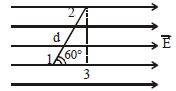
The electric field $\vec E$ between two points is constant in both magnitude and direction. Consider a path of length d at an angle $\theta = 60^o$ with respect to field lines shown in figure. The potential difference between points $1$ and $2$ is
A point mass of $1 \mathrm{~kg}$ collides elastically with a stationary point mass of $5 \mathrm{~kg}$. After their collision, the $1 \mathrm{~kg}$ mass reverses its direction and moves with a speed of $2 \mathrm{~ms}^{-1}$. Which of the following statement(s) is (are) correct for the system of these two masses?

$(A)$ Total momentum of the system is $3 \mathrm{~kg} \mathrm{~ms}^{-1}$

$(B)$ Momentum of $5 \mathrm{~kg}$ mass after collision is $4 \mathrm{~kg} \mathrm{~ms}^{-1}$

$(C)$ Kinetic energy of the centre of mass is $0.75 \mathrm{~J}$

$(D)$ Total kinetic energy of the system is $4 \mathrm{~J}$

Air is filled in a motor tube at ${27^o}C$ and at a pressure of $8$ atmospheres. The tube suddenly bursts, then temperature of air is $[{\rm{Given}}\,\,\gamma \,{\rm{of}}\,{\rm{air}} = \,1.5]$