Question
$\text{Let}\ \vec{\text{a}}=4\hat{\text{i}}+5\hat{\text{j}}-\hat{\text{k}},\vec{\text{b}}=\hat{\text{i}}-4\hat{\text{j}}+5\hat{\text{k}}$ and $\vec{\text{c}}=3\hat{\text{i}}+\hat{\text{j}}-\hat{\text{k}}$ Find a vector $\vec{\text{d}}$ which is perpendicular to both $\vec{\text{c}}\ \text{and }\vec{\text{b}}\ \text{and}\ \vec{\text{d}}\cdot\vec{\text{a}}=21.$
Answer

$\vec{\text{a}}=4\hat{\text{i}}+5\hat{\text{j}}-\hat{\text{k}}$
$\vec{\text{b}}=\hat{\text{i}}-4\hat{\text{j}}+5\hat{\text{k}}$
$\vec{\text{c}}=3\hat{\text{i}}+\hat{\text{j}}-\hat{\text{k}}$
To find vector $\vec{\text{d}}$ such that
$\vec{\text{d}}\cdot\vec{\text{c}}=0$
$\vec{\text{d}}\cdot\vec{\text{b}}=0$
$\vec{\text{d}}\cdot\vec{\text{a}}=21$
$\text{Let}\ \vec{\text{d}}=\text{x}\hat{\text{i}}+\text{y}\hat{\text{j}}+\text{z}\hat{\text{k}}$
$\Big(\text{x}\hat{\text{i}}+\text{y}\hat{\text{j}}+\text{z}\hat{\text{k}}\Big)\cdot\Big(3\hat{\text{i}}+\hat{\text{j}}-\hat{\text{k}}\Big)=0$
$3\text{x}+\text{y}-\text{z}=0\ \ \ ....(1)$
$\Big(\text{x}\hat{\text{i}}+\text{y}\hat{\text{j}}+\text{z}\hat{\text{k}}\Big)\cdot\Big(\hat{\text{i}}-4\hat{\text{j}}+5\hat{\text{k}}\Big)=0$
$\text{x}-4\text{y}+5\text{z}=0\ \ \ ....(2)$
$\Big(\text{x}\hat{\text{i}}+\text{y}\hat{\text{j}}+\text{z}\hat{\text{k}}\Big)\cdot\Big(4\hat{\text{i}}+5\hat{\text{j}}-\hat{\text{k}}\Big)=21$
$4\text{x}+5\text{y}-\text{z}=21\ \ \ ....(3)$
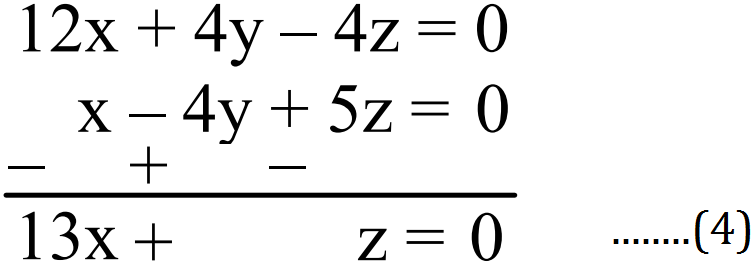
$\text{eq}^\text{n}(1)\times4+\text{eq}^\text{n}(2)$

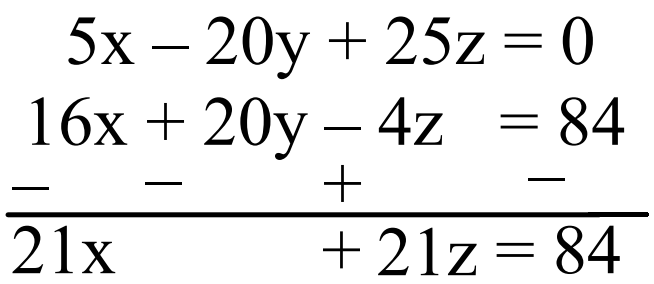
$\text{eq}^\text{n}(2)\times5+\text{eq}^\text{n}(3)\times4$

$21(\text{x}+\text{z})=84$
$\text{x}+\text{z}=4\ \ \ ....(5)$
$\text{eq}.(4)-(5)$
$12\text{x}=-4$
$\text{x}=\frac{-4}{12}=\frac{-1}{3}$
$\text{z}=4-\text{x}$
$\text{z}=4+\frac{1}{3}=\frac{13}{3}$
$\text{Put x}\ \&\ \text{z in }(1)$
$3\text{x}+\text{y}-\text{z}=0$
$3\times\Big(\frac{-1}{3}\Big)+\text{y}-\frac{13}{3}=0$
$\text{y}=\frac{13}{3}+1$
$\text{y}=\frac{16}{3}$
$\vec{\text{d}}=\text{x}\hat{\text{i}}+\text{y}\hat{\text{j}}+\text{z}\hat{\text{k}}$
$\vec{\text{d}}=\frac{-1}{3}\hat{\text{i}}+\frac{16}{3}\hat{\text{j}}+\frac{13}{3}\hat{\text{k}}$

Need a full question paper?

Generate a complete, print-ready paper with questions like this in minutes — across 16+ boards, with answer keys.

Start Generating Free

Similar questions

Find the equation of the plane passing through the point (2, 1, -1) and (-1, 3, 4) and perpendicular to the plane x - 2y + 4z = 10.
What will be the minimum cost?
If $xy^2 = 1$, prove that $2\frac{\text{dy}}{\text{dx}}+\text{y}^3=0$
If a white ball is selected, what is the probability that it came from:
  1. Bag 2
  2. Bag 3
Differentiate the following functions with respect to x:
$\text{x}^{\sin^{-1}\text{x}}$
A farmer mixes two brands P and Q of cattle feed. Brand P, costing Rs. 250 per bag, contains 3 units of nutritional element A, 2.5 units of element B and 2 units of element C. Brand Q costing Rs. 200 per bag contains 1.5 units of nutritional element A, 11.25 units of element B, and 3 units of element C. The minimum of nutrients A, B and C are 18 units, 45 units and 24 units respectively. Determine the number of bags of each brand which should be mixed in order to produce a mixture having a minimum cost per bag? What is the minimum cost of the mixture per bag?
Find the equation of the plane which contains the line of intersection of the planes $\vec{\text{r}}.\Big(\hat{\text{i}}+2\hat{\text{j}}+3\hat{\text{k}}\Big)-4=0,\ \vec{\text{r}}.\Big(2\hat{\text{i}}+\hat{\text{j}}-\hat{\text{k}}\Big)+5=0$ and which is perpendicular to the plane $\vec{\text{r}}.\Big(5\hat{\text{i}}+3\hat{\text{j}}-6\hat{\text{k}}\Big)+8=0.$
If $\text{a}(1-\cos\theta),\text{y}=\text{a}(\theta+\sin\theta),$ prove that, $\frac{\text{d}^2\text{y}}{\text{dx}^2}=-\frac{1}{\text{a}}$ at $\theta=\frac{\pi}{2}.$
If $\vec{\text{a}}$ and $\vec{\text{b}}$ are two non-collinear unit vectors such that $\big|\vec{\text{a}}+\vec{\text{b}}\big|=\sqrt{3},$ find $\big(2\vec{\text{a}}-5\vec{\text{b}}\big).\big(3\vec{\text{a}}+\vec{\text{b}}\big).$
m is said to be related to n if m and n are integers and m - n is divisible by 13. Does this define an equivalence relation?