MCQ
$\text{x} + 2\text{y}\leq8$
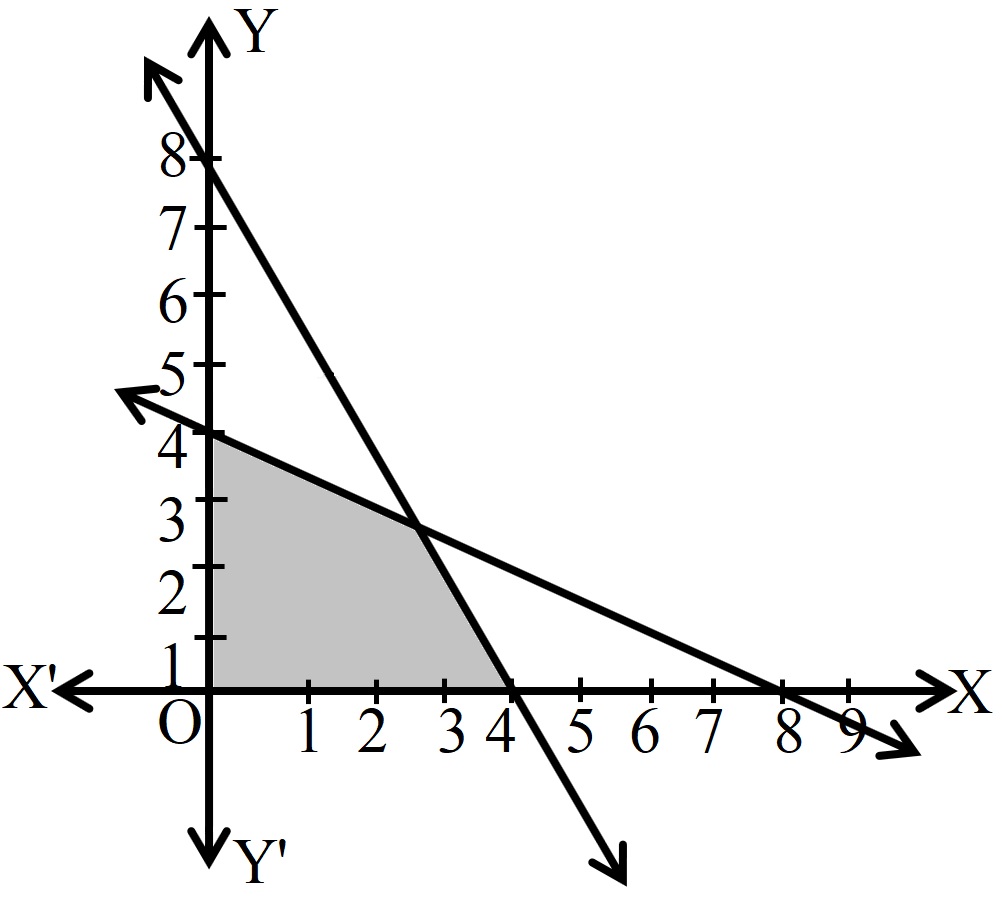
$\text{x}\geq0, \text{y}\geq0$
$\text{x}\leq0,\text{y}\leq0$
$ 2\text{x} + \text{y}\leq8$
$4\text{x}+5\text{y}\geq40$
  • A
    (i), (iii) and (v)
  • B
    (i), (iv) and (v)
  • C
    (i), (iii) and (iv)
  • (i), (ii) and (iv)

Answer

Correct option: D.
(i), (ii) and (iv)
  1. (i), (ii) and (iv)

Need a full question paper?

Generate a complete, print-ready paper with questions like this in minutes — across 16+ boards, with answer keys.

Start Generating Free

Similar questions

If $A, B, C, D$ are the angles of a cyclic quadrilateral, then $\cos \,A + \cos B + \cos \,\,C + \cos D = $
The sum of infinite terms of the geometric progression $\frac{{\sqrt 2 + 1}}{{\sqrt 2 - 1}},\frac{1}{{2 - \sqrt 2 }},\frac{1}{2}.....$ is
The length of the latus rectum and directrices of a hyperbola with eccentricity e are 9 and $\mathrm{x}= \pm \frac{4}{\sqrt{3}}$, respectively. Let the line $y-\sqrt{3} \mathrm{x}+\sqrt{3}=0$ touch this hyperbola at $\left(\mathrm{x}_0, \mathrm{y}_0\right)$. If $\mathrm{m}$ is the product of the focal distances of the point $\left(\mathrm{x}_0, \mathrm{y}_0\right)$, then $4 \mathrm{e}^2+\mathrm{m}$ is equal to ...........
$\mathop {{\rm{lim}}}\limits_{x \to 0} \frac{{{\rm{sin}}\left( {\pi {{\cos }^2}x} \right)}}{{{x^2}}} = $
For any two sets A and B, $\text{A}\cap\text{(A}\cup\text{B)}'$ is equal to:
  1. $\text{A}$
  2. $\text{B}$
  3. $\phi$
  4. $\text{A}\cap\text{B}.$
The value of $\left(\frac{1+\sin \frac{2 \pi}{9}+i \cos \frac{2 \pi}{9}}{1+\sin \frac{2 \pi}{9}-i \cos \frac{2 \pi}{9}}\right)^{3}$ is
The equation of the common tangent of the parabolas ${x^2} = 108y$ and ${y^2} = 32x$, is
The coefficients of the expansions are arranged in an array. This array is called ………
Choose the correct answer. Let a, b, c, d, e be the observations with mean m and standard deviation s. The standard deviation of the observations a + k, b + k, c + k, d + k, e + k is:
If the probability that a randomly chosen $6$-digit number formed by using digits $1$ and $8$ only is a multiple of $21$ is $p$, then $96\;p$ is equal to