Question
$\text{Zn}\text{(s)}+\text{Cu}^{2+}\text{(aq)}\xrightarrow{ \ \ \ \ \ \ \ \ }\text{Zn}^{2+}\text{(aq)}+\text{Cu}\text{(s)}$ Is this reaction redox reaction? If yes, name the oxidising agent as well as reducing agent.

Answer

Yes, $\text{Cu}^{2+}$ is oxidising agent, whereas Zn is reducing agent.

Need a full question paper?

Generate a complete, print-ready paper with questions like this in minutes — across 16+ boards, with answer keys.
Start Generating Free

Similar questions

Write the electronic configuration of following elements :
(i) ${ }_{29} Cu$(ii) ${ }_{42} Mo$(iii) ${ }_{46} Pd$
(iv) ${ }_{47} Ag$(v) ${ }_{78} Pt$(vi) ${ }_{79} Au$
  1. Name the most metallic element in second period and most non-metallic element.
  2. Name the element with (a) largest atomic radius, (b) smallest atomic radius in third period.
  3. Name the element having general electronic configuration $n s^2 n p^4$ in fourth period.
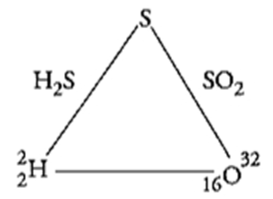
The element H and O combine separately with the third element S to form $H _2 S$ and $SO _2$ respectively, then show that they combine directly with each other to from $H _2 O$.
Image
Give the possible alkyl alcohols of molecular formula $C _4 H _{10}$.
How many gram of $\mathrm{Na}_2 \mathrm{CO}_3$ should be dissolved to make $100 \mathrm{~cm}^3$ of $0.15 \mathrm{M} \mathrm{~Na}_2 \mathrm{CO}_3$ solution?
What is the lowest value of n that allows g orbitals to exist?
Describe the theory associated with the radius of an atom as it.
loses an electron.
Represent a galvanic cell in electrode and ions containing Cu electrode dipped in molar solution of copper sulphate and silver electrode dipped in molar solution of silver nitrate.
$\Big[\text{Given E}^\circ_{\frac{\text{Cu}^{2+}}{\text{Cu(s)}}}=0.34\text{V, E}^\circ_{\frac{\text{Ag}^+}{\text{Ag(s)}}}=0.80\text{V}\Big]$
What is state of hybridization of the carbon atoms in $\text{CH}_3-\text{HC}=\text{CH}_2?$
  1. How do the electronic configurations of the elements with Z = 107 to 109 differ from one another?
  2. Rn (Z = 86) is the last noble gas discovered. Predict what will be the atomic number of the next noble gas to be discovered. Write its symbol.