The acceleration of a particle performing S.H.M. is at a distance of $3\; cm$ from the mean position is $ 12\,cm/sec^2 $. Its time period is ..... $\sec$
Easy


Download our appand get started for free
Experience the future of education. Simply download our apps or reach out to us for more information. Let's shape the future of learning together!No signup needed.*
Similar Questions
- 1A particle of mass $10\, gm$ moves in a field where potential energy per unit mas is given by expression $v = 8 \times 10^4\, x^2\, erg/gm$. If the total energy of the particle is $8 \times 10^7\, erg$ then the relation between $x$ and time $t$ isView Solution
- 2A lift is descending with acceleration $g/3$ . What will be the time period of a simple pendulum suspended from its ceiling if its time period in staionary life is $'T'$ ?View Solution
- 3When a body of mass $1.0\, kg$ is suspended from a certain light spring hanging vertically, its length increases by $5\, cm$. By suspending $2.0\, kg$ block to the spring and if the block is pulled through $10\, cm$ and released the maximum velocity in it in $m/s$ is : (Acceleration due to gravity $ = 10\,m/{s^2})$View Solution
- 4If $x = a\sin \left( {\omega t + \frac{\pi }{6}} \right)$ and $x' = a\cos \omega t$, then what is the phase difference between the two wavesView Solution
- 5View SolutionA tunnel has been dug through the centre of the earth and a ball is released in it. It will reach the other end of the tunnel after
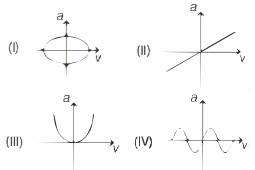
- 6If the speed $v$ of the bob in a simple pendulum is plotted against the tangential acceleration $a$, the correct graph will be represented byView Solution
- 7A vertical mass-spring system executes simple harmonic oscillations with a period of $2\,s$. A quantity of this system which exhibits simple harmonic variation with a period of $1\, s$ isView Solution
- 8Due to some force $F_1$ a body oscillates with period $4/5\, sec$ and due to other force $F_2$ oscillates with period $3/5\, sec$. If both forces act simultaneously, the new period will be .... $\sec$View Solution
- 9A force of $6.4\, N$ stretches a vertical spring by $0.1 \,m$. The mass that must be suspended from the spring so that it oscillates with a period of $\left( {\frac{\pi }{4}} \right)sec$. is ... $kg$View Solution
- 10A mass $m$ attached to a spring oscillates every $2\, sec$. If the mass is increased by $2 \,kg$, then time-period increases by $1\, sec$. The initial mass is ..... $kg$View Solution