Question
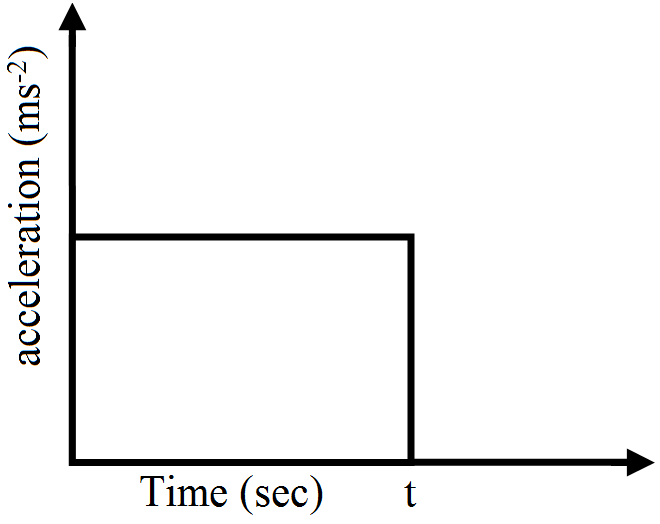
The acceleration-time graph for a body is shown in the figure below. Plot the corresponding velocity-time graph.
Answer

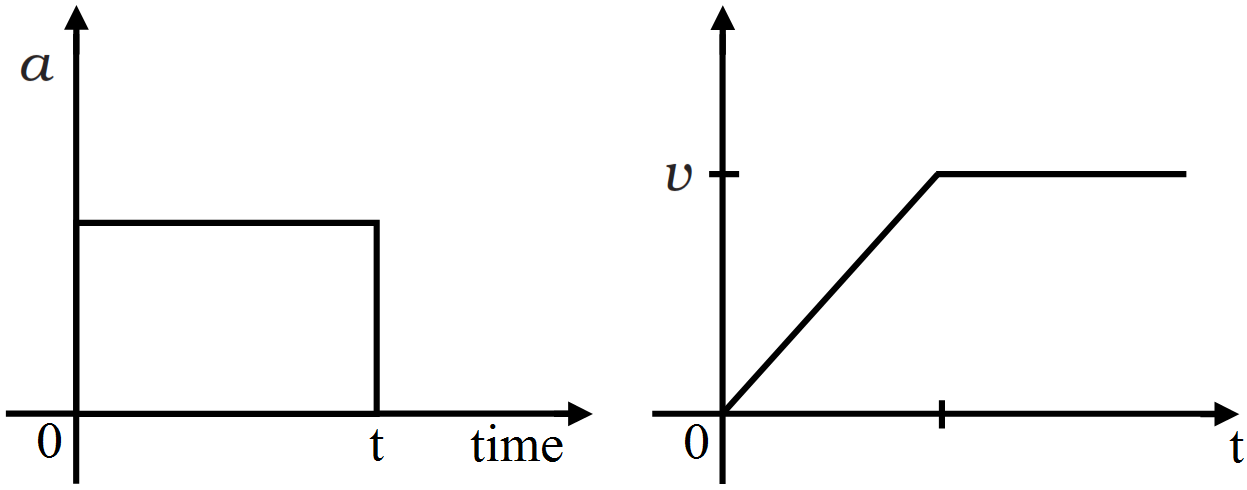
For time t, there is an acceleration a.
$\therefore$ Velocity increases after time 't' acceleration is zero.
Thus v-t graph will be shown as

Need a full question paper?

Generate a complete, print-ready paper with questions like this in minutes — across 16+ boards, with answer keys.

Start Generating Free

Similar questions

A barometer is constructed with its tube having radius 1.0mm. Assume that the surface of mercury in the tube is spherical in shape. If the atmospheric pressure is equal to 76cm of mercury, what will be the height raised in the barometer tube. The contact angle of mercury with glass = 135º and surface tension of mercury = 0.465N/m. Density of mercury = 13600kg/m3.
The earth revolves round the sun because the sun attracts the earth. The sun also attracts the moon and this force is 'about twice as large as the attraction of the earth on the moon. Why does the moon not revolve round the sun? Or does it?
If force F, length L and time T are taken as fundamental units then what will be the dimensions of mass?
A player throws a ball upwards with an initial speed of 29.4m s–1.
What is the direction of acceleration during the upward motion of the ball?
Compare an isothermal and an adiabatic process.
A steel ball initially at a pressure of 1.0 × 105Pa is heated from 20°C to 120°C keeping its volume constant. Find the pressure inside the ball. Coefficient of linear expansion of steel = 12 × 10-6 °C-1 and bulk modulus of steel = 1.6 × 10¹¹Nm-2.
A block of mass m moving at a speed v compresses a spring through a distance x before its speed is halved. Find the spring constant of the spring.
Find the temperature at which the root mean square velocity of oxygen molecules is equal to the root mean square velocity of hydrogen molecules at 200 K. (Molecular weight of oxygen $=32$, molecular weight of hydrogen $= 2$)
What will be the value of the coefficient and performance of $a$ Carnot refrigerant oprating between $40^{\circ} C$ and $0^{\circ} C$ ?
If the kinetic energy of a light and heavy body is equal, then whose momentum is less?