The adjoining diagram shows the spectral energy density distribution ${E_\lambda }$of a black body at two different temperatures. If the areas under the curves are in the ratio $16 : 1$ , the value of temperature $T$ is ........ $K$

Medium
Download our app for free and get started
(d) $\frac{{{A_T}}}{{{A_{2000}}}} = \frac{{16}}{1}$ (given)
Area under ${e_\lambda } - \lambda $ curve represents the emissive power of body and emissive power $ \propto {T^4}$
(Hence area under ${e_\lambda } - \lambda $ curve) $ \propto {T^4}$
Area under ${e_\lambda } - \lambda $ curve represents the emissive power of body and emissive power $ \propto {T^4}$
(Hence area under ${e_\lambda } - \lambda $ curve) $ \propto {T^4}$
==>$\frac{{AT}}{{{A_{2000}}}} = {\left( {\frac{T}{{2000}}} \right)^4}$
==> $\frac{{16}}{1} = {\left( {\frac{T}{{2000}}} \right)^4}$==> $T = 4000K.$

Download our appand get started for free
Experience the future of education. Simply download our apps or reach out to us for more information. Let's shape the future of learning together!No signup needed.*
Similar Questions
- 1Two bodies $A$and $B$ have thermal emissivities of $0.01$ and $0.81$ respectively. The outer surface areas of the two bodies are the same. The two bodies emit total radiant power at the same rate. The wavelength ${\lambda _B}$ corresponding to maximum spectral radiancy in the radiation from $B$ is shifted from the wavelength corresponding to maximum spectral radiancy in the radiation from $A$, by $1.00\mu m$. If the temperature of $A$ is $5802\;K$View Solution
- 2The total radiative power emitted by spherical black body with radius $R$ and temperature $T$ is $P$. If the radius is doubled and the temperature is halved, then the radiative power will beView Solution
- 3The energy emitted per second by a black body at ${27^o}C$ is $10\;J$. If the temperature of the black body is increased to ${327^o}C$, the energy emitted per second will be ......... $J$View Solution
- 4View SolutionDistribution of energy in the spectrum of a black body can be correctly represented by
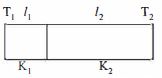
- 5One end of a thermally insulated rod is kept at a temperature $T_1$ and the other at $T_2$ . The rod is composed of two sections of length $l_1$ and $l_2$ and thermal conductivities $K_1$ and $K_2$ respectively. The temperature at the interface of the two section isView Solution
- 6View SolutionA thin paper cup filled with water does not catch fire when placed over a flame. This is because
- 7A cane is taken out from a refrigerator at $0°C$ . The atmospheric temperature is $25°C$ . If $t_1$ is the time taken to heat from $0°C$ to $5°C$ and $t_2$ is the time taken from $10°C$ to $15°C$, thenView Solution
- 8View SolutionIce formed over lakes has
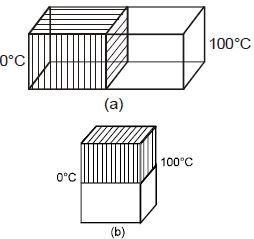
- 9Two identical square rods of metal are welded end to end as shown in figure $(a)$. Assume that $10\, cal$ of heat flows through the rods in $2\, min$. Now the rods are welded as shown in figure, $(b)$. The time it would take for $10$ cal to flow through the rods now, is ........ $\min$View Solution
- 10A solid copper cube of edges $1\;cm$ is suspended in an evacuated enclosure. Its temperature is found to fall from ${100^o}C$ to ${99^o}C$ in $100\;s$. Another solid copper cube of edges $2\;cm$, with similar surface nature, is suspended in a similar manner. The time required for this cube to cool from ${100^o}C$ to ${99^o}C$ will be approximately ...... $\sec$View Solution