Distribution of energy in the spectrum of a black body can be correctly represented by
Easy


Download our appand get started for free
Experience the future of education. Simply download our apps or reach out to us for more information. Let's shape the future of learning together!No signup needed.*
Similar Questions
- 1Energy is being emitted from the surface of a black body at ${127^o}C$ temperature at the rate of $1.0 \times {10^6}J/\sec - {m^2}$. Temperature of the black body at which the rate of energy emission is $16.0 \times {10^6}J/\sec - {m^2}$ will be......... $^oC$View Solution
- 2Assume that Solar constant is $1.4 \,kW / m ^2$, radius of sun is $7 \times 10^5 \,km$ and the distance of earth from centre of sun is $1.5 \times 10^{8} \,km$. Stefan's constant is $5.67 \times 10^{-6} \,Wm ^{-2} K ^{-4}$, find the approximate temperature of sun ....... $K$View Solution
- 3A slab consists of two parallel layers of two different materials of same thickness having thermal conductivities $K_1$ and $K_2$ . The equivalent conductivity of the combination isView Solution
- 4A black body at $200 K$ is found to exit maximum energy at a wavelength of $14\mu m$. When its temperature is raised to $1000K$ , the wavelength at which maximum energy is emitted isView Solution
- 5The only possibility of heat flow in a thermos flask is through its cork which is $75 cm^2$ in area and $5 cm$ thick. Its thermal conductivity is $0.0075 cal/cmsec^oC$. The outside temperature is$ 40^oC$ and latent heat of ice is $80 cal g^{-1}$. Time taken by $500 g$ of ice at $0^oC$ in the flask to melt into water at $0^oC$ is ....... $hr$View Solution

- 6Shown below are the black body radiation curves at temperatures $T1$ and $T2$ (T2>T1). Which of the following plots is correctView Solution
- 7In the Ingen Hauz’s experiment the wax melts up to lengths $10$ and $25 cm$ on two identical rods of different materials. The ratio of thermal conductivities of the two materials isView Solution
- 8If temperature of sun is decreased by $1 \%$ then the value of solar constant will change by ........... $\%$View Solution
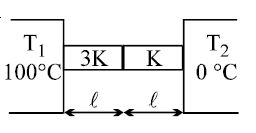
- 9Two rods $A$ and $B$ of same cross-sectional are $A$ and length $l$ connected in series between a source $(T_1 = 100^o C)$ and a sink $(T_2 = 0^o C)$ as shown in figure. The rod is laterally insulated If $G_A$ and $G_B$ are the temperature gradients across the rod $A$ and $B$, thenView Solution
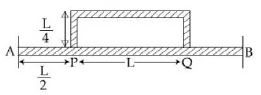
- 10Temperature difference of $120\,^oC$ is maintained between two ends of a uniform rod $AB$ of length $2L$. Another bent rod $PQ$, of same cross-section as $AB$ and length $\frac{{3L}}{2}$, is connected across $AB$ (See figure). In steady state, temperature difference between $P$ and $Q$ will be close to .......... $^oC$View Solution