MCQ
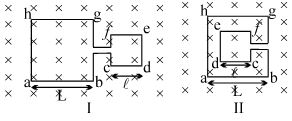
The adjoining figure shows two different arrangements in which two square wire frames are placed in a uniform constantly decreasing magnetic field $B.$ The direction of induced current in the case $I$ is
  • A
    from $a$ to $b$ and from $c$ to $d$
  • B
    from $a$ to $b$ and from $f$ to $e$
  • from $b$ to $a$ and from $d$ to $c$
  • D
    from $b$ to $a$ and from $e$ to $f$

Answer

Correct option: C.
from $b$ to $a$ and from $d$ to $c$
c
$Case\, I,$ $I=\frac{1}{R} \frac{d \phi}{d t}=\frac{\left(L^{2}+l^{2}\right)}{R} \frac{d B}{d t}$

since $\mathrm{B}$ is decreasing so$B_{\text {duce}} will \, be \otimes$ therefore option $C$ is correct.

Need a full question paper?

Generate a complete, print-ready paper with questions like this in minutes — across 16+ boards, with answer keys.

Start Generating Free

Similar questions

A circular disc $A$ of radius r is made from an iron plate of thickness $(t)$ and another circular disc $B$ of radius $4r$ is made from an iron plate of thickness $\frac{\text{t}}{4}.$ The relation between the moments of inertia $I_A$ and $I_B$ is:
Imagine that the electron in a hydrogen atom is replaced by a muon $(\mu) .$ The mass of muon particle is $207$ times that of an electron and charge is equal to the charge of an electron. The ionization potential of this hydrogen atom will be ............. $eV$
The depletion layer in silicon diode is $1 \ mm$ wide and the knee potential is $0.6 V,$ then the electric field in the depletion layer will be
An oscillator circuit consists of an inductance of 0.5mH and a capacitor of 20 μF. The resonant frequency of the circuit is nearly
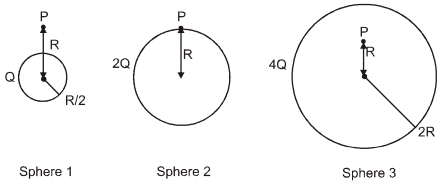
Charges $Q, 2Q$ and $4Q$ are uniformly distributed in three dielectric solid spheres $1,2$ and $3$ of radii $R/2, R$ and $2 R$ respectively, as shown in figure. If magnitudes of the electric fields at point $P$ at a distance $R$ from the centre of spheres $1,2$ and $3$ are $E_1 E_2$ and $E_3$ respectively, then
A hollow sphere of charge does not produce an electric field at any
What is the angle between the electric dipole moment and the electric field strength due to it on the equatorial line......$^o$
The material suitable for making electromagnets should have:
The magnitude of angular momentum, orbit radius and frequency of revolution of electron in hydrogen atom corresponding to quantum number $n$ are $L, r$ and $f$ respectively. Then according to Bohr's theory of hydrogen atom,
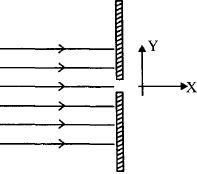
A parallel beam of electrons travelling in $x-$ direction falls on a slit of width $d$ (see figure) . If after passing the slit, an electron acquires momentum $P_y$ in the $y-$ direction then for a majority of electrons passing through the slit ( $h$ is Planck's constant)