MCQ
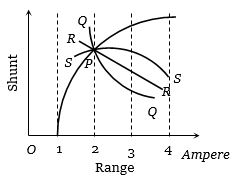
The ammeter has range $1\, ampere$ without shunt. the range can be varied by using different shunt resistances. The graph between shunt resistance and range will have the nature
  • A
    $P$
  • $Q$
  • C
    $R$
  • D
    $S$

Answer

Correct option: B.
$Q$
b
(b) To make range $n$ times, the galvanometer resistance should be $G /n$, where $G$ is initial resistance.
 

Need a full question paper?

Generate a complete, print-ready paper with questions like this in minutes — across 16+ boards, with answer keys.
Start Generating Free

Similar questions

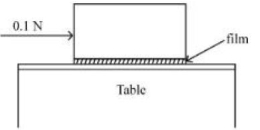
A metal block of base area $0.20\,m ^2$ is placed on a table, as shown in figure. A liquid film of thickness $0.25\,mm$ is inserted between the block and the table. The block is pushed by a horizontal force of $0.1\,N$ and moves with a constant speed. If the viscosity of the liquid is $5.0 \times 10^{-3} \;Pa-s$, the speed of block is $.........\times 10^{-3}\,m / s$
A parallel beam of monochromatic light of wavelength $600 \mathrm{~nm}$ passes through single slit of $0.4 \mathrm{~mm}$ width. Angular divergence corresponding to second order minima would be  . . . . . .$\times 10^{-3} \mathrm{rad}$.
A star which appears blue will be
Two vibrating tuning forks produce progressive waves given by $Y_1 = 4\, sin\, 500\pi t$ and $Y_2 = 2\, sin\, 506\, \pi t$ Number of beats produced per minute is 
If ${\lambda _v},\,{\lambda _x}$ and ${\lambda _m}$ represent the wavelength of visible light $X-$ rays and microwaves respectively, then
$Assertion :$ For a gas atom the number of degrees of freedom is $3$.
$Reason :$ $\frac{{{C_P}}}{{{C_V}}} = \gamma $
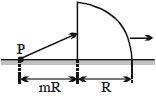
A quarter cylinder of radius $R$ and refractive index $1.5$ is placed on a table. $A$ point object $P$ is kept at a distance of $mR$ from it. Find the value of $m$ for which a ray from $P$ will emerge parallel to the table as shown in the figure.
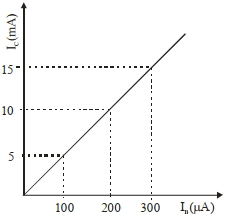
In an experiment of $CE$ configuration of $n-p-n$ transistor, the transfer characteristics are observed as given in figure. If the input resistance is $200 \Omega$ and output resistance is $60 \Omega$ the voltage gain in this experiment will be..........
The equation of motion of a particle is $x = a\,cos (\alpha\, t)$ . The motion is
The displacement $x$ of a particle along a straight line at time $t$ is given by $x = {a_0} + {a_1}t + {a_2}{t^2}$. The acceleration of the particle is