The equation of motion of a particle is $x = a\,cos (\alpha\, t)$ . The motion is
Medium


Download our appand get started for free
Experience the future of education. Simply download our apps or reach out to us for more information. Let's shape the future of learning together!No signup needed.*
Similar Questions
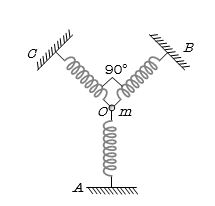
- 1A particle of mass $m$ is attached to three identical springs $A, B$ and $C$ each of force constant $ k$ a shown in figure. If the particle of mass $m$ is pushed slightly against the spring $A$ and released then the time period of oscillations isView Solution
- 2If the mass of the bob in a simple pendulum is increased to thrice its original mass and its length is made half its original length, then the new time period of oscillation is $\frac{x}{2}$ times its original time period. Then the value of $x$ is:View Solution
- 3A rod of mass $‘M’$ and length $‘2L’$ is suspended at its middle by a wire. It exhibits torsional oscillations; If two masses each of $‘m’$ are attached at distance $‘L/2’$ from its centre on both sides, it reduces the oscillation frequency by $20\%$. The value of ratio $m/M$ is close toView Solution
- 4If the length of a pendulum is made $9$ times and mass of the bob is made $4$ times then the value of time period becomesView Solution
- 5The displacement of an oscillator is given by $x = a\, \sin \, \omega t + b\, \cos \, \omega t$. where $a, b$ and $\omega$ are constant. Then :-View Solution
- 6The potential energy of a simple harmonic oscillator at mean position is $2\,joules$. If its mean $K.E.$ is $4\,joules$, its total energy will be .... $J$View Solution
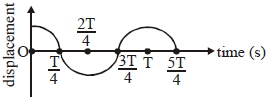
- 7The displacement time graph of a particle executing $S.H.M.$ is given in figure: (sketch is schematic and not to scale) Which of the following statements is are true for this motion?View Solution
$(A)$ The force is zero $t=\frac{3 T}{4}$
$(B)$ The acceleration is maximum at $t=T$
$(C)$ The speed is maximum at $t =\frac{ T }{4}$
$(D)$ The $P.E.$ is equal to $K.E.$ of the oscillation at $t=\frac{T}{2}$
- 8If the displacement equation of a particle be represented by $y = A\sin PT + B\cos PT$, the particle executesView Solution
- 9The angular frequency of motion whose equation is $4\frac{{{d^2}y}}{{d{t^2}}} + 9y = 0$ is ($y =$ displacement and $t =$ time)View Solution
- 10As per given figures, two springs of spring constants $K$ and $2\,K$ are connected to mass $m$. If the period of oscillation in figure $(a)$ is $3 s$, then the period of oscillation in figure $(b)$ will be $\sqrt{ x }$ s. The value of $x$ is$.........$View Solution