The amplitude of a particle executing $SHM$ is made three-fourth keeping its time period constant. Its total energy will be
Easy


Download our appand get started for free
Experience the future of education. Simply download our apps or reach out to us for more information. Let's shape the future of learning together!No signup needed.*
Similar Questions
- 1Values of the acceleration $A$ of a particle moving in simple harmonic motion as a function of its displacement $x$ are given in the table below. The period of the motion isView Solution
$A (mm \,\,s^{-2}$) $16$
$8$
$0$
$- 8$
$- 16$
$x\;(mm)$
$- 4$
$- 2$
$0$
$2$
$4$
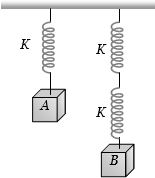
- 2The springs shown are identical. When $A = 4kg$, the elongation of spring is $1\, cm$. If $B = 6\,kg$, the elongation produced by it is ..... $ cm$View Solution
- 3The graphs in figure show that a quantity $y$ varies with displacement $d$ in a system undergoing simple harmonic motion. Which graphs best represents the relationship obtained when $y$ is The total energy of the systemView Solution

- 4The length of a simple pendulum is increased by $2\%$. Its time period willView Solution
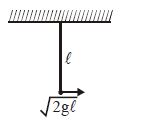
- 5A simple pendulum having length $\ell $ is having speed $\sqrt {2g\ell }$ at bottom most point of its trajectory. Its motion will beView Solution
- 6Two simple pendulums of length $1\, m$ and $4\, m$ respectively are both given small displacement in the same direction at the same instant. They will be again in phase after the shorter pendulum has completed number of oscillations equal toView Solution
- 7In $SHM,$ acceleration versus displacement (from mean position) graph :View Solution
- 8When the potential energy of a particle executing simple harmonic motion is one-fourth of its maximum value during the oscillation, the displacement of the particle from the equilibrium position in terms of its amplitude $a$ isView Solution
- 9A point object is kept in front of a plane mirror. The plane mirror is doing $SHM$ of amplitude $2\,cm$. The plane mirror moves along the $x-$ axis and $x-$ axis is normal to the mirror. The amplitude of the mirror is such that the object is always infront of the mirror. The amplitude of $SHM$ of the image is .... $cm$View Solution
- 10The general displacement of a simple harmonic oscillator is $x = A \sin \omega t$. Let $T$ be its time period. The slope of its potential energy (U) - time (t) curve will be maximum when $t=\frac{T}{\beta}$. The value of $\beta$ is $.........$View Solution