MCQ
The amplitude of simple harmonic motion starting from equilibrium position is 1.0 cm and period second instantaneous displacement (cm) will be
  • A
    $y=0.1 \sin \frac{2 \pi}{1.0} t$
  • $y=1.0 \sin \frac{2 \pi}{0.1} t$
  • C
    $y=1.0 \sin \frac{2 \pi}{1.0} t$
  • D
    $y=0.1 \sin 2 \pi \times 0.1 t$

Answer

Correct option: B.
$y=1.0 \sin \frac{2 \pi}{0.1} t$
(B)

Need a full question paper?

Generate a complete, print-ready paper with questions like this in minutes — across 16+ boards, with answer keys.

Start Generating Free

Similar questions

The position of a particle along $x$-axis at time $t$ is given by $x=2+t-3 t^2$. The displacement and the distance travelled in the interval $t=0$ to $t=1$ are respectively
A cracker rocket is ejecting gases at a rate of $0.05 \,kg / s$ with a velocity $400 \,m / s$. The accelerating force on the rocket is
The area of a square is $5.29\, cm^2$. The area of $7$ such squares taking into account the significant figures is  ........... $cm^2$
A ball is thrown up with a certain velocity at an angle $\theta$ to the horizontal. The kinetic energy $KE$ of the ball varies with horizontal displacement $x$ as
A vertical U-tube of uniform cross-section contains water in both the arms. A $10 \,cm$ glycerine column ($R.D$. $=1.2$ ) is added to one of the limbs. The level difference between the two free surfaces in the two limbs will be ...... $cm$
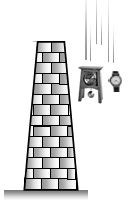
A man having a wrist watch and a pendulum clock rises on a $TV$ tower. The wrist watch and pendulum clock per chance fall from the top of the tower. Then
Which graph represents the difference between total energy and potential energy of a particle executing $SHM$ Vs it's distance from mean position?
A neutron makes a head-on elastic collision with a stationary deuteron. The fractional energy loss of the neutron in the collision is
A block of mass $1\,\, kg$ is hanging vertically from a string of length $1\,\, m$ and mass /length $= 0.001\,\, Kg/m$. A small pulse is generated at its lower end. The pulse reaches the top end in approximately .... $\sec$
In which of the following cases forces may not be required to keep the