MCQ
The angle between the two vectors $\overrightarrow A = 5\hat i + 5\hat j$ and $\overrightarrow B = 5\hat i - 5\hat j$ will be ....... $^o$
  • A
    $0$
  • B
    $45$
  • $90$
  • D
    $180$

Answer

Correct option: C.
$90$
c
(c) $\vec A.\vec B = 0$ 

$⇒$ $\theta = 90^\circ $

Need a full question paper?

Generate a complete, print-ready paper with questions like this in minutes — across 16+ boards, with answer keys.
Start Generating Free

Similar questions

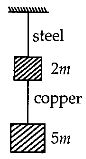
If the ratio of diameters, lengths and Young's modulus of steel and copper wires shown in the figure are $p, q$ and $s$ respectively, then the corresponding ratio of increase in their lengths would be
A ball is thrown vertically up ward. It has a speed of $10\;m/sec$ when it has reached one half of its maximum height. How high ($m$ માં) does the ball rise? (Take $g = 10 \;m/s^2$)
Force constant of a spring $(K)$ is synonymous to
A proton moving with one tenth of velocity of light has a certain de Broglie wavelength of $\lambda$. An alpha particle having certain kinetic energy has the same de-Brogle wavelength $\lambda$. The ratio of kinetic energy of proton and that of alpha particle is:
Assertion: Electron move away from a region of higher potential to a region of lower potential.

Reason: An electron has a negative charge.
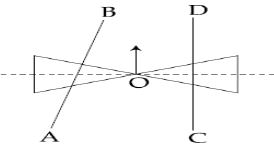
A roller is mad e by joining  together two cones at their vertices $O$. It is kept on two rails $AB$ and $CD$, which are placed asymmetrically (see figure) , with its axis perpendicular to $CD  $ and its centre $O$ at the centre ofline joining $AB$ and $CD$ (see figure) . It is given a light push so that it $A$ starts rolling with its centre $O$ moving parallel to $CD$ in the direction shown. As it moves, the roller will tend to
A pulley fixed to the ceilling carries a string with blocks of mass $m$ and $3 \,m$ attached to its ends. The masses of string and pulley are negligible. When the system is released, its centre of mass moves with what acceleration
Where should an object be placed infront of a concave mirror of focal length $20\,cm$ so that image is $2\,times$ of the size of object
The time of revolution of an electron around a nucleus of charge $Ze$ in $n^{th}$ Bohr orbit is directly proportional to
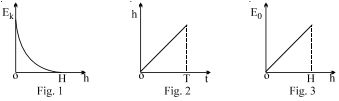
$A$ ball is projected vertically upwards. Air resistance  variation in $g$ may be neglected. The ball rises to its maximum height $H$ in a time $T$, the height being $h$ after a time $t$

$[1]$ The graph of kinetic energy $E_k$ of the ball against height $h$ is shown in figure $1$

$[2]$ The graph of height $h$ against time $t$ is shown in figure $2$

$[3]$ The graph of gravitational energy $E_g$ of the ball against height $h$ is shown in figure $3$

Which of $A, B, C, D, E$ shows the correct answers?