MCQ
The angle between the vectors $(\hat i + \hat j)$ and $(\hat j + \hat k)$ is ....... $^o$
  • A
    $30$
  • B
    $45$
  • $60$
  • D
    $90$

Answer

Correct option: C.
$60$
c
(c) $(\hat i + \hat j).(\hat j + \hat k) = 0 + 0 + 1 + 0 = 1$

$\cos \theta = \frac{{\vec A.\vec B}}{{|\vec A||\vec B|}} = \frac{1}{{\sqrt 2 \times \sqrt 2 }} = \frac{1}{2}$ 

$\theta = 60^\circ $

Need a full question paper?

Generate a complete, print-ready paper with questions like this in minutes — across 16+ boards, with answer keys.
Start Generating Free

Similar questions

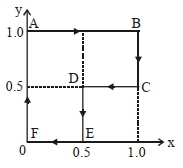
A particle is moved along a path $A B-B C-C D-D E-E F-F A$, as shown in figure, in presence of a force $\overrightarrow{ F }=(\alpha \hat{y}+2 \alpha \hat{x} \hat{j}) N$, where $x$ and $y$ are in meter and $\alpha=-1 N / m ^{-1}$. The work done on the particle by this force $\vec{F}$ will be. . . . . . Joule.
The radius of gyration of a disc of mass $50\,g$ and radius $2.5\,cm$ , about an axis passing through its centre of gravity and perpendicular to the plane, is ....... $cm$.
Which is the correct unit for measuring nuclear radii
Which one of the following graphs represents correctly the variation of the gravitational field $(F) $ with the distance $(r)$ from the centre of a spherical shell of mass $M$ and radius $a$
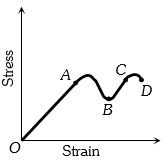
A graph is shown between stress and strain for a metal. The part in which Hooke's law holds good is
Two ideal gases at absolute temperature $T_1$ and $T_2$ are mixed. There is no loss of energy. The masses of the molecules are $m_1$ and $m_2$ and the number of molecules in the gases are $n_1$ and $n_2$ respectively. The temperature of mixture will be
The density of a solid metal sphere is determined by measuring its mass and its diameter. The maximum error in the density of the sphere is $\left(\frac{x}{100}\right) \% .$ If the relative errors in measuring the mass and the diameter are $6.0 \%$ and $1.5 \%$ respectively, the value of $x$ is
A piece of wood of mass $0.03\, kg$ is dropped from the top of a $100\, m$ height building. At the same time, a bullet of mass $0.02\, kg$ is fired vertically upward, with a velocity $100\, ms^{- 1}$, from the ground. The bullet gets embedded in the wood. Then the maximum height to which the combined system reaches above the top of the building before falling below is ........ $m$. $(g = 10\, ms^{-2})$
The position vector of a particle changes with time according to the relation $\vec r\left( t \right) = 15{t^2}\hat i + \left( {4 - 20{t^2}} \right)\hat j$. What is the magnitude of the acceleration at $t = 1$ ?
In electromagnetic theory, the electric and magnetic phenomena are related to each other. Therefore, the dimensions of electric and magnetic quantities must also be related to each other. In the questions below, $[E]$ and $[B]$ stand for dimensions of electric and magnetic fields respectively, while $\left[\varepsilon_0\right]$ and $\left[\mu_0\right]$ stand for dimensions of the permittivity and permeability of free space respectively. $[L]$ and $[T]$ are dimensions of length and time respectively. All the quantities are given in $SI$ units.

($1$) The relation between $[E]$ and $[B]$ is

$(A)$ $[ E ]=[ B ][ L ][ T ]$  $(B)$ $[ E ]=[ B ][ L ]^{-1}[ T ]$  $(C)$ $[ E ]=[ B ][ L ][ T ]^{-1}$  $(D)$ $[ E ]=[ B ][ L ]^{-1}[ T ]^{-1}$

($2$) The relation between $\left[\varepsilon_0\right]$ and $\left[\mu_0\right]$ is

$(A)$ $\left[\mu_0\right]=\left[\varepsilon_0\right][ L ]^2[ T ]^{-2}$  $(B)$ $\left[\mu_0\right]=\left[\varepsilon_0\right][ L ]^{-2}[ T ]^2$   $(C)$ $\left[\mu_0\right]=\left[\varepsilon_0\right]^{-1}[ L ]^2[ T ]^{-2}$  $(D)$ $\left[\mu_0\right]=\left[\varepsilon_0\right]^{-1}[ L ]^{-2}[ T ]^2$

Give the answer or quetion ($1$) and ($2$)