MCQ
The position vector of a particle changes with time according to the relation $\vec r\left( t \right) = 15{t^2}\hat i + \left( {4 - 20{t^2}} \right)\hat j$. What is the magnitude of the acceleration at $t = 1$ ?
  • A
    $40$
  • B
    $100$
  • C
    $25$
  • $50$

Answer

Correct option: D.
$50$
d
$\begin{array}{l}
\vec r = \left( {15{t^2}} \right)\hat i + \left( {4 - 20{t^2}} \right)\hat j\\
\vec v = \frac{{d\vec r}}{{dt}} = \left( {30t} \right)\hat i - \left( {40t} \right)\hat j\\
\vec a = \frac{{d\vec v}}{{dt}} = \left( {30} \right)\hat i - \left( {40} \right)\hat j\\
\left| {\vec a} \right| = 50
\end{array}$

Need a full question paper?

Generate a complete, print-ready paper with questions like this in minutes — across 16+ boards, with answer keys.
Start Generating Free

Similar questions

The two thigh bones (femures), each of cross-sectional area $10 \,cm ^2$ support the upper part of a person of mass $50 \,kg$. The average pressure sustained by the femures is ........... $N / m ^2$
A mass $M$ is suspended from a light spring. An additional mass m added displaces the spring further by a distance $x$. Now the combined mass will oscillate on the spring with period
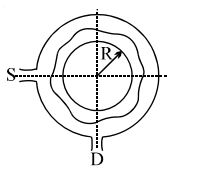
A narrow tube is bent in the form of a circle of radius $R,$ as shown in the figure. Two small holes $S$ and $D$ are made in the tube at the positions right angle to each other. A source placed at $S$ generated a wave of intensity $I_0$ which is equally divided into two parts : One part travels along the longer path, while the other travels along the shorter path. Both the part waves meet at the point $D$ where a detector is placed  The maximum value of $\lambda$ to produce a maxima at $D$ is given by
A hole diffuses from the p-side to the n-side in a p-n junction. This means that.
  1. A bond ia broken on the n-side and the electron freed from the bond jumps to the conduction band.
  2. A conduction electron on the p-side jumps to a broken bond to complete it.
  3. A bond is broken on the n-side and the electron freed from the bond jumps to a broken bond on the p-side to complete it.
  4. A bond is broken on the p-side and the electron freed from the bond jumps to a broken bond on the n-side to complete it.
There is some liquid in a closed bottle. The amount of liquid is continuously decreasing. The vapour in the remaining part:
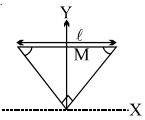
The figure shows an isosceles triangular plate of mass $M$ and base $L$. The angle at the apex is $90^o$. The apex lies at the origin and the base is parallel to $X$ -axis The moment of inertia of the plate about the $x$ -axis is
The radii of two planets $A$ and $B$ are $R$ and $4 R$ and their densities are $\rho$ and $\rho / 3$ respectively. The ratio of acceleration due to gravity at their surfaces $\left(g_A: g_B\right)$ will be
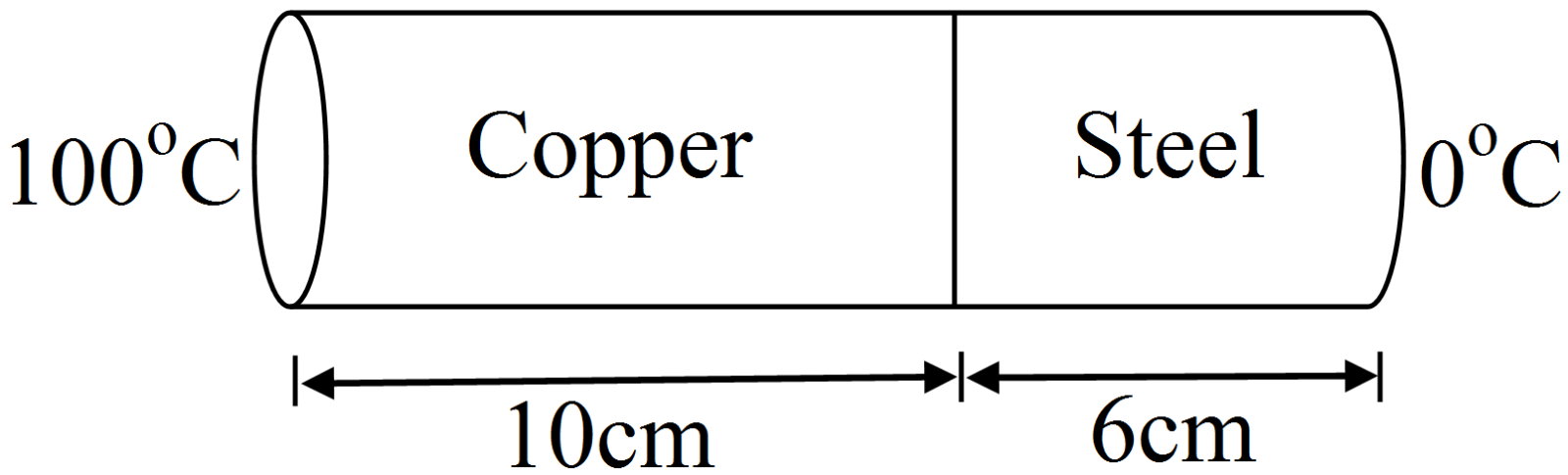
The coefficient of thermal conductivity of copper is nine times that of steel. In the composite cylindrical bar shown in fig. What will be the temperature at the junction of copper and steel?
At standard temperature and pressure the density of a gas is $1.3$ $kg/{m^3}$ and the speed of the sound in gas is $330\, m/sec.$ Then the degree of freedom of the gas will be
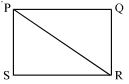
Moment of inertia of a rectangular plate about an axis passing through $P$ and perpendicular to the plate is $I$. Then moment of $PQR$ about an axis perpendicular to the plane of the plate: