Question
The angle between $\vec{\text{A}}=\hat{\text{i}}+\hat{\text{j}}$ and $\vec{\text{B}}=\hat{\text{i}}-\hat{\text{j}}$ is
  1. 45°
  2. 90°
  3. –45°
  4. 180°

Answer

  1. 90°

Explanation:

Given $\vec{\text{A}}=\hat{\text{i}}+\hat{\text{j}}$

$\vec{\text{B}}=\hat{\text{i}}-\hat{\text{j}}$

$\vec{\text{A}}.\vec{\text{B}}=|\text{A}||\text{B}|\cos\theta$

$\cos\theta=\frac{\vec{\text{A}}.\vec{\text{B}}}{|\text{A}||\text{B}|}$

$=\frac{(\hat{\text{i}}+\hat{\text{j}}).(\hat{\text{i}}-\hat{\text{j}})}{\sqrt{1^2+1^2}\times\sqrt{1^2+(-1)^2}}=\frac{1-1}{2}=0$

$\Rightarrow\cos\theta=\cos90$

$\therefore\theta=90^\circ.$ Hence, verifies the option (b).

Need a full question paper?

Generate a complete, print-ready paper with questions like this in minutes — across 16+ boards, with answer keys.
Start Generating Free

Similar questions

For a particle performing uniform circular motion, choose the correct statement(s) from the following:
If $I = 50\, kg-m^2$, then ......... $N-m$ torque will be applied to stop it in $10\, sec$. Its initial angular speed is $20\, rad/sec$.
A force $F$ is given by $F = at + b{t^2}$, where $t$ is time. What are the dimensions of $a$ and $b$
Along a streamline:
  1. The velocity of a fluid particle remains constant.
  2. The velocity of all fluid particles crossing a given position is constant.
  3. The velocity of all fluid particles at a given instant is constant.
  4. The speed of a fluid particle remains constant.
Let Q and W denote the amount of heat given to an ideal gas and the work done by it in an isothermal process.
  1. Q = 0
  2. W = 0
  3. Q ≠ W
  4. Q = W
The density of a material $A$ is $1500 kg/m^3$ and that of another material $B$ is $2000 kg/m^3$. It is found that the heat capacity of $8$ volumes of $A$ is equal to heat capacity of $12$ volumes of $B$. The ratio of specific heats of $A$ and $B$ will be
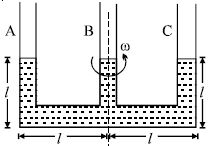
Figure shows a three arm tube in which a liquid is filled upto levels of height $l$. It is now rotated at an angular frequency $\omega$ about an axis passing through arm $B$. The angular frequency $\omega$ at which level of liquid in arm $B$ becomes zero. 
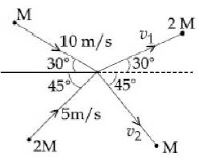
Two particles, of masses $M$ and $2M$, moving as shown, with speeds of $10\, m/s$ and $5\, m/s$, collide elastically at the origin. After the collision, they move along the indicated directions with speeds $v_1$ and $v_2$ respectively. The value of $v_1$ and $v_2$ are nearly
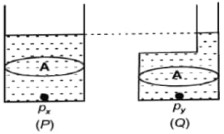
Figure shows two containers $P$ and $Q$ with same base area $A$ and each filled upto same height with same liquid. Select the correct alternative .............
Infinite springs with force constant $k$, $2k$, $4k$ and $8k$.... respectively are connected in series. The effective force constant of the spring will be