MCQ
The angle between vectors $(\vec{M} \times \vec{N})$ and $(\bar{N} \times \vec{M})$ is ................
  • A
    $0$
  • B
    $60$
  • C
    $90$
  • $180$

Answer

Correct option: D.
$180$
d
(d)

$\vec{M} \times \vec{N} \neq \vec{N} \times \vec{M}$

$\vec{M} \times \vec{N}$ is from $\vec{M}$ to $\vec{N}$

$\vec{N} \times \vec{M}$ is from $\vec{N}$ to $\vec{M}$

This means the two vectors are in opposite direction.

$\text { So, } \vec{M} \times \vec{N} =\vec{N} \times \vec{M}$

$=180^{\circ}$

Need a full question paper?

Generate a complete, print-ready paper with questions like this in minutes — across 16+ boards, with answer keys.

Start Generating Free

Similar questions

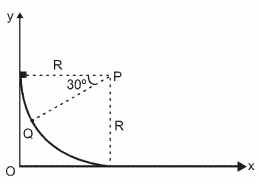
$40 \ m$. The block slides along the track without toppling and a frictional force acts on it in the direction opposite to the instantaneous velocity. The work done in overcoming the friction up to the point $Q$, as shown in the figure below, is $150 \ J$. (Take the acceleration due to gravity, $g =10 \ m s ^{-2}$ )

$1.$ The speed of the block when it reaches the point $Q$ is :

$(A)$ $5 \ ms ^{-1}$ $(B)$ $10 \ ms ^{-1}$$(C)$ $10 \sqrt{3} \ ms ^{-1}$ $(D)$ $20 \ ms ^{-1}$

$2.$ The magnitude of the normal reaction that acts on the block at the point $Q$ is :

$(A)$ $7.5 \ N$ $(B)$ $8.6 \ N$ $(C)$ $11.5 \ N$ $(D)$ $22.5 \ N$

Give the answer question $1$ and $2.$
A Carnot engine takes $3 \times {10^6}\,cal$. of heat from a reservoir at $627°C$, and gives it to a sink at $27°C.$ The work done by the engine is
Dry ice is
Three perfect gases at absolute temperatures $T_1 , T_2$ and $T_3$ are mixed. The masses of molecules are $m_1 , m_2$ and $m_3$ and the number of molecules are $n_1, n_2$ and $n_3$ respectively. Assuming no loss of energy, the final temperature of the mixture is
If the current in the circuit for heating the filament is increased, the cutoff wavelength:
  1. Will increase.
  2. Will decrease.
  3. Will remain unchanged.
  4. Will change.
A disc and a ring of same mass are rolling and if their kinetic energies are equal, then the ratio of their velocities will be
If the source of light used in a Young's double slit experiment is changed from red to violet:
  1. The fringes will become brighter.
  2. Consecutive fringes will come closer.
  3. The intensity of minima will increase.
  4. The central bright fringe will become a dark fringe.
Four mole of hydrogen, two mole of helium and one mole of water vapour form an ideal gas mixture. What is the molar specific heat at constant pressure of mixture?
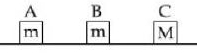
Three blocks $A, B$ and $C$ are lying on a smooth horizontal surface, as shown in the figure. $A$ and $B$ have equal masses, $m$ while $C$ has mass $M$. Block $A$ is given an initial speed $v$ towards $B$ due to which it collides with $B$ perfectly inelastically. The combined mass collides with $C$, also perfectly inelastically. The combined mass collides with $C$, also perfectly inelastically if $\frac{5}{6}^{th}$ of the initial kinetic energy is lost in whole process. What is value of $M/m$ ?
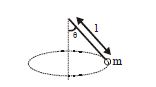
A conical pendulum is moving in a circle with angular velocity $\omega $ as shown. If tension in the string is $T$ , which of following equation are correct?