Question
The angles of a cyclic quadrilateral ABCD are
$\angle\text{A}=(6\text{x}+10)^\circ,\ \angle\text{B}=(5\text{x})^\circ$
$ \angle\text{C}=(\text{x}+\text{y})^\circ, \angle\text{D}=(3\text{y}-10)^\circ$
Find x and y, and hence the values of the four angles.
Answer

We know that, by property of cuclic quadrilateral,Sum of opposite angles = 180°
$\big[\because\ \angle\text{A}=(6\text{x}+10)^\circ,\ \angle\text{C}=(\text{x}+\text{y})^\circ,\ \text{given}\big]$ $\Rightarrow\ 7\text{x}+\text{y}=170\ .....(\text{i})$ and $\angle\text{B}+\angle\text{D}=(5\text{x})^\circ+(3\text{y}-10)^\circ=180^\circ$ $\big[\because\ \angle\text{B}=(5\text{x})^\circ,\ \angle\text{D}=(3\text{y}-10)^\circ,\ \text{given}\big]$ $\Rightarrow\ 5\text{x}+3\text{y}=190^\circ\ .....(\text{ii})$ On multiplying Eq. (i) by 3 and then subtracting, we get $3\times(7\text{x}+\text{y})-(5\text{x}+3\text{y})=510^\circ-190^\circ$ $\Rightarrow\ 21\text{x}+3\text{y}-5\text{x}-3\text{y}=320^\circ$ $\Rightarrow\ 16\text{x}=320^\circ$ $\therefore\ \text{x}=20^\circ$ On putting $\text{x}=20^\circ$ in Eq. (i), we get $7\times20+\text{y}=170^\circ$ $\Rightarrow\ \text{y}=170^\circ-140^\circ\Rightarrow\ \text{y}=30^\circ$ $\therefore\ \angle\text{A}=(6\text{x}+10)^\circ=6\times20^\circ+10^\circ$ $=120^\circ+10^\circ=130^\circ$ $\angle\text{B}=(5\text{x})^\circ=5\times20^\circ=100^\circ$ $\angle\text{C}=(\text{x}+\text{y})^\circ=20^\circ+30^\circ=50^\circ$ $\angle\text{D}=(3\text{y}-10)^\circ=3\times30^\circ-10^\circ$ $=90^\circ-10^\circ=80^\circ$ Hence, the required values of x and y are 20° and 30° respectively and the values of the four angles i.e., ZA, ZB, ZC, and ZD are 130°, 100°, 50°and 80° respectively.

Need a full question paper?

Generate a complete, print-ready paper with questions like this in minutes — across 16+ boards, with answer keys.

Start Generating Free

Similar questions

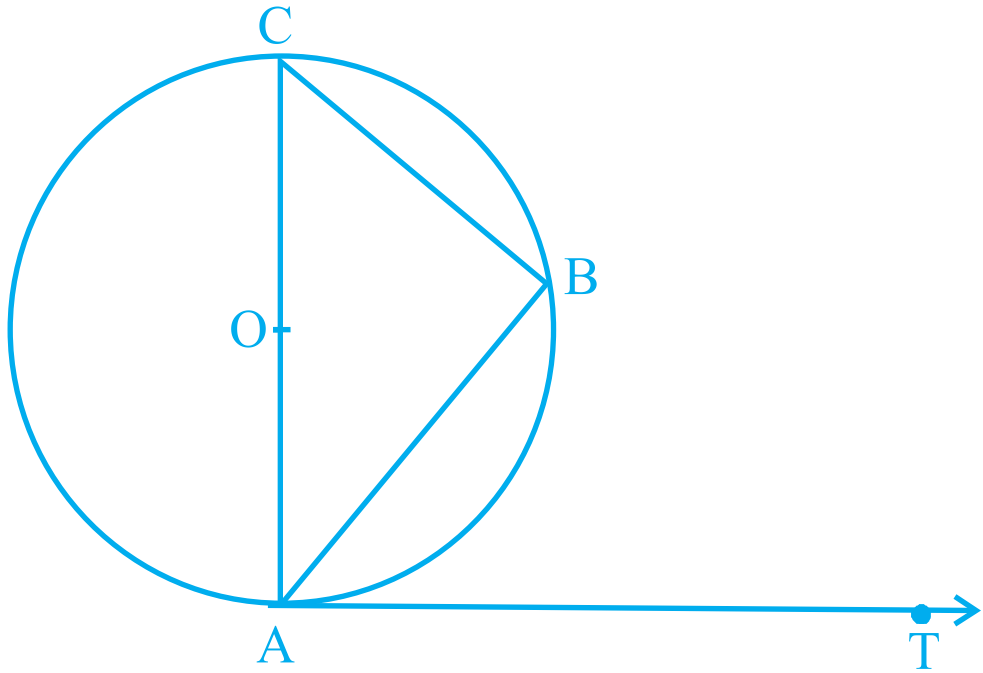
If AB is a chord of a circle with centre O, AOC is a diameter and AT is the tangent at A as shown in Figure. Prove that $\angle\text{BAT}=\angle\text{ACB}.$
Two poles of height $p$ and $q$ metres are standing vertically on a level ground, a metres apart. Prove that the height of the point of intersection of the lines joining the top of each pole to the foot of the opposite pole is given by $\frac{p q}{p+q}$ metres.
Solve the following quadratic equations by factorization:
$\frac{2}{\text{x}+1}+\frac{3}{2(\text{x}-2)}=\frac{23}{5\text{x}},$ $\text{x}\neq0,-1,2$
Find two consecutive multiples of 3 whose product is 648.
Raghav scored 70 marks in a test getting 4 marks for each right answer and losing 1 mark for each wrong answer. Had 5 marks been awarded for each correct answer and 2 marks been deducted for each wrong answer, then Raghav would have scored 80 marks. How many questions were there in the test?
Which value would Raghav violate if he resorts to unfair means?
Find the coordinates of the points which divide the line segment joining A(-2, 2) and B(2, 8) into four equal parts.
The side of a square is 10cm. Find (i) the area of the inscribed circle, and (ii) the area of the circumscribed circle. $[\text{Take }\pi\ =3.14]$
In a flower bed, there are 43 rose plants in the first row, 41 in the second, 39 in the third, and so on. There are 11 rose plants in the last row. How many rows are there flower bed?
Find the maximum number of students among whom 1001 pens and 910 pencils can be distributed in such a way that each student gets the same number of pens and the same number of pencils.
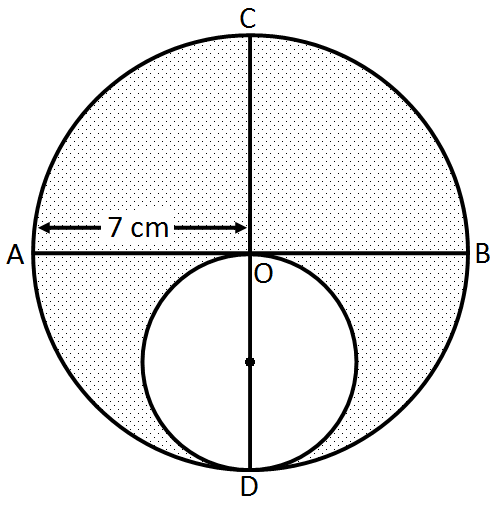
In the following figure, AB and CD are two diameters of a circle perpendicular to each other and OD is the diameter of the smaller circle. If OA = 7cm, find the area of the shaded region.