MCQ
The angular dispersion produced by a prism:
  • Increases if the average refractive index increases.
  • B
    Increases if the average refractive index decreases.
  • C
    Remains constant whether the average refractive index increases or decreases.
  • D
    Has no relation with average refractive index.
Answer

Correct option: A.
Increases if the average refractive index increases.

If $\mu$ is the average refractive index and A is the angle of prism, then the angular dispersion produced by the prism is given by $\delta=(\mu-1)\text{A}.$

Need a full question paper?

Generate a complete, print-ready paper with questions like this in minutes — across 16+ boards, with answer keys.

Start Generating Free

Similar questions

In a Young's double slit experiment, an angular width of the fringe is $0.35^{\circ}$ on a screen placed at $2\,m$ away for particular wavelength of $450\,nm$. The angular width of the fringe, when whole system is immersed in a medium of refractive index $7 / 5$, is $\frac{1}{\alpha}$. The value of $\alpha$ is ..............
Dielectrics are $......$ substances.
Two thin lenses, when in contact, produce a combination of power $+ 10\, D$. When they are $0.25\, m$ apart, the power reduces to $+ 6D$. The focal lengths of the lenses (in $m$) are
In $NPN$ transistor the collector current is $20\, mA$. If $90\%$ of electrons emitted reach the collector, then
The average $e.m.f$. induced in a coil in which a current changes from $0$ to $2 \,A$ in $0.05$ $s$ is $8 \,V.$ The self inductance of the coil is....$H$
Assertion : Two electric bulbs of 50 and 100 W are given. When connected in series 50 W bulb glows more but when connected parallel 100 W bulb glows more.
Reason : In series combination, power is directly proportional to the resistance of circuit. But in parallel combination, power is inversely proportional to the resistance of the circuit.
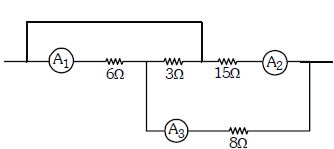
A part of circuit is shown in figure. All the ammeters are ideal. If reading of ammeter $A_1$ is $1.0\ A$ , then
The graph which shows the variation of $\left(\frac{1}{\lambda^2}\right)$ and its kinetic energy, $E$ is (where $\lambda$ is de Broglie wavelength of a free particle):
A 20N metal block is suspended by a spring balance. A beaker containing some water is placed on a weighing machine which reads 40N. The spring balance is now lowered so that the block gets immersed in the water. The spring balance now reads 16N. The reading of the weighing machine will be.
The resistivity of a wire varies with: