MCQ
The angular frequency of motion whose equation is $4\frac{{{d^2}y}}{{d{t^2}}} + 9y = 0$ is ($y =$ displacement and $t =$ time)
  • A
    $2.25$
  • B
    $0.44$
  • $1.5$
  • D
    $0.67$

Answer

Correct option: C.
$1.5$
c
$4 \frac{d^{2} y}{d t^{2}}+9 y=0$

or $\frac{d^{2} y}{d t^{2}}=\frac{-9}{4} y$

Comparing with $SHM$ equation

$\frac{\mathrm{d}^{2} \mathrm{y}}{\mathrm{dt}^{2}}=-\omega^{2} \mathrm{y}$

$\therefore \omega^{2}=\frac{9}{4}$

$\therefore \omega=\frac{3}{2}$

Need a full question paper?

Generate a complete, print-ready paper with questions like this in minutes — across 16+ boards, with answer keys.

Start Generating Free

Similar questions

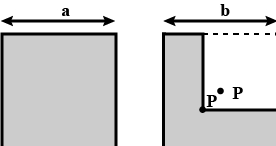
A uniform square wooden sheet of side $a$ has its centre of mass located at point $O$ as shown in the figure below on the left. A square portion of side $b$ of this sheet is cut out to produce an $L$-shaped sheet as shown in the figure on the right.The centre of mass of the L-shaped sheet lies at the point $P$ (in the above diagram), when
Two bodies $A$ and $B$ collide as shown in Fig. $(i)$ and $(ii)$ Which statement is true ?
A sample of ideal gas $(\gamma = 1.4)$ is heated at constant pressure. If an $100\, J$ is supplied to gas, the work done by the gas is ...... $J$
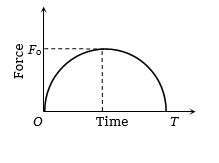
A particle of mass $m$, initially at rest, is acted upon by a variable force $F$ for a brief interval of time $T$. It begins to move with a velocity $u$ after the force stops acting. $F$ is shown in the graph as a function of time. The curve is a semicircle.
A standing wave pattern is formed on a string. One of the waves is given by equation ${y_1} = a\,\cos \,\left( {\omega t - kx + \pi /3} \right)$ then the equation of the other wave such that at $x = 0$ a node is formed
 
One circular ring and one ciruclar disc, both are having the same mass and radius. the ratio of their moments of inertia about the axes passing through their centres and perpendicular to their planes, will be
$Assertion :$ In pressure-temperature $(P-T)$ phase diagram of water, the slope of the melting curve is found to be negative.
$Reason :$ Ice contracts on melting to water.
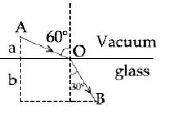
A ray of light $AO$ in vacuum is incident on a glass slab at angle $60^o$ and refracted at angle $30^o$ along $OB$ as shown in the figure. The optical path length of light ray from $A$ to $B$ is
Which of the following aldehydes is most reactive towards nucleophilic addition reactions
Which of the following orbits is a possible orbit for a planet ?