MCQ
The angular momentum of a moving body remains constant, if
  • A
    net pressure is applied
  • B
    net external torque is applied
  • C
    net external force is applied
  • D
    net external torque is not applied

Need a full question paper?

Generate a complete, print-ready paper with questions like this in minutes — across 16+ boards, with answer keys.

Start Generating Free

Similar questions

Let r be the distance of a point on the axis of a magnetic dipole from its centre. The magnetic field at such a point is proportional to:

  1. $\frac{1}{\text{r}}$

  2. $\frac{1}{\text{r}^2}$

  3. $\frac{1}{\text{r}^3}$

  4. None of these.

A man of mass $M$ stands at one end of a plank of length $\ell $ , which lies at rest on a frictionless surface. The man walks to the other end of plank, if mass of plank is $3M$ , the distance moved by the man relative to the ground is
Two pendulums of length $121\,cm$ and $100\,cm$ start vibrating in phase. At some instant, the two are at their mean position in the same phase. The minimum number of vibrations of the shorter pendulum after which the two are again in phase at the mean position is :
A liquid of density $10^3 \,kg / m ^3$ and coefficient of viscosity $8 \times 10^{-2} \;decapoise$ is flowing in a tube of radius $2 \,cm$ with speed $2 \,m / s$. The Reynold's number is ..........
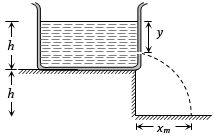
A tank is filled upto a height $h$ with a liquid and is placed on a platform of height h from the ground. To get maximum range ${x_m}$ a small hole is punched at a distance of $y$ from the free surface of the liquid. Then
Consider two waves passing through the same string. Principle of superposition for displacement says that the net displacement of a particle on the string is sum of the displacements produced by the two waves individually. Suppose we state similar principles for the net velocity of the particle and the net kinetic energy of the particle. Such a principle will be valid for:
  1. Both the velocity and the kinetic energy.
  2. The velocity but not for the kinetic energy.
  3. The kinetic energy but not for the velocity.
  4. Neither the velocity nor the kinetic energy.
The pressure and density of a diatomic gas $(\gamma = 7/5)$ change adiabatically from $(P, d)$ to $(P', d')$. If $\frac{{d'}}{d} = 32$, then $\frac{{P'}}{P}$ should be
Two trains along the same straight rails moving with constant speed $60\, km/hr$ and $30\, km/hr$ respectively towards each other. If at time $t = 0$, the distance between them is $90\, km$, the time when they collide is ......... $hr$
A $150\, m$ long train is moving to north at a speed of $10 \,m/s$. A parrot flying towards south with a speed of $5\, m/s$ crosses the train. The time taken by the parrot the cross to train would be........$s$
A particle of mass $ 0.3 \,kg$ is subjected to a force $F = - kx$ with $k = 15\,N/m.$ What will be its initial acceleration if it is released from a point $20 \,cm$ away from the origin .......... $m/s^2$