MCQ
The angular momentum of electron in $n^{th}$ orbit is given by
  • A
    $nh$
  • B
    $\frac{h}{{2\pi n}}$
  • $n\frac{h}{{2\pi }}$
  • D
    ${n^2}\frac{h}{{2\pi }}$

Answer

Correct option: C.
$n\frac{h}{{2\pi }}$
c
(c) According to Bohr’s second postulate.

Need a full question paper?

Generate a complete, print-ready paper with questions like this in minutes — across 16+ boards, with answer keys.
Start Generating Free

Similar questions

Two spheres $A$ and $B$ of radius $4\,cm$ and $6\,cm$ are given charges of $80\,\mu c$ and $40\,\mu c$ respectively. If they are connected by a fine wire, the amount of charge flowing from one to the other is
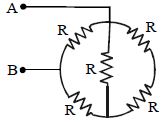
The equivalent resistance between $A$ and $B$ is
Two transparent media $A$ and $B$ are separated by a plane boundary. The speed of light in those media are $1.5 \times 10^{8}\,m / s$ and $2.0 \times 10^{8}\,m / s$, respectively. The critical angle for a ray of light for these two media is :
A particle moves in a circular orbit under the action of a central attractive force inversely proportional to the distance $'r'$. The speed of the particle is
A boy can throw a stone up to a maximum height of $10\ m$. The maximum horizontal distance that the boy can throw the same stone up to will be $.......... m$
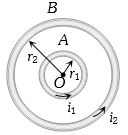
$A$ and $B$ are two concentric circular conductors of centre $O$ and carrying currents ${i_1}$ and ${i_2}$ as shown in the adjacent figure. If ratio of their radii is $1 : 2$ and ratio of the flux densities at $O$ due to $A$ and $B$ is $1 : 3$, then the value of ${i_1}/{i_2}$ is
A stationary body of mass $m$ gets exploded in $3$ parts having mass in the ratio of $1 : 3 : 3$. Its two fractions having equal mass moving at right angle to each other with velocity of $15\,m/sec$. Then the velocity of the third body is
The pressure of a medium is changed from $1.01 × 10^5$ $Pa$ to $1.165 × 10^5$ $Pa$ and change in volume is $10\% $ keeping temperature constant. The Bulk modulus of the medium is
The truth table shown in figure is for

$A\,\, 0\,\, 0\,\, 1\,\, 1$

$B\,\, 0\,\, 1\,\, 0\,\, 1$

$Y \,\,1\,\, 0\,\, 0\,\, 1$

If the acceleration due to gravity experienced by a point mass at a height $h$ above the surface of earth is same as that of the acceleration due to gravity at a depth a depth $\alpha$ h $\left(h \ll R_{e}\right)$ from the earth surface. The value of $\alpha$ will be$....$(use $R _{ e }=6400\,km$ )