Question
The angular momentum of electron in $n^{th}$ orbit is given by

Answer

(c) According to Bohr’s second postulate.

Need a full question paper?

Generate a complete, print-ready paper with questions like this in minutes — across 16+ boards, with answer keys.

Start Generating Free

Similar questions

You are on a frictionless horizontal plane. How can you get off if no horizontal force is exerted by pushing against the surface
A conducting circular loop made of a thin wire, has area $3.5 \times 10^{-3}\, m^2$ and resistance $10\,\Omega $. It is placed perpendicular to a time dependent magnetic field $B(t) = (0.4\,T)\, sin\, (50\, \pi t)$. The field is uniform in space. Then the net charge flowing through the loop during $t = 0\, s$ and $t = 10\, ms$ is close to.......$mC$
The driver of a car travelling with speed $30$ metres per second towards a hill sounds a horn of frequency $600 Hz$. If the velocity of sound in air is $330$ metres per second, the frequency of the reflected sound as heard by the driver is  .... $Hz$
The centre of mass of a non uniform rod of length $L$ whose mass per unit length $\lambda $ varies as $\lambda \ =\ \frac{{k\,.\,{x^3}}}{L}$ where $k$ is a constant & $x$ is the distance of any point on rod from its one end, is at distance (from the same end)
The pressure $P_{1}$ and density $d_{1}$ of diatomic gas $\left(\gamma=\frac{7}{5}\right)$ changes suddenly to $P _{2}\left(> P _{1}\right)$ and $d _{2}$ respectively during an adiabatic process. The temperature of the gas increases and becomes $......$ times of its initial temperature.$\left(\right.$ given $\left.\frac{ d _{2}}{ d _{1}}=32\right)$
Which relation is wrong
A hole is made at the bottom of the tank filled with water (density $1000\, kg/m^3$). If the total pressure at the bottom of the tank is $3$ atmosphere ($1$ atmosphere $= 10^5\, N/m^2$), then the velocity of efflux is
The water equivalent of $20 \,g$ of aluminium (specific heat $0.2 \,cal ^{-1}{ }^{\circ} C ^{-1}$ ), is ......... $g$
Which of the following phenomena does not explain by wave nature of light.

$(A)$ reflection $(B)$ diffraction $(C)$ photoelectric effect $(D)$ interference $(E)$ polarization

Choose the most appropriate answer from the options given below :
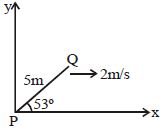
A conducting rod $PQ$ of length $5\,m$ oriented as shown in fig. is moving with velocity $(2m / s)\hat i$ with out any rotation in a uniform magnetic field $(3\hat j + 4\hat k)$ tesla. $Emf$ induced in the rod is........$ volts$