MCQ
The angular speed of earth around its own axis is ......... $rad / s$
  • $\frac{\pi}{43200}$
  • B
    $\frac{\pi}{3600}$
  • C
    $\frac{\pi}{86400}$
  • D
    $\frac{\pi}{1800}$

Answer

Correct option: A.
$\frac{\pi}{43200}$
a
(a)

Angular speed $=\frac{2 \pi}{T}$

$T \rightarrow$ Time period of earth $=24 h$

$\omega=\frac{2 \pi}{24 \times 60 \times 60}=\frac{\pi}{43200} \,rad s ^{-1}$

Need a full question paper?

Generate a complete, print-ready paper with questions like this in minutes — across 16+ boards, with answer keys.
Start Generating Free

Similar questions

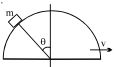
$A$ hemisphere of mass $3m$ and radius $R$ is free to slide with its base on a smooth horizontal table. $A$ particle of mass $m$ is placed on the top of the hemisphere. If particle is displaced with a negligible velocity, then find the angular velocity of the particle relative to the centre of the hemisphere at an angular displacement $\theta$ , when velocity of hemisphere is $v$.
A capillary tube of radius $r$ is immersed in water and water rises in it to a height $h$. The mass of water in the capillary tube is $5\,g$. Another capillary tube of radius $2r$ is immersed in water. The mass of water that will rise in this tube is ...... $g$
A projectile is thrown with velocity $v$ at an angle $\theta$ with horizontal. When the projectile is at a height equal to half of the maximum height, the vertical component of the velocity of projectile is ...........
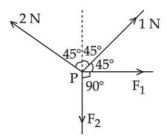
Four forces are acting at a point $P$ in equilibrium as shown in figure. The ratio of force $F_{1}$ to $F_{2}$ is $1: x$ where $x =....$
Some physical quantities are given in Column $I$ and some possible $SI$ units in which these quantities may be expressed are given in Column $II$. Match the physical quantities in Column $I$ with the units in Column $II$ and indicate your answer by darkening appropriate bubbles in the $4 \times 4$ matrix given in the $ORS$.

Column $I$ Column $II$

$(A)$ $\mathrm{GM}_e \mathrm{M}_5$

$\mathrm{G} \rightarrow$ universal gravitational constant, $\mathrm{M}_{\mathrm{e}} \rightarrow$ mass of the earth,

$\mathrm{M}_5 \rightarrow$ mass of the Sun

$(p)$ (volt) (coulomb) (metre)

$(B)$ $\frac{3 \mathrm{RT}}{\mathrm{M}} ; \mathrm{R} \rightarrow$ universal gas constant, $\mathrm{T} \rightarrow$ absolute temperature,

$\mathrm{M} \rightarrow$ molar mass

$(q)$ (kilogram) $(\text { metre) })^3$ (second) $)^{-2}$
$(C)$ $\frac{F^2}{q^2 B^2}$ ;$\quad F \rightarrow$ force, $q \rightarrow$ charge, $B \rightarrow$ magnetic field  $(r)$ $(\text { meter })^2$ (second) $)^{-2}$

$(D)$ $\frac{\mathrm{GM}_e}{\mathrm{R}_{\mathrm{e}}}, G \rightarrow$ universal gravitational constant,

$\mathrm{M}_{\mathrm{e}} \rightarrow$ mass of the earth, $\mathrm{R}_{\mathrm{e}} \rightarrow$ radius of the earth

$(s)$ (farad) $(\text { volt) })^2(\mathrm{~kg})^{-1}$
A projectile is hurled into air from a point on the horizontal ground at an angle with the vertical.
If the air exerts a constant resistive force,
A block of mass $1 \,kg$ attached to a spring is made to oscillate with an initial amplitude of $12\, cm$. After $2\, minutes$ the amplitude decreases to $6\, cm$. Determine the value of the damping constant for this motion. (take In $2=0.693$ )
Two masses $m_1$ and $m_2\, (m_1 < m_2)$ are released from rest from a finite distance. They start under their mutual gravitational attraction
Two stones are projected with the same speed but making different angles with the horizontal. Their ranges are equal. If the angle of projection of one is $\pi /3$ and its maximum height is $h_1$ then the maximum height of the other will be
Three musicians experiment with the Doppler effect. Musician $A$ rides in a car at a speed $u$ directly away from musician $B$ who is stationary. Musician $C$ rides in a car directly toward $B$ and travels at the same speed as $A$ . Musician $A$ plays a note at frequency $f_A$ on his trumpet $B$ hears the note, adjusts his trumpet, and plays the same note he heard. Choose the incorrect statement
