MCQ
The angular spread of central maximum, in the diffraction pattern, does not depend on ______.
- AThe distance between the slit and sources
- BWidth of slit
- CWavelength of light
- DFrequency of light
Explanation:
Angular spread of central maxima $=(\theta)=\frac{\lambda}{\text{b}}$
Where $\lambda$ = wavelength of light
b = width of slit
⇒ Clearly, it does depends on the distance between slit and sources.
Generate a complete, print-ready paper with questions like this in minutes — across 16+ boards, with answer keys.
We have a galvanometer of resistance 25 Ω. It is shunted by a 2.5 Ω wire. The part of total current that flows through the galvanometer is given as
|
(a) |
(b) |
(c) |
(d) |
How much work is required to carry a 6 mC charge from the negative terminal to the positive terminal of a 9 V battery
|
(a) 54 × |
(b) 54 × |
(c) 54 × |
(d) 54 × |
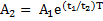
The activity of a sample of a radioactive material is A, at time  and
and  at time
  . If its mean life T, then
|
(a) |
(d) |
(c) |
(d) |
A Young's double slit experiment uses a monochromatic source. The shape of the interference fringes formed on a screen is
|
(a) Straight line |
(b) Parabola |
(c) Hyperbola |
(d) Circle |
Which of the following is diamagnetism
|
(a) Aluminium |
(b) Quartz |
(c) Nickel |
(d) Bismuth |
Assertion : All the radioactive elements are ultimately converted in lead.
Reason : All the elements above lead are unstable.
|
(a) If both assertion and reason are true and the reason is the correct explanation of the assertion. |
|
(b) If both assertion and reason are true but reason is not the correct explanation of the assertion. |
|
(c) If assertion is true but reason is false. |
|
(d) If the assertion and reason both are false. |
When the length of a microscope tube increases, its magnifying power:
Assertion : When a magnet is brought near iron nails, only translatory force act on it.
Reason : The field due to a magnet is generally uniform.
|
(a) If both assertion and reason are true and the reason is the correct explanation of the assertion. |
|
(b) If both assertion and reason are true but reason is not the correct explanation of the assertion. |
|
(c) If assertion is true but reason is false. |
|
(d) If the assertion and reason both are false. |
Light travels through a glass plate of thickness t and having refractive index n. If c is the velocity of light in vacuum, the time taken by the light to travel this thickness of glass is
|
(a) |
(b) tnc |
(c) |
(d) |