MCQ
The appropriate reagent for the transformation
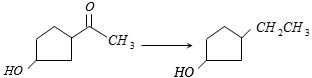
- A$Zn(Hg),\,HCl$
- ✓$N{H_2}N{H_2}O{H^ - }$
- C${H_2}/Ni$
- D$NaB{H_4}$
but $HCl$ will also bring about dehydration of alcohol to form alkene. Therefore, appropriate reagent for the conversion is $N{H_2}N{H_2},\,\,O{H^ - }$.
Generate a complete, print-ready paper with questions like this in minutes — across 16+ boards, with answer keys.

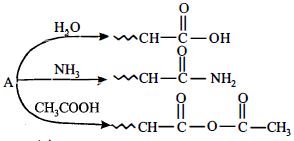
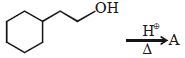
$A.$ Chlorophyll - Co
$B.$ Water hardness - EDTA
$C.$ Photography $-\left[ Ag ( CN )_2\right]^{-}$
$D.$ Wilkinson catalyst - $\left[\left(P h_3 P\right)_3 R h C l\right]$
$E.$ Chelating ligand - D - Penicillamine
Choose the correct answer from the options given below:
$\begin{matrix}
O\,\,\,\,\,\,\,\,\,\,\,\,\,\,\,\,\,\,\,\,\,\,\,\,\,\,\,\,\,\,\,\,\,\,\,\,\,\,\,\,\,\,\,\,\,\,\, \\
||\,\,\,\,\,\,\,\,\,\,\,\,\,\,\,\,\,\,\,\,\,\,\,\,\,\,\,\,\,\,\,\,\,\,\,\,\,\,\,\,\,\,\,\,\,\,\,\, \\
C{{H}_{3}}-C-OH+C{{H}_{3}}-OH\overset{cat.}{\longleftrightarrow} \\
\end{matrix}\begin{matrix}
O\,\,\,\,\,\,\,\,\,\,\,\,\,\,\,\,\,\,\,\,\,\,\,\,\,\,\,\,\,\, \\
||\,\,\,\,\,\,\,\,\,\,\,\,\,\,\,\,\,\,\,\,\,\,\,\,\,\,\,\,\, \\
C{{H}_{3}}-C-O-C{{H}_{3}}+{{H}_{2}}O \\
\end{matrix}$
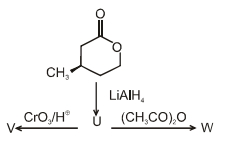
$(A)$ $T$ is soluble in hot aqueous $NaOH$
$(B)$ $U$ is optically active
$(C)$ Molecular formula of $W$ is $C _{10} H _{18} O _4$
$(D)$ $V$ gives effervescence on treatment with aqueous $NaHCO _3$