MCQ
The area bounded by the curves $y = {\log _e}x$ and $y = {({\log _e}x)^2}$ is
- ✓$3 - e$
- B$e - 3$
- C$\frac{1}{2}(3 - e)$
- D$\frac{1}{2}(e - 3)$
$A = \int_1^e {\,\log x\,dx} - \int_1^e {{{(\log x)}^2}dx} $
$ = [x\log x - x]\,_1^e - [x{(\log x)^2} - 2x\log x + 2x]\,_1^e$
$ = [e - e - ( - 1)] - [e{(1)^2} - 2e + 2e - (2)]$
$ = (1) - (e - 2)$$ = 3 - e$.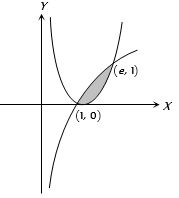
Generate a complete, print-ready paper with questions like this in minutes — across 16+ boards, with answer keys.
where [ ] denotes the greatest integer function is :
$f(x)=\sin x+3 x-\frac{2}{\pi}\left(x^2+x\right) \text {, where } x \in\left[0, \frac{\pi}{2}\right] \text {, }$
consider the following two statements :
($I$) $\mathrm{f}$ is increasing in $\left(0, \frac{\pi}{2}\right)$.
($II$) $\mathrm{f}^{\prime}$ is decreasing in $\left(0, \frac{\pi}{2}\right)$.
Between the above two statements,
($A$) differentiable at $x=0$ if $a=0$ and $b=1$
($B$) differentiable at $x=1$ if $a=1$ and $b=0$
($C$) $NOT$ differentiable at $x=0$ if $a=1$ and $b=0$
($D$) $NOT$ differentiable at $x=1$ if $a=1$ and $b=1$