MCQ
The area bounded by the lines $|x| + |y| = 1$ is:
  • A
    $\text{1 sq. unit}$
  • $\text{2 sq. units}$
  • C
    $2\sqrt{2}\text{ sq}.\text{units}$
  • D
    $\text{4 sq. units}$

Answer

Correct option: B.
$\text{2 sq. units}$

Need a full question paper?

Generate a complete, print-ready paper with questions like this in minutes — across 16+ boards, with answer keys.
Start Generating Free

Similar questions

Choose the correct answer from the given four option.
The order and degree of the differential equation $\frac{\text{d}^2\text{y}}{\text{d}\text{x}^2}+\Big(\frac{\text{d}\text{y}}{\text{d}\text{x}}\Big)^{\frac{1}{4}}+\text{x}^{\frac{1}{5}}$ respectively, are:
If $A$ is a square matrix such that $A^2 = I$, then $A^{-1}$ is equal to:
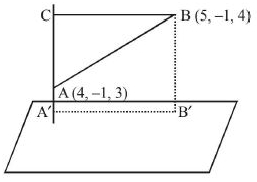
The length of the projection of the line segment joining the point  $\left( {5, - 1,4} \right)$ and $\left( {4, - 1,3} \right)$ on the plane $x + y + z = 7$ is :
$\int\limits^1_{-1}|1-\text{x}|\text{dx}$ is equal to:
What is the value of $ \cos (2 \cos^{-1} 0.8)\cos(2\cos−10.8)?$
Let $M =\left[\begin{array}{lll}0 & 1 & a \\ 1 & 2 & 3 \\ 3 & b & 1\end{array}\right]$ and adj $M =\left[\begin{array}{ccc}-1 & 1 & -1 \\ 8 & -6 & 2 \\ -5 & 3 & -1\end{array}\right]$ where $a$ and $b$ are real numbers. Which of the following options is/are correct?

$(1)$ $a+b=3$

$(2)$ $\operatorname{det}\left(\operatorname{adj} M ^2\right)=81$

$(3)$ $(\operatorname{adj} M)^{-1}+\operatorname{adj} M^{-1}=-M$

$(4)$ If $M \left[\begin{array}{l}\alpha \\ \beta \\ \gamma\end{array}\right]=\left[\begin{array}{l}1 \\ 2 \\ 3\end{array}\right]$, then $\alpha-\beta+\gamma=3$

If $A$ and $B$ are two invertible square matrices of the same order such that $(A + B)(A -B) = A^2-B^2$, then $(A^2BA^{-1}B^{-1})^3$ is equal to-
$\int {\sqrt {1 + \sin \left( {\frac{x}{4}} \right)\,} } dx$
The equation of family of curves for which the length of the normal is equal to the radius vector is
Let $\text{f(x)}=\begin{vmatrix}\cos\text{x}&\text{x}&1\\2\sin\text{x}&\text{x}&2\text{x}\\\sin\text{x}&\text{x}&\text{x}\end{vmatrix},$ then $\lim_\limits{\text{x}\rightarrow0}\frac{\text{f(x)}}{\text{x}^2}$ is equal to: