MCQ
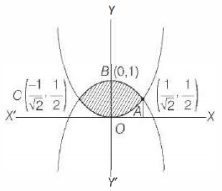
The area bounded by the parabolas $y=x^2$ and $y=1-x^2$ equals
  • A
    $\frac{\sqrt{2}}{3}$
  • $\frac{2 \sqrt{2}}{3}$
  • C
    $\frac{1}{3}$
  • D
    $\frac{2}{3}$

Answer

Correct option: B.
$\frac{2 \sqrt{2}}{3}$
b
(b)

We have, $y=x^2$ and $y=1-x^2$

Intersection point of $y=x^2$ and $y=1-x^2$ is $A\left(\frac{1}{\sqrt{2}}, \frac{1}{2}\right)$ and $C\left(\frac{-1}{\sqrt{2}}, \frac{1}{2}\right)$

Area of shaded region

$=2 \int \limits_0^{1 / \sqrt{2}}\left[\left(1-x^2\right)-\left(x^2\right)\right] d x$

$=2 \int \limits_0^{1 / \sqrt{2}}\left(1-2 x^2\right) d x$

$=2\left[x-\frac{2 x^3}{3}\right]_0^{1 / \sqrt{2}}$

$=2\left[\frac{1}{\sqrt{2}}-\frac{1}{3 \sqrt{2}}\right]$

$=\frac{2}{\sqrt{2}}\left[\frac{3-1}{3}\right]=\frac{2 \sqrt{2}}{3}$ sq units
Need a full question paper?

Generate a complete, print-ready paper with questions like this in minutes — across 16+ boards, with answer keys.

Start Generating Free

Similar questions

If $\text{a},\text{b},\text{c}\in+\text{R}$ such that $\lambda\text{ abc}$ is the minimum value of $a(b^2 + c^2) + b(c^2 + a^2) + c(a^2 + b^2)$, then $\lambda=$
A coin is tossed 4 times. The probability that at least one head turns up is:
The degree and the order of the differential equation:
$\frac{\text{d}^2\text{y}}{\text{dx}^2}=\sqrt{1}+\Big(\frac{\text{dy}}{\text{dx}}\Big)^3\text{ are:}$
In a trapezium, the vector $\overrightarrow {BC} = \lambda \overrightarrow {AD} .$ We will then find that $p = \overrightarrow {AC} + \overrightarrow {BD} $ is collinear with $\overrightarrow {AD} ,$ If $p = \mu \overrightarrow {AD} ,$ then
Let $f: R \rightarrow R$ be a function defined as $f(x)=a \sin \left(\frac{\pi[x]}{2}\right)+[2-x], a \in R$, where [t] is the greatest integer less than or equal to $t$. If $\lim _{x \rightarrow-1} f(x)$ exists, then the value of $\int_{0}^{4} f(x) d x$ is equal to.
Which of the following is the general solution of the differential equation $\frac{d y}{d x}=\frac{y}{x}$ ?
If $\text{F}:[1,\infty)\rightarrow[2,\infty)$ is given by $\text{f(x)}=\text{x}+\frac{1}{\text{x}},$ then $f^{-1}(x)$ equals:
If $a$  and $ b$ are mutually perpendicular vectors, then ${(a + b)^2} = $
If ${\sin ^{ - 1}}a + {\sin ^{ - 1}}b + {\sin ^{ - 1}}c = \pi ,$ then the value of $a\sqrt {(1 - {a^2})} + b\sqrt {(1 - {b^2})} + c\sqrt {(1 - {c^2})} $ will be
If $\int\frac{\text{x}^3\text{dx}}{\sqrt{1+\text{x}^2}}=\text{a}(1+\text{x}^2)^{\frac{3}{2}}+\text{b}\sqrt{1+\text{x}^2}+\text{c,}$ then: